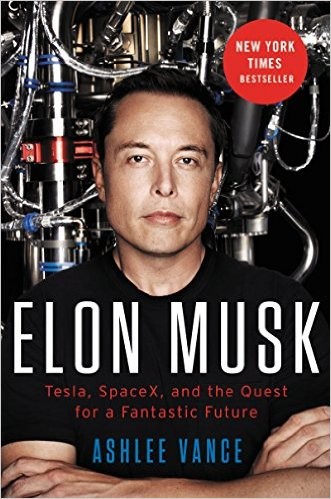
What Is Elon Musk by Ashlee Vance?
Elon Musk: Tesla, SpaceX, and the Quest for a Fantastic Future (2015) by Ashlee Vance is the biography of Elon Musk written with his cooperation — the first and most comprehensive account of Musk's life and career up to the mid-2010s. Published before Tesla's Model 3 mass-market breakthrough and SpaceX's Starship development, the book captures Musk at the moment his ambitions were still largely unproven at scale: a man who had built two of the most audacious companies in American history and come close to losing both of them in the same year.
Vance spent two years researching the book, interviewing Musk directly (after an initial refusal and subsequent negotiation), and interviewing hundreds of people in Musk's orbit — employees, co-founders, family members, competitors, and investors. The result is a portrait that is simultaneously admiring and unsettling: a man of extraordinary vision, genuine technical brilliance, and uncommon courage who has also driven employees to breakdowns, destroyed professional relationships, and treated the people closest to him with a coldness that family and colleagues describe with evident pain.
The book is not a hagiography. Vance does not present Musk as a hero — he presents him as a genuinely novel human phenomenon: someone whose personality and operating style would be disqualifying in almost any other professional context, and who has used those same qualities to do things that no one else has done. Whether you admire Musk or distrust him, Elon Musk is the best available account of how he operates and why he has succeeded where more conventional founders would have failed.
Musk's Childhood and Early Life
The book opens in South Africa, where Musk was born in 1971 in Pretoria. His early childhood is described through interviews with family members, and the picture that emerges is of a child who was isolated, bookish to an unusual degree, and subject to serious bullying. Musk himself has described being bullied so severely that he required hospitalization at one point.
His response to this environment was retreat into books and, later, computers. He read encyclopedias and science fiction obsessively, absorbing vast amounts of information about physics, engineering, history, and space. By age 12, he had taught himself to program and sold his first software — a space-themed video game called Blastar. Vance uses these early details not as colorful biographical material but as evidence of the character traits that would define Musk's adult behavior: an almost pathological willingness to tackle things alone, an indifference to conventional social approval, and an insatiable appetite for technical knowledge across domains.
Musk left South Africa in his late teens, spending time in Canada before enrolling at Queen's University in Ontario and then transferring to the University of Pennsylvania, where he studied economics and physics. He was admitted to a Stanford PhD program in energy physics but dropped out after two days to co-found Zip2 — his first startup — with his brother Kimbal.
Zip2 and PayPal: The First Fortune
Zip2 was a software company that provided online city guides and mapping services to newspapers. The company was sold to Compaq in 1999 for $307 million, giving Musk approximately $22 million. He used the money to co-found X.com, an online financial services company that eventually became PayPal.
The PayPal story, as Vance tells it, is one of the most dramatic in Silicon Valley history. The company went through multiple near-deaths — fraud attacks, regulatory challenges, competing products from eBay's own payment system — and internal coups that removed Musk as CEO and replaced him with Peter Thiel. Musk remained on the board and a major shareholder through the eBay acquisition in 2002, netting approximately $180 million.
Vance's account of PayPal is important because it documents something about Musk that becomes a recurring theme: his tendency to be displaced from leadership of his own companies by boards or co-founders who found his management style untenable, combined with his ability to come back from those displacements financially and strategically intact. He was removed as PayPal CEO, later removed from Tesla's chairmanship under threat, and publicly humiliated by employees at SpaceX — and in each case, the company and Musk continued.
SpaceX: The Mission and the Near-Deaths
SpaceX is the biographical centerpiece of the book. Musk founded Space Exploration Technologies in 2002 with a stated goal that almost everyone in the aerospace establishment treated as delusional: build a private rocket company to reduce the cost of access to space by a factor of ten, and eventually make humanity multiplanetary.
He invested $100 million of his PayPal proceeds — essentially his entire liquid net worth — in SpaceX. He hired a core team of aerospace engineers and began designing the Falcon 1, a small orbital rocket, from near scratch.
The next six years are the story of the book. Falcon 1's first launch attempt in 2006 failed. The second, in 2007, failed. The third, in 2008, failed — due to a correctable technical error that occurred seconds after an otherwise successful launch. By this point, Musk was nearly out of money. The 2008 financial crisis had devastated the investment climate. Tesla, which Musk had joined as chairman and lead investor in 2004 and taken over as CEO in 2008, was simultaneously running out of money and struggling to produce its first car.
In September 2008, Musk had to decide whether to put his remaining money into SpaceX for a fourth launch attempt, or into Tesla to fund its survival through the financial crisis. He could not fund both. He chose to split the remaining resources between both companies, meaning both were underfunded and neither had a clear path to survival.
The fourth Falcon 1 launch, on September 28, 2008, worked. It was the first private rocket to reach orbit. Months later, NASA awarded SpaceX a $1.6 billion Commercial Resupply Services contract, saving the company financially. Tesla survived the crisis through a combination of Musk's remaining personal funds, a DOE loan, and a last-minute private funding round.
Vance's account of this period is the most gripping section of the book. The detail is vivid — the failed launches, the engineering post-mortems, the all-night debugging sessions, the near-bankruptcy calculations — and the emotional stakes are high in ways that make the eventual success genuinely dramatic.
Tesla: The Founding and Musk's Takeover
Tesla was not Musk's idea. It was founded in 2003 by Martin Eberhard and Marc Tarpenning, two engineers who had read about the AC Propulsion tzero electric vehicle and believed there was a commercial market for a premium electric sports car. Musk learned about the company, led a $7.5 million Series A in 2004, and joined the board as chairman.
The relationship between Musk and Eberhard is one of the most studied founder conflicts in startup history. Vance's account is nuanced: Eberhard was a capable founder who built a real company and recruited a talented team, but his production estimates were consistently optimistic and the Roadster project repeatedly missed milestones and blew its budget. Musk grew increasingly frustrated, and in 2007 he forced Eberhard out of the CEO role.
The legal battle that followed — Eberhard sued Musk and Tesla for defamation and breach of contract after Musk began publicly questioning his contributions — was settled out of court. Both men have given conflicting accounts of the founding period. Vance interviewed both and presents a reasonably even-handed account, though the book's sympathy ultimately lies with Musk's operational judgment even if it acknowledges the personal costs of how the conflict was handled.
Musk became CEO in 2008, just as the financial crisis hit and Tesla's original Roadster production was in serious trouble. The combination of the crisis, the production problems, and SpaceX's simultaneous near-failure gave Musk what he has described as the most stressed year of his life.
Management Style and Culture
One of the book's most valuable contributions is its documentation of Musk's management style, based on interviews with dozens of current and former employees. The picture that emerges is of someone who is demanding, sometimes brilliant, often inspiring, and occasionally cruel.
The demands Musk places on employees are described as extreme. Hundred-hour weeks are not unusual during crisis periods. Employees who cannot meet his technical standards are fired, sometimes in the middle of presentations. He has a near-photographic memory for technical details and will call out engineering errors that his own engineers have missed. He sets deadlines that seem impossible and sometimes are — but he also drives his organizations to accomplish things that most people in the industry believed were impossible.
Former employees describe a complex experience: working at SpaceX or early Tesla was genuinely exciting and meaningful, the missions were real, and many employees describe their time there as the most important work of their careers. At the same time, the turnover is extremely high, the emotional costs are significant, and the culture rewards a specific type of person — technically brilliant, personally resilient, and capable of functioning under sustained high pressure — that excludes many talented people.
Vance does not moralize extensively about this management style. He documents it and lets readers draw their own conclusions. His observation is that Musk's extreme demands have produced extreme results that would not have been produced otherwise, and that this is both the book's central argument and its central discomfort.
The Book's Limitations and Value
Elon Musk was published in 2015, and much of what has happened since then changes the context significantly. Tesla's Model 3 mass-market production, SpaceX's Starship program, Musk's Twitter/X acquisition, and his political activities in the years following the book's publication all represent developments that Vance could not have anticipated. Readers should approach the book as a document of Musk from 2002 to 2014 — an extraordinarily rich document of that period, but not a guide to the Musk of today.
The book is also written from a perspective of general admiration for Musk's technical and entrepreneurial accomplishments, which means that some of the criticisms of his management style and personal behavior are present but not fully developed. Walter Isaacson's 2023 biography of Musk covers the later period and is in some ways more critical; Vance's 2015 account remains the definitive document of the early and middle periods.
What the book does exceptionally well is document the specific technical and organizational decisions that allowed SpaceX and Tesla to survive multiple near-deaths and eventually become dominant in their respective industries. The specific engineering choices, the specific hiring decisions, the specific financing maneuvers — this level of operational detail is rare in founder biographies and is the most valuable part of the book for founders trying to understand how to build companies that survive genuine existential crises.
What Founders Take Away
The lessons of Elon Musk for founders are not comfortable ones. The book does not present a template that most founders can or should replicate. But it does illustrate several principles that are genuinely useful.
The cost of bold ambition is different from the cost of ordinary ambition. When you set out to build the world's first private orbital rocket company, the failure modes are different from those of a conventional startup. They are more expensive, more public, and more final. But the potential upside — being the company that defined a new industry — is also categorically different. Musk accepted both sides of this trade and it produced outcomes that no one else has achieved.
Technical depth in leadership matters. Much of SpaceX's ability to survive its early failures came from Musk's genuine technical understanding of rocket engineering — not as deep as his best engineers', but deep enough to engage at the technical level, challenge assumptions, and understand what was and wasn't working. Founders who are purely business operators and who rely entirely on technical teams often find it harder to navigate genuinely novel engineering challenges.
Mission clarity provides organizational resilience. The employees who stayed at SpaceX through the failed launches and the near-bankruptcies were kept there partly by Musk's personal force of will, but also by genuine belief in the mission — that making humanity multiplanetary was important enough to justify the sacrifice. Companies with genuine missions that their employees believe in can sustain more organizational stress than companies held together only by compensation and career advancement.