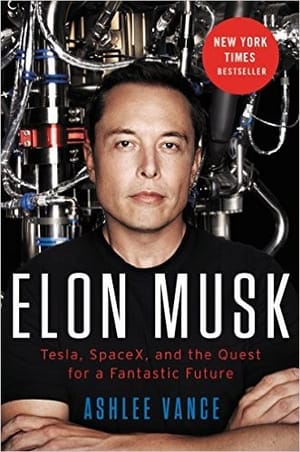
Ashlee Vance is a technology journalist, author, and documentary filmmaker best known for his 2015 biography of Elon Musk — Elon Musk: Tesla, SpaceX, and the Quest for a Fantastic Future — which became one of the best-selling technology biographies of the decade and the definitive account of Musk's life and career up to that point. Vance spent over a decade at Bloomberg Businessweek as one of the publication's most prolific technology writers before transitioning to books and documentary work. He is widely regarded as one of the best long-form technology journalists of his generation — capable of the kind of deep, sustained reporting that produced the Musk biography while maintaining the narrative drive that makes complex technological subjects accessible to general readers.
What distinguishes Vance from many technology journalists is his combination of genuine technical curiosity and biographical craft. He is interested in both the engineering — how rockets work, why electric vehicles were hard to build at scale, what the actual technical challenges were at SpaceX during the early years — and in the human story: what kind of person dedicates his entire net worth to two near-impossible companies simultaneously, and what that combination of vision and recklessness produces over time.
Vance grew up in South Africa before moving to the United States, which gave him a particular affinity for telling Musk's story — Musk also grew up in South Africa, and Vance's familiarity with that context informs his treatment of Musk's childhood and early influences in ways that a purely American journalist might have missed.
Vance began his journalism career at The Register, the British technology news website known for its skeptical, contrarian take on the technology industry. Working at The Register in the early 2000s gave Vance training in a style of technology journalism that was deeply skeptical of corporate PR and willing to challenge the narratives that Silicon Valley companies preferred to project. This skepticism is visible throughout his later work, including the Musk biography, which is notably unwilling to simply repeat Musk's preferred version of events.
He moved to The New York Times as a technology reporter, covering the broader Silicon Valley ecosystem during the mid-2000s, a period when Google was ascending, social media was emerging, and the iPhone was about to change mobile computing permanently. At the Times, Vance developed the skills for narrative feature writing that would later define his Bloomberg work — the ability to combine reporting with storytelling in ways that made complex technological subjects engaging for non-specialist readers.
The core of Vance's career was spent at Bloomberg Businessweek, where he joined as a senior writer and produced some of the most-read and most-discussed technology journalism of the 2010s. His coverage at Bloomberg ranged across the full spectrum of Silicon Valley: profiles of major executives, investigations of corporate culture, analyses of emerging technology trends, and the deep-dive narrative features that Bloomberg Businessweek became known for under editors like Josh Tyrangiel.
Vance wrote cover stories on companies including Google, Apple, Amazon, Facebook, and dozens of smaller technology companies. He developed particular expertise in manufacturing and hardware technology — areas that most Silicon Valley journalists undercover — which made him unusually well-equipped to understand and explain SpaceX's rocket engineering and Tesla's car manufacturing challenges.
His journalism during this period built relationships throughout Silicon Valley that would prove essential when he approached Musk for the biography. The credibility he had established as a serious, fair, technically literate reporter was part of what eventually convinced Musk to cooperate with the project after initially refusing.
Vance's account of how the Musk biography came to be is itself interesting. He began researching Musk in 2012 without Musk's cooperation — interviewing dozens of people in Musk's orbit, building a picture of the man and his companies from sources who knew him but were not controlled by him. When he approached Musk directly, Musk initially refused to participate.
After Vance informed Musk that he intended to write the book with or without his cooperation, Musk reconsidered. Musk's reasoning, as reported by Vance, was that he preferred to be a source in a book that was going to be written about him regardless, rather than to have the book written entirely from the perspectives of others. The two eventually reached an agreement: Musk would sit for extensive interviews and encourage others to speak to Vance, but Vance retained editorial control over the final manuscript.
This access/independence balance is one of the defining characteristics of the book's credibility. Vance had enough access to Musk to understand his perspective, his motivations, and his own account of key events; but he also had enough independence — and enough interviews from people who had been harmed by Musk's management style — to present a picture that Musk himself found uncomfortable in places.
Vance spent approximately two years researching and writing the book. The research process involved interviewing Musk directly multiple times, interviewing hundreds of current and former employees at SpaceX and Tesla, speaking with family members including Musk's first wife Justine and his mother Maye, and studying the technical history of the companies in enough detail to write credibly about the engineering challenges.
The book's treatment of the 2008 near-death experiences at SpaceX and Tesla is the section that required the most technical depth. Vance had to understand rocket engineering well enough to explain why the first three Falcon 1 launches failed and what the specific engineering decisions were that made the fourth succeed. He also had to understand automotive manufacturing well enough to explain why Tesla's Roadster production was so catastrophically over budget and behind schedule.
His background covering hardware and manufacturing technology at Bloomberg proved essential here. Where many technology journalists might have glossed over the engineering specifics, Vance went deep — and that depth is part of what makes the book's account of SpaceX's early years so compelling and credible.
When the book was published, Musk's then-wife MacKenzie Bezos (Jeff Bezos's wife, who is also a novelist) wrote a critical Amazon review pointing out what she considered factual errors and characterization issues. Vance has stood by his reporting. The episode illustrated the nature of authorized biography: the cooperation of the subject provides access but also creates pressure to present the subject favorably, and maintaining the independence to challenge that pressure is one of the defining challenges of the form.
After the Musk biography, Vance expanded into documentary filmmaking and continued his journalism career at Bloomberg. He created and hosted Hello World, a Bloomberg documentary series that explored technology and innovation outside of Silicon Valley — in places like Estonia, Japan, Iceland, South Korea, and rural America. The series was notable for its interest in the global dimensions of technological change and its willingness to spend time in places that the American technology press typically ignores.
He has continued to write long-form technology journalism for Bloomberg, covering topics including artificial intelligence, space technology, electric vehicles, and the evolving landscape of Silicon Valley culture. His journalism continues to draw on the same combination of technical depth and biographical interest that defined his best work at Businessweek.
The research and writing process for Elon Musk represents one of the most thorough acts of journalistic biography in the technology genre. What makes Vance's approach distinctive is the combination of depth and access: he did not simply interview Musk and write a profile, nor did he write an unauthorized account from exclusively hostile sources. He built a picture of Musk from multiple angles — the man's own perspective, the perspectives of people who admire and work with him, and the perspectives of people who have been harmed or alienated by him.
The approximately two hundred interviews that Vance conducted for the book include some of the most honest accounts of working for Musk available in print. Employees who left SpaceX or Tesla under difficult circumstances describe their experiences in detail — the impossible demands, the public humiliations, the genuine technical brilliance, and the equally genuine personal cruelty that sometimes accompanied it. Vance presents these accounts without heavy editorializing, letting the patterns speak for themselves.
His treatment of the 2008 crisis is the book's journalistic centerpiece. The detail about the Falcon 1 fourth launch — the specific engineering changes made between the third and fourth attempts, the atmosphere in the control room, Musk's own state of mind — reads like literary journalism at its best. The combination of technical accuracy and emotional resonance in those scenes represents Vance's writing at its peak.
Vance approaches technology biography with the assumption that the most important thing to understand about a founder is not their strategic vision or their management philosophy — it's the specific choices they made under specific constraints at specific moments, and why they made those choices rather than the alternatives available to them. This approach produces books that are more granular and more credible than many founder biographies, which tend to present strategy in retrospect as having been more coherent than it actually was.
He is also interested in the relationship between personal psychology and company-building outcomes — the ways that specific traits in a founder's personality, which might be disadvantageous or even pathological in other contexts, can become productive in the context of building ambitious technology companies. The Musk biography is partly an exploration of how a certain type of psychological intensity — the willingness to bet everything, the discomfort with conventional limits, the inability to accept that some things are impossible — can produce extraordinary results that more conventionally minded people cannot achieve.
In interviews about the biography, Vance has described several things that surprised him about Musk. He was surprised by the depth of Musk's technical knowledge — the ability to engage at the engineering level on rocket design, battery chemistry, and automotive manufacturing is unusual for a CEO and was more profound than Vance had anticipated. He was surprised by Musk's genuine commitment to the underlying missions of SpaceX and Tesla — the belief that making humanity multiplanetary and accelerating the transition to sustainable energy are genuinely important to the long-term survival of civilization, not marketing language.
He was also surprised, and somewhat unsettled, by the costs that Musk imposed on the people around him. The employees who broke down, the marriages that dissolved, the co-founders who were discarded — these are documented in the book, and Vance has described coming away from the research with a more complicated view of the relationship between extraordinary ambition and ordinary human cost than he had when he began.
Geek Silicon Valley (2007) — An early book exploring the culture and key figures of Silicon Valley, written during Vance's early journalism career. More topical than biographical, it serves as a document of the Valley in the mid-2000s.
Elon Musk: Tesla, SpaceX, and the Quest for a Fantastic Future (2015) — The primary work and the book for which Vance is best known. An authorized biography that is far more candid than most authorized biographies, drawing on two years of research and hundreds of interviews to produce the most comprehensive account of Musk's early life and the founding of SpaceX and Tesla.
The Unhappy Valley (Bloomberg documentary series) — Not a book but Vance's documentary work, which represents a significant part of his post-biography output and extends his journalistic interests into video format.
Vance has appeared extensively in the podcast world following the publication of the Musk biography, though he is more selective about media appearances than many authors. His most substantive conversations have been on long-form interview shows where the format allows for detailed discussion of his research process and findings.
He appeared on the Lex Fridman Podcast in a conversation that covered both the Musk biography's research process and Vance's broader views on technological ambition. The conversation is particularly valuable for his discussion of what made Musk's willingness to risk his personal fortune on SpaceX and Tesla different from conventional entrepreneurial risk-taking.
He has also been interviewed extensively on Bloomberg's own podcast and video properties, where discussions of his documentary work and ongoing journalism complement the book. His conversations about Hello World — the documentary series about technology outside Silicon Valley — reveal a different aspect of his thinking from the founder biography mode: a genuine interest in the global dimensions of technological change and the ways that different cultures approach innovation differently.
For readers interested in the Musk biography specifically, his interviews with Tim O'Reilly and with various technology publication editors in the months after the book's publication are the most detailed discussions of the research process and the choices he made in presenting Musk's story.
Current role: Author and technology journalist
Previous roles:
"Musk has set himself apart from nearly every entrepreneur in history through sheer audacity of vision."