Who Is Andy Grove?
Andy Grove is one of the most consequential business leaders of the twentieth century and, for startup founders, one of the most instructive. He took Intel from a memory chip company on the verge of irrelevance and transformed it into the dominant microprocessor manufacturer in the world — a decision that required abandoning the product line that had built the company and betting everything on an emerging market that Intel did not yet lead. That transformation is now one of the most studied examples of successful strategic adaptation in business history.
Grove is also the intellectual originator of two frameworks that have become foundational in startup culture: the strategic inflection point (from his book Only the Paranoid Survive) and the OKR system of management by objectives (which he developed at Intel and which John Doerr later brought to Google and much of Silicon Valley). If you have ever set quarterly OKRs, you have Andy Grove to thank for the structure.
For founders studying disruption and organizational change, Grove is a more useful figure than most: he actually did it, under real competitive pressure, with real consequences for thousands of people, and he left a detailed written account of how he thought through the decisions.
Career
The Refugee Years and Education
Andy Grove was born András Gróf in Budapest, Hungary in 1936. He survived Nazi occupation and the Holocaust as a child — his family was Jewish, and he spent part of the war hiding his identity. After World War II, Hungary came under Soviet communist rule. In 1956, at 20 years old, during the Hungarian Revolution, Grove fled the country with nothing, crossing into Austria on foot and eventually making his way to the United States as a refugee.
He arrived in New York City speaking almost no English. He enrolled at City College of New York, which offered free tuition, and studied chemical engineering. He graduated at the top of his class. He then earned a PhD in chemical engineering from UC Berkeley, completing it in 1963. His intellectual formation — rigorous scientific training combined with the lived experience of surviving two authoritarian systems — shaped both his management style and his strategic thinking in ways that are visible throughout his writing.
Co-Founding Intel (1968)
After his PhD, Grove joined Fairchild Semiconductor and worked under Gordon Moore and Robert Noyce. In 1968, Moore and Noyce left Fairchild to start a new company. Grove left with them. Intel was founded in July 1968; Grove was the third hire and head of operations.
Intel's early business was memory chips — dynamic random-access memory (DRAM). The company was successful. By the late 1970s, Intel was a significant player in the semiconductor industry and Grove had risen to President. But the Japanese semiconductor industry, heavily subsidized and operating with a ferocious efficiency advantage, was beginning to undercut American memory chip manufacturers on both price and quality.
The DRAM Crisis and the Microprocessor Pivot
The decision that defines Grove's career came in 1985. Intel's DRAM business was being destroyed by Japanese competition. Margins had collapsed. The company was losing money. Grove and Gordon Moore faced a choice that was, in its structure, exactly the scenario Clayton Christensen would later describe in The Innovator's Dilemma: the core product that had built the company was becoming a commodity in which Intel could not compete, while a newer product — the microprocessor, which Intel had invented but which was growing in importance with the personal computer industry — offered a different future.
Grove describes the key moment in Only the Paranoid Survive: he and Moore were sitting in Moore's office, staring at each other, and Grove asked: "If we got kicked out and the board brought in a new CEO, what would he do?" Moore said immediately: "He would get us out of memories." Grove replied: "Why can't you and I walk out the door, come back in, and do it ourselves?"
They did. Intel exited DRAM manufacturing almost entirely and shifted resources to microprocessors. The transition was painful — it required factory closures, significant layoffs, and the reorientation of the company's entire identity. But it worked. Intel's x86 microprocessor architecture became the dominant chip platform of the personal computer era, and Intel became the world's most valuable semiconductor company.
The CEO Years (1987–1998) and Time Person of the Year
Grove became Intel's CEO in 1987 and served until 1998. During that period, Intel grew from a company with revenues of around $1 billion to one with revenues of over $25 billion. The Intel Inside campaign transformed a component manufacturer into a consumer brand. Moore's Law — the observation that the number of transistors on a chip doubles approximately every two years — became the organizing principle of the entire technology industry under Grove's stewardship.
In 1994, Grove faced the Pentium FDIV bug crisis: a flaw in Intel's Pentium chip caused rare floating-point calculation errors. His initial response — to acknowledge the bug but dismiss its practical impact — was a public relations disaster. He eventually issued a full recall and replacement offer for any customer who wanted it. The episode cost Intel approximately $475 million but preserved customer trust. It is now a case study in crisis management.
Time magazine named Grove its Person of the Year in 1997, citing his role in the transformation of the global economy through the semiconductor industry.
Parkinson's Disease and Later Life
Grove disclosed in 1997 that he had been diagnosed with Parkinson's disease. He stepped down as CEO in 1998 and as chairman in 2004. He remained intellectually active — writing, speaking, and publishing — until near the end of his life. He died in March 2016 at the age of 79.
Andy Grove Net Worth
Grove's net worth at the time of his death was estimated at approximately $300–400 million, largely in Intel stock accumulated over decades of leadership. He was not a billionaire by the standards of later technology founders, reflecting both the different equity compensation norms of the 1970s–1990s and his relative indifference to personal wealth accumulation. He donated significantly to Stanford University, UC San Francisco, and various Hungarian cultural causes.
Ideas and Philosophy
Strategic Inflection Points. Grove's most important contribution to strategic thinking is the concept of the strategic inflection point: a moment when the balance of competitive forces shifts so fundamentally that the rules of the game change. His formulation is precise: a 10x change in one of the key forces in Porter's Five Forces model — 10x change in the power of a competitor, a supplier, a customer, a substitute product, or complementary products — signals a strategic inflection point. The danger, Grove argues, is that these points are invisible until you are past them, and the companies that respond successfully are those that develop the organizational capacity to detect the shift early and act before the crisis becomes undeniable.
Only the Paranoid Survive. This phrase, which became the title of his 1996 book, is not a slogan about anxiety. It is a discipline: the deliberate practice of assuming that your competitive position is more fragile than it appears, that the threat you are not watching is more dangerous than the one you are, and that success in the present is the most reliable predictor of complacency that leads to failure in the future. For startup founders, this translates directly: the moment your product achieves market leadership is precisely the moment to begin worrying about what will disrupt it.
OKRs: Management by Objectives at Intel. Grove developed the Objectives and Key Results system at Intel in the 1970s, drawing on Peter Drucker's earlier work on management by objectives. The essential structure: define a small number of ambitious objectives (where do we want to go?) and for each objective, define a set of measurable key results (how will we know when we've gotten there?). The system requires that objectives be ambitious enough to be uncomfortable — if you are hitting 100% of your key results, you are not setting them ambitiously enough. John Doerr, who worked at Intel and learned the system from Grove, later introduced it to Google and documented it in his book Measure What Matters. Today OKRs are used by Google, Amazon, LinkedIn, Twitter, and thousands of other companies.
Constructive Confrontation. Grove believed that organizational politeness — the tendency to avoid direct disagreement in the interest of harmony — is one of the most dangerous management dysfunctions. He developed a culture at Intel of "constructive confrontation": the expectation that disagreements would be surfaced explicitly, argued on the merits, and resolved by the person with the most relevant knowledge rather than the most organizational authority. This is distinct from aggression; the goal is clarity, not dominance.
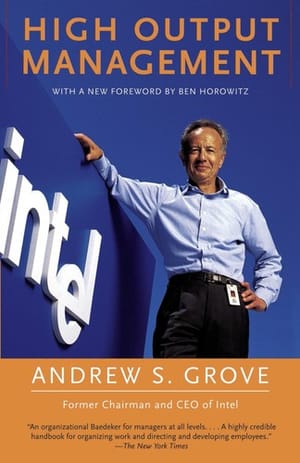
High Output Management. His 1983 book, High Output Management, remains one of the best books on management ever written. It is practical, rigorous, and rooted in Grove's background as an engineer: he analyzes management tasks the way an engineer analyzes a production process, decomposing each function into its inputs, throughputs, and outputs, and identifying the points of maximum leverage. The book's core insight — that a manager's output is the output of the teams they manage and the teams they influence — has shaped how many of the best technology managers think about their roles.
Andy Grove in Startup Books
The Innovator's Dilemma
Andy Grove and Intel are among the most important cases in Clayton Christensen's The Innovator's Dilemma. Christensen uses Intel's pivot from memory chips to microprocessors as one of his primary examples of a large, successful company successfully navigating disruptive change — a counterexample to his broader thesis that most established companies fail to respond adequately to disruption.
Christensen's analysis of Intel's situation is careful: the pivot from DRAMs to microprocessors was not, strictly speaking, a response to disruptive technology from below. DRAM was being commoditized by efficient Japanese manufacturers competing on sustaining technology. The microprocessor was not a disruptive technology in Christensen's sense — it was not cheaper or simpler than what it replaced; it was genuinely better and more capable. But the organizational dynamics were identical to those Christensen describes in disruption scenarios: the established product (DRAM) had a large installed base, a dedicated sales force, and strong customer relationships that made it politically difficult to exit; the new product (microprocessors) was supported by a small team with different skills, serving different customers, with unclear revenue potential.
Christensen argues that Intel succeeded not because its leadership was smarter than other companies' leadership, but because the resource allocation process — the way the company decided where to direct engineering effort and manufacturing capacity — had a built-in feedback mechanism. Microprocessors were more profitable per wafer than DRAMs, which meant that the manufacturing teams, responding to internal profit signals rather than top-down mandates, were already shifting capacity toward microprocessors before the strategic decision was formally made. The strategic inflection point Grove describes in Only the Paranoid Survive was, in Christensen's reading, partly a recognition of what the organization's own resource allocation process had already been deciding.
This is one of Christensen's most important and counterintuitive arguments: the key to navigating disruptive change is often to create a separate organizational unit with its own resource allocation process, not to try to fight the political dynamics of the existing organization.
The Hard Thing About Hard Things
Andy Grove appears briefly but significantly in The Hard Thing About Hard Things as one of Ben Horowitz's intellectual influences. Grove's High Output Management was required reading in Horowitz's operating philosophy at Opsware. Horowitz credits Grove's framework for thinking about management leverage — the idea that a manager's job is to multiply the output of the team, not to add their own individual contribution to it — as foundational to how he structured the Opsware leadership team during its most difficult period.
Grove also appears through his influence on the culture of Intel, which in turn shaped the culture of Silicon Valley companies in the 1980s and 1990s. The directness, the expectation of rigorous debate, the focus on output over process — these Grovian principles permeate the way Horowitz thinks about building leadership teams.
Related Reading on Startupbooks.com
- The Innovator's Dilemma — Clayton Christensen's framework for understanding disruption, in which Intel's DRAM-to-microprocessor pivot is one of the central case studies of successful navigation of strategic change
Career
Current: Former Chairman and CEO of Intel Corporation
- President of Intel (1979–1987)
- CEO of Intel (1987–1998)
- Chairman of Intel (1998–2004)
- Co-founder of Intel (1968)
Related Companies
Intel · Apple · Netflix
Key Themes
- Strategic inflection points
- Management by objectives (OKRs — Grove invented them at Intel)
- Paranoia as a competitive advantage
- Making hard decisions in the face of disruptive change
Famous Quotes
"Only the paranoid survive."
"Success breeds complacency. Complacency breeds failure. Only the paranoid survive."
"A strategic inflection point is when the balance of forces shifts from the old structure to the new."
Further Reading