No company appears more frequently in startup literature than Apple. It is the canonical case study for disruptive innovation, the proof of concept for design-led product strategy, the cautionary tale about founder-board dynamics, and the most dramatic comeback story in the history of capitalism. Pick up almost any serious book about building companies and Apple will appear within the first hundred pages — not as background decoration but as the primary evidence for whatever thesis the author is trying to prove.
The reasons are not hard to understand. Apple has been at the center of almost every major disruption in consumer technology over the past fifty years: the personal computer, portable digital music, the smartphone, the tablet, the wearable. It was built by a founder whose biography encapsulates every extreme experience a startup founder can have — visionary success, board-driven exile, near-collapse, and then the most improbable return in business history. And it operates, at its peak, as the purest example of a monopoly built not through coercion but through genuine product excellence — exactly the kind of monopoly Peter Thiel argues in From 0 to 1 that founders should aspire to create.
For startup founders, Apple is not just a success story. It is a reference library.
Apple was founded on April 1, 1976 by Steve Jobs, Steve Wozniak, and Ronald Wayne in the garage of Jobs's childhood home in Los Altos, California. Wozniak was the engineer — a genuine computer genius who built the Apple I and Apple II essentially by himself. Jobs was the visionary and the salesman, the person who understood not just that personal computers could exist but that they could matter to ordinary people.
The Apple II, launched in 1977, was the company's first mass-market success. It was one of the first personal computers to be sold fully assembled, and its open architecture allowed third-party software developers to create applications — most importantly, VisiCalc, the first spreadsheet, which turned the Apple II into a business tool and drove commercial adoption. By the early 1980s, Apple was a genuinely large technology company with hundreds of millions in revenue.
The Macintosh launched in January 1984 with one of the most famous advertisements in history — a single television spot aired during the Super Bowl that positioned Apple as the rebel against IBM's conformist dominance. The Mac itself was a genuine leap: a personal computer with a graphical user interface and a mouse, making it the first such machine to reach mainstream consumers. Apple had taken the ideas developed at Xerox PARC and turned them into a product real people could use.
What followed was one of the most documented governance disasters in Silicon Valley history. Jobs, whose management style was caustic and visionary in roughly equal measure, clashed repeatedly with John Sculley, the Pepsi executive he had personally recruited as CEO. In 1985, the Apple board sided with Sculley and forced Jobs out of the company he had founded. Apple spent the next twelve years drifting — producing a parade of undifferentiated products, losing market share, and eventually coming close to insolvency. By 1997, Apple had less than ninety days of cash remaining.
Jobs returned in 1997 when Apple acquired his NeXT software company. He immediately cut Apple's product line from dozens of items to four, killed every peripheral and accessory that was not essential, and refocused the company on making a small number of products that were genuinely excellent. The iMac in 1998 — colorful, consumer-friendly, and designed by Jony Ive — announced that Apple was back. The iPod in 2001 and the iTunes Store in 2003 demonstrated that Apple could disrupt industries beyond computers. The iPhone in 2007 did something more fundamental: it created a new category of device so dominant that it eventually made Apple the most valuable company on earth.
Jobs died in October 2011. Under Tim Cook, Apple has continued to grow — adding the iPad, Apple Watch, AirPods, and services businesses — and reached a $3 trillion market capitalization in 2022.
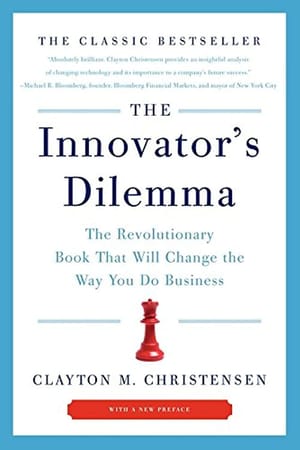
Clayton Christensen's The Innovator's Dilemma uses Apple as a recurring illustration of his central thesis, and the ways in which Apple appears in the book are genuinely illuminating — not least because some of them are double-edged.
The Macintosh, in Christensen's framework, is a classic disruptive innovation relative to the existing PC industry. In the early 1980s, IBM and its clone manufacturers dominated a market that was defined around enterprise and technical users. The Mac was worse by most of the metrics that mattered to that market: it was expensive, it had a proprietary operating system, and it had far less third-party software. But it was dramatically better on a dimension those customers weren't measuring: ease of use. It brought computing to designers, writers, educators, and creative professionals who had never used a PC before — an entirely new population of users. Apple created a new market rather than directly competing in the existing one.
Christensen also uses the iPod as a case study in disruption from outside your own industry. In the early 2000s, the portable music player market was defined by Sony's Walkman and Discman and by a range of early MP3 players. The iPod was not technically first in any of these categories, but it combined hardware, software (iTunes), and a retail content channel (the iTunes Store) in a way that made every alternative irrelevant. The key insight Christensen draws out is that Apple competed across a system, not a product — and that systems-level competition is extraordinarily difficult for incumbents to match.
The most interesting passage in Christensen's treatment of Apple, however, concerns Nokia. In the original editions of The Innovator's Dilemma, Nokia appears as an example of an incumbent that successfully responded to disruption by transforming from a rubber and cable company into a mobile phone manufacturer. By the time later editions were written, Nokia had itself been disrupted — by the iPhone. Apple turned out to be the disruptive entrant that Nokia, despite its sophistication and resources, could not match. Christensen's framework predicts this: Nokia was defending a profitable product line against a device that was initially worse by Nokia's metrics (call quality, battery life, physical durability) but dramatically better on dimensions Nokia wasn't yet measuring (internet browsing, app ecosystem, touch interface).
The broader lesson Christensen draws from Apple's arc is one of the most important in the book: disruption is not a one-time event. The same company can be the disruptor in one cycle and the disrupted in the next. What protected Apple from the Nokia fate was Jobs's willingness to cannibalize his own products — the iPhone made the iPod largely obsolete, and Apple launched it anyway.
Peter Thiel's treatment of Apple in From 0 to 1 cuts from a completely different angle. Where Christensen is interested in the mechanics of disruption, Thiel is interested in monopoly — in the conditions under which a company can build a defensible, durable competitive advantage that allows it to capture a large fraction of the value it creates.
Thiel uses Apple as his primary example of a technology monopoly built through genuine product innovation rather than through network effects or regulatory capture. Apple's monopoly in premium smartphones is not maintained by switching costs in the traditional sense — it is maintained by the fact that Apple's products are simply better, in ways that matter to the customers who pay for them, than any available alternative. The integration of hardware, software, and services into a seamless experience is not easily replicable. Every competitor can observe exactly what Apple has built; replicating the organizational capability that produces it is another matter.
The specific Apple example Thiel uses most memorably involves the iPod and Jobs's product vision. When Jobs introduced the iPod in 2001, he described it not as an MP3 player or a storage device but as "1,000 songs in your pocket." This phrase is not marketing copy — or rather, it is not only marketing copy. It is an expression of the product's actual value to a user: the ability to carry your entire music library, effortlessly accessible, everywhere you go. Thiel uses this as an illustration of the difference between features and value propositions. Competitors focused on features (storage capacity, bitrate, file format support). Jobs focused on the experiential outcome for the user. The company that understands what its product actually does for people — the job it is hired to do, in Clayton Christensen's language — will almost always beat the company that understands its own technical specifications.
Thiel also uses Apple to make a point about the relationship between monopoly and innovation. The standard economic assumption is that monopolies are bad for innovation — without competitive pressure, incumbents have no incentive to improve. Thiel argues the opposite: Apple has invested more in product R&D, generated more category-defining innovation, and produced more genuine improvements in people's lives than any collection of competing commodity businesses combined. The profits from Apple's quasi-monopolistic position in smartphones fund the research that produces the next generation of Apple products. Monopoly profits and innovation are not in tension; they are causally connected.
The story that founders return to most often from Apple's history is the exile and return. Jobs was forced out of Apple in 1985 by a board that believed, plausibly, that the company needed a professional manager rather than its difficult, often abusive founder. Twelve years later, the professional management had nearly destroyed the company, and Jobs was brought back. What Apple produced under Jobs between 1997 and 2011 is the most impressive product run in technology history.
The obvious lesson — don't let your board push you out — is not the interesting one. The interesting lesson is about what Jobs did between 1985 and 1997. He founded NeXT, a company that produced beautiful, expensive workstations that largely failed commercially but created the Unix-based operating system that became the foundation of Mac OS X. He bought Pixar from George Lucas for $10 million and oversaw its transformation into the most successful animation studio in the world. He was not idle, and he was not broken. He was learning, operating in domains where the stakes were somewhat lower, developing capabilities and perspectives that he brought back to Apple. The exile was not a detour from the story; it was part of the story.
The second lesson is about integration. Apple's competitive advantage is not any single product or technology — it is the vertical integration of hardware, software, operating system, retail, and services into a single experience that Apple fully controls. Most technology companies choose one of these layers and partner with others for the rest. Apple chose all of them. This makes Apple's products harder to match and gives Apple full control over the user experience at every point of contact. For founders, the lesson is about the strategic value of owning the full stack, even when it is expensive and difficult to do so.
The third lesson concerns the relationship between design and strategy. Apple under Jobs did not treat design as decoration applied to engineering — design was the engineering. The physical form of the product, the interface through which users interacted with it, the packaging it came in, the store in which it was sold — all of these were treated as strategic decisions with competitive consequences. Most companies treat design as a finishing step. Apple treated it as a foundational constraint that shaped every other decision.
Which startup books mention Apple most? The Innovator's Dilemma (Clayton Christensen) and From 0 to 1 (Peter Thiel) are the two most substantive treatments. Christensen uses Apple across multiple chapters as both a disruptor and a disruption target. Thiel uses Apple as his primary example of a technology monopoly built through genuine innovation.
What does Clayton Christensen say about the iPhone? Christensen's framework explains the iPhone's disruption of Nokia better than almost any other analytical tool. The iPhone was initially worse than Nokia phones on the metrics Nokia measured (voice call quality, battery life, physical robustness) but better on dimensions Nokia wasn't yet measuring (internet experience, app ecosystem, interface). This is the classic disruptive pattern: a new entrant that underperforms on established metrics while overperforming on emerging ones.
Was Steve Jobs a "wartime CEO" in Ben Horowitz's framework? Horowitz's distinction between wartime and peacetime CEOs maps interestingly onto Jobs. The Jobs who returned to Apple in 1997 — cutting product lines, demanding accountability, moving with extreme urgency — was a wartime CEO operating in a genuine survival scenario. The Jobs who ran Apple at the height of the iPhone era was operating in a different mode. Ben Horowitz discusses Jobs as an example in several interviews, noting that the wartime posture that saves a company can become destructive once the existential threat has passed.
Is Apple a blue ocean company? Apple's strategy has elements of blue ocean thinking — particularly the iPod/iTunes combination, which created a new market by targeting non-consumption rather than competing for existing MP3 player users. However, Apple's core smartphone business is highly competitive and cannot be described as a blue ocean. Apple competes in crowded markets and wins by being better, not by redefining the competitive space.