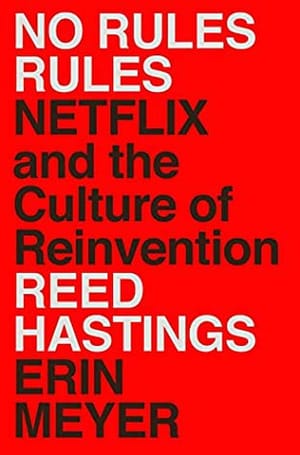
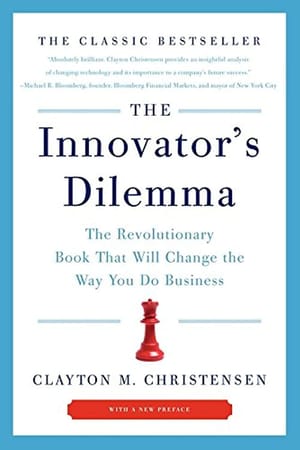
Netflix's story is the most complete illustration of disruptive innovation available to modern readers. The company disrupted Blockbuster. Then it disrupted itself. Then it disrupted Hollywood. Each stage of disruption followed Christensen's framework so precisely that it might have been designed as a teaching case — which is probably why The Innovator's Dilemma is frequently updated with Netflix as the primary contemporary example of its core arguments.
But Netflix is also important to startup literature for a second reason that has nothing to do with Christensen: the Netflix Culture Deck. Released publicly in 2009, this internal document — which Reed Hastings later developed into a full book, No Rules Rules (2020) — became required reading in Silicon Valley and changed how an entire generation of founders thought about company culture, talent density, and radical transparency. The Culture Deck is arguably Netflix's second most influential product.
Netflix was founded in August 1997 by Reed Hastings and Marc Randolph in Scotts Valley, California. The founding story is frequently told through the lens of Hastings being charged a $40 late fee at Blockbuster for returning Apollo 13 past its due date — a story Hastings has since acknowledged was more of a useful founding narrative than a literal account of the company's origins. The actual origin was more prosaic: Hastings and Randolph noticed that DVDs, which were just becoming available, were lightweight and durable enough to mail, unlike VHS tapes. A DVD-by-mail service would let customers choose from a much larger catalog than any physical store could carry.
Netflix.com launched in April 1998. The initial model was transactional — customers rented individual DVDs at a set price per rental, with a per-rental late fee. This model was, in fact, quite similar to Blockbuster's model, just delivered through the mail. The key innovation came in September 1999, when Netflix switched to a subscription model: a flat monthly fee for unlimited rentals, with a queue system that automatically sent the next DVD in a customer's list when they returned the previous one. The subscription model eliminated late fees entirely.
This is the moment Christensen's framework becomes clearly applicable. The subscription model was, on most dimensions that Blockbuster measured, worse. The selection was mailed rather than immediately available. If you wanted a specific movie immediately, Netflix could not help you. But for the customer who was willing to plan ahead, who wanted access to a deeper catalog than any local Blockbuster could stock, and who found late fees infuriating, Netflix was dramatically better.
In September 2000, Netflix approached Blockbuster with an offer to be acquired for $50 million. The Blockbuster executives — by various accounts, including Hastings's own — laughed them out of the room. This is the most cited moment in the Netflix story, not because it was the turning point of Netflix's success (Netflix was already growing rapidly) but because of what it reveals about Blockbuster's model. Blockbuster's revenue depended significantly on late fees — reportedly 16% of its annual revenue, approximately $800 million, came from late and other penalty fees. A service that eliminated late fees by design was not just a competitor; it was an existential threat to Blockbuster's business model. The Blockbuster executives were not being irrational when they laughed — they were protecting a business model that was currently highly profitable. This is precisely the dynamic Christensen describes: the incumbent's rational defense of its current profit pool makes it unable to respond to a low-end disruptor.
Netflix went public in May 2002. Blockbuster filed for bankruptcy in 2010. There is one remaining Blockbuster store, in Bend, Oregon.
The streaming pivot is the second major chapter of the Netflix story. In 2007, Netflix launched a streaming service — initially called "Watch Now" — that allowed subscribers to watch a subset of the catalog online, without waiting for a DVD to arrive. The streaming catalog was initially limited and the streaming technology was primitive by today's standards. But the direction was clear.
In 2011, Netflix attempted to separate its streaming and DVD businesses, raising prices significantly for customers who wanted both. The reaction was severe — nearly a million customers cancelled, the stock fell 77%, and Hastings issued a public apology. But the underlying logic was sound: streaming and DVD were different businesses requiring different capabilities, and conflating them was holding back the streaming business. Netflix continued investing aggressively in streaming, expanded internationally beginning in 2010, and launched House of Cards — its first original production — in 2013. The original content strategy transformed Netflix from a distributor of other studios' content into a studio in its own right, giving it control over its most valuable assets and eliminating the dependency on licensing agreements that could be revoked.
By 2022, Netflix had more than 220 million paid subscribers globally and had won more Emmy Awards than any traditional broadcast network.
Christensen's framework predicts and explains the Blockbuster-Netflix dynamic with unsettling precision. This is not hindsight analysis — the structural features of the disruption were visible from the early years of Netflix's existence to anyone who was applying Christensen's framework.
Netflix entered the video rental market as a classic low-end disruptor. It was worse than Blockbuster on the dimension Blockbuster's core customers valued most: immediate availability. If you wanted a movie tonight, Netflix could not help you. Blockbuster could. This meant Netflix was not, initially, a serious threat to Blockbuster's best customers — the people who went to Blockbuster on Friday night because they wanted something specific, right now.
But Netflix was dramatically better for a different set of customers: people who planned ahead, who wanted access to a wider catalog than any physical store could carry, and who found late fees infuriating. This is the "non-consumer" dynamic that Christensen describes as the most reliable entry point for disruptive innovation. Netflix was not competing for Blockbuster's best customers — it was competing for customers who were poorly served by Blockbuster's model or who were not Blockbuster customers at all.
As Netflix's catalog, delivery speed, and user experience improved, it began to serve better and better customers — customers who might previously have been reliable Blockbuster visitors. By the time Netflix was genuinely threatening Blockbuster's core customer base, Netflix had scale advantages (larger catalog, more sophisticated recommendation engine, lower costs from volume) that Blockbuster could not match.
Blockbuster's strategic response was to launch Blockbuster Online in 2004 — a DVD-by-mail service that directly competed with Netflix. This was, by most analyses, a well-executed response that genuinely threatened Netflix. Under CEO John Antioco, Blockbuster Online grew rapidly, eliminated late fees at retail stores, and offered features (including the ability to exchange online rentals in physical stores) that Netflix could not match. Netflix briefly suspended its growth guidance in 2005, acknowledging the competitive threat.
But Blockbuster's board intervened. Carl Icahn, who had accumulated a significant Blockbuster stake, pressured the board to replace Antioco and cut the investment in Blockbuster Online. The new CEO, Jim Keyes, famously said in 2008 that he saw "no fundamental shift in the business" from online video. Blockbuster filed for bankruptcy two years later. This is the second Christensen lesson in the Netflix story: the structural incentives of incumbent organizations — in this case, the pressure from investors to protect existing profits — prevent sustained commitment to the disruptive response even when leaders understand the threat.
Christensen also uses Netflix's own disruption of its DVD business as a case study in self-disruption. The streaming service that Netflix launched in 2007 was, initially, worse than the DVD service on almost every dimension that DVD customers measured: smaller catalog, lower resolution, no ability to watch on your television without additional hardware. But the streaming service was infinitely more convenient — no discs to mail, no waiting, no late fees, no physical inventory constraint. As broadband speed improved and streaming technology matured, the streaming service became good enough for more and more customers. The DVD business became a declining business.
The $50 million offer Blockbuster rejected is now a piece of startup folklore, but Christensen's interest in it is analytical rather than dramatic. The offer illustrates what incumbents typically do with potential disruptors when they encounter them: they evaluate them using the metrics of their existing business model. By Blockbuster's metrics — immediate availability, revenue per rental, store-based customer experience — Netflix was inferior and overpriced at $50 million. The Blockbuster executives who rejected the offer were not stupid; they were applying the wrong analytical framework.
In 2009, Netflix published on its website an internal presentation titled "Netflix Culture: Freedom and Responsibility." The document — which Sheryl Sandberg called "the most important document to come out of Silicon Valley" — is 125 slides that articulate Netflix's philosophy of talent, culture, and management. It was never intended as a public document. It went viral.
The core argument of the Culture Deck is that the standard mechanisms large companies use to manage people — detailed procedures, approval processes, travel and expense rules, rigid performance review systems — are solutions to a talent density problem, not solutions to a management problem. If a company has high talent density — if every person in the organization is genuinely excellent — most of the rules become unnecessary. Excellent people don't need rules to behave responsibly; they need context.
The most controversial element of the Culture Deck is what became known as the "keeper test." Netflix managers are encouraged to ask themselves, for each person on their team: "If this person told me they were leaving for a competitor, would I fight hard to keep them?" If the answer is no, the manager should proactively let that person go, with a generous severance payment. Netflix does not believe in the standard performance improvement plan for underperformers. It believes in paying excellent people well, treating them as adults, and letting go of anyone who is merely good rather than excellent.
The Culture Deck also codifies Netflix's approach to transparency. Netflix managers are expected to share context about the business — strategy, competitive threats, financial performance, executive decisions — with employees much more freely than most companies. The theory is that employees who have the full picture make better decisions, and that the cost of information control (employees making uninformed decisions, feeling disrespected, not aligning their behavior with strategy) exceeds the cost of information sharing.
For startup founders, the Culture Deck is important for a specific reason: it demonstrates that culture is a product that can be designed. Netflix did not arrive at its culture by accident or by hiring nice people. It arrived at it by making specific, deliberate choices — about what to reward, what to tolerate, what to remove, and how to explain the reasoning to every person in the organization. The document itself is part of the culture: by making the reasoning explicit and public, Netflix creates accountability for its cultural commitments.
The late fee is always somewhere in your business model. Blockbuster's late fee revenue was not just a revenue line — it was evidence of a fundamental misalignment between the company's business model and its customers' interests. Customers hated late fees; Blockbuster depended on them. Netflix's flat-rate subscription model eliminated this misalignment, and customers rewarded it with loyalty. The lesson for founders: look for the revenue mechanisms in your business that customers resent paying. Those are your vulnerabilities.
Defend a profitable business long enough and it will destroy you. Blockbuster's board intervention to protect retail rental margins from the threat of Blockbuster Online is the most important moment in the Netflix story, and the least discussed. Antioco's online strategy was working. The board cut it to protect short-term profitability. The result was Blockbuster's bankruptcy. For founders: the pressure to protect existing margins will feel rational and responsible. It often isn't.
Self-disruption is a choice, not an accident. Netflix's streaming pivot was not forced upon the company by external circumstances. Reed Hastings saw the trajectory of broadband penetration and storage costs in the early 2000s and made a deliberate bet that streaming would eventually replace physical media. The 2011 price increase disaster was a stumble in execution, not a failure of strategy. The strategy — build streaming before streaming builds itself without you — was correct.
Culture decks are management tools, not mission statements. The Netflix Culture Deck works because it is specific, honest, and enforced. It does not describe aspirations; it describes actual behaviors and actual consequences. When Netflix says it will pay generous severance to good employees who are not excellent, it means it. When it says managers should not apply approval processes that treat employees as children, it means it. The specificity is what makes it useful.
Why didn't Blockbuster successfully copy Netflix? Blockbuster Online, under John Antioco, was genuinely competitive with Netflix for a period in 2004–2005. The failure was not in strategy but in execution — specifically, the board's decision to cut investment in online to protect retail margins. Carl Icahn's intervention, in retrospect, is one of the most consequential decisions in technology history. Blockbuster was within striking distance of surviving its disruption; the board withdrew the resources required to do so.
Is Netflix still a growth company? Netflix's growth has moderated significantly from its peak. The company lost subscribers in 2022 for the first time in a decade, prompting a stock decline of more than 50% before partial recovery. Netflix has since launched an advertising-supported tier, invested in live events, and expanded into gaming. The fundamental question of whether streaming is a commodity business or a differentiated one — and whether Netflix has the content library to command premium subscription prices — remains open.
What is the Netflix Culture Deck actually saying about performance reviews? Netflix replaced traditional annual performance reviews with a system of ongoing feedback and what Hastings calls a "360-degree review" process. The keeper test, applied continuously rather than annually, is the mechanism by which underperformers are identified and let go. Netflix does not wait for an annual review to address a performance problem; it addresses it as soon as it is identified.
Did Netflix ever try to buy Blockbuster? The offer went the other direction: Netflix approached Blockbuster in 2000 offering to be acquired. Blockbuster passed. There is no recorded instance of Netflix attempting to acquire Blockbuster.