Wilmot Reed Hastings Jr. was born in 1960 in Boston, Massachusetts. He studied mathematics at Bowdoin College, served in the Peace Corps in Swaziland teaching math, then returned to the United States and earned a master's degree in artificial intelligence from Stanford University. He co-founded two companies — Pure Software in 1991 and Netflix in 1997 — and spent over twenty-five years as Netflix's chief executive before transitioning to executive chairman in January 2023.
Hastings is best known as the builder of Netflix, but his influence on business culture extends well beyond streaming. The Netflix Culture Deck — an internal document he developed with Patty McCord and published online in 2009 — became one of the most widely read management documents in Silicon Valley history. Sheryl Sandberg described it as "the most important document ever to come out of Silicon Valley." The 2020 book No Rules Rules, co-written with organizational theorist Erin Meyer, is the full articulation of the philosophy that document outlined.
His story is, in many ways, the opposite of the classic Silicon Valley founding narrative. He did not drop out of college. He did not build his first company in a garage. He is a graduate student turned Peace Corps volunteer turned software entrepreneur who stumbled into one of the most consequential companies in entertainment history by noticing that DVDs were small enough to mail. What he did consistently and brilliantly over twenty-five years was build a company culture that attracted excellent people and gave them the freedom to do excellent work.
Career
Pure Software (1991–1997)
Hastings's first company was Pure Software, founded in 1991 to sell software debugging tools for the C programming language. The company's first product, Purify, was technically excellent — it detected memory errors in C programs with a precision that existing tools could not match — and Pure Software grew quickly on the strength of it.
But Pure Software's growth created management problems that Hastings later acknowledged he handled badly. As the company scaled from a small team to hundreds of employees, he responded by adding systems, processes, and rules — the standard corporate playbook for managing larger organizations. By the time Pure Software went public in 1995 and merged with Atria Software in 1996 to become Pure Atria, the company had, in Hastings's own description, become bureaucratic and slow. The entrepreneurial spark that had made the original product excellent was diluted by layers of process designed to prevent mistakes.
Pure Atria was acquired by Rational Software in 1997 for approximately $750 million. Hastings walked away from the sale with a significant personal payout and a conviction that the standard approach to scaling organizations was wrong. The bureaucratic growth of Pure Software was not, in his retrospective analysis, an inevitability. It was a choice — and the wrong one.
The Pure Software experience is the direct origin of Netflix's cultural philosophy. Hastings's goal when building Netflix was to avoid replicating what he had done at Pure Software: adding rules and processes as a substitute for talent density and judgment. Everything in the Netflix Culture Deck — the keeper test, radical candor, context over control — can be traced back to the lessons Hastings took from watching Pure Software become exactly the kind of company he had never wanted to build.
Netflix: The DVD Era (1997–2007)
Netflix was co-founded in 1997 by Hastings and Marc Randolph. The founding story that Hastings often tells — that a $40 Blockbuster late fee for Apollo 13 prompted the idea for a subscription rental service — is partially mythologized; Hastings has acknowledged that the late fee was more of a convenient narrative frame than a literal origin moment. The actual insight was more mundane: DVDs were lightweight and durable enough to mail reliably, unlike VHS tapes, and a mail-based rental service could offer a catalog that no physical store could match.
Netflix.com launched in April 1998 with a transactional model — customers rented individual DVDs at a set price. In September 1999, Netflix made the strategic shift that defined its first decade: it switched to a flat-rate subscription model with no due dates and no late fees. This change eliminated the central tension in the video rental business — the conflict between customers' desire to watch movies at their own pace and the store's need for its inventory back — and created a genuinely different value proposition from Blockbuster.
The 2001 dot-com crash forced a painful round of layoffs that cut the Netflix workforce by a third. Hastings has written extensively about the unexpected consequence: the smaller team was significantly more effective than the larger one had been. This observation became the empirical foundation for the talent density philosophy that has defined Netflix's management approach ever since.
In 2000, Netflix had approached Blockbuster with an offer to be acquired for $50 million. Blockbuster declined. Netflix went public in 2002. Blockbuster filed for bankruptcy in 2010.
Netflix: The Streaming Era (2007–2020)
In January 2007, Netflix launched its streaming service — initially called "Watch Now" — which allowed subscribers to watch movies and television online for no additional charge. The streaming catalog was limited and the technology was primitive compared to what it would become, but the strategic logic was clear: broadband penetration was growing, storage costs were falling, and the future of video consumption was on demand over the internet. Hastings had been watching these trends for years.
The streaming business grew alongside the DVD business through the late 2000s, and Netflix expanded internationally beginning with Canada in 2010. In 2011, Hastings made the decision to separate the streaming and DVD businesses — raising prices significantly for customers who wanted both and attempting to spin off the DVD business as a separate company called Qwikster. The reaction was severe: Netflix lost approximately 800,000 subscribers in a single quarter, the stock fell by more than 70%, and Hastings issued a public apology and reversed the Qwikster decision. The price increase held, and Hastings has argued retrospectively that the strategic logic — treating streaming and DVD as fundamentally different businesses — was correct even though the execution was poor.
Netflix launched its first original production, House of Cards, in February 2013. The decision to produce original content was transformative: it gave Netflix control over its most valuable assets, reduced its dependence on licensing agreements that could be revoked by studios threatened by streaming, and positioned Netflix as a competitor to HBO and the traditional broadcast networks rather than a distributor for them. Hastings's investment in original content — which became billions of dollars annually by the mid-2010s — is perhaps his most consequential strategic decision as CEO.
By 2018, Netflix had over 130 million subscribers globally. By 2020, it had over 200 million. The company had won more Emmy Awards than any traditional broadcast network. The DVD rental business that Blockbuster once laughed at had become the most powerful force in global entertainment.
Chairman and Post-CEO (2023–Present)
In January 2023, Hastings stepped down as CEO, transitioning to executive chairman. Greg Peters and Ted Sarandos became co-CEOs. The transition was planned rather than forced — Hastings has described it as the culmination of a years-long process of building the management depth that would make succession possible.
Since stepping back from the CEO role, Hastings has focused increasingly on educational philanthropy. He has donated hundreds of millions of dollars to educational causes, including a $100 million gift to historically Black colleges and universities in 2020 and substantial ongoing support for charter school networks and educational reform efforts in California and beyond. His education philanthropy reflects a long-standing personal interest: Hastings served on the California State Board of Education from 2000 to 2004 and was an early advocate for charter school expansion.
Reed Hastings Net Worth
Reed Hastings's net worth as of 2024 is estimated at approximately $5 billion, derived primarily from his Netflix equity. He was one of Netflix's largest individual shareholders throughout his CEO tenure. His compensation structure was unusual by tech CEO standards — heavy on salary relative to equity awards — because Netflix's philosophy about executive compensation aligned with its philosophy about all employee compensation: pay top of market in cash rather than offering equity as the primary incentive.
Hastings has been a significant philanthropist throughout his time at Netflix. His educational donations through the Hastings Fund have totaled over $500 million, making him one of the largest donors to K-12 educational reform efforts in the United States. He has described education as a more tractable problem than most people assume, and his philanthropic approach — supporting evidence-based reforms, backing charter school networks, funding teacher development — reflects the same data-driven pragmatism that characterized his management of Netflix.
Ideas and Philosophy
Hastings's management philosophy can be summarized as an argument about what organizations fail to trust their employees to do, and the cost of that distrust. Most organizational design is built on the assumption that employees need to be managed — that without rules, approval processes, and structured oversight, they will waste resources, make bad decisions, and behave irresponsibly. Hastings disagrees. He argues that this assumption is self-fulfilling: treating people as untrustworthy produces untrustworthy behavior, because it signals that the company does not respect their judgment.
His alternative is built on three principles. First, invest heavily in talent: hire only excellent people, pay them extremely well, and let go of anyone who falls short of that standard. Second, build a culture of radical honesty: make direct feedback a professional expectation rather than a social nicety. Third, once talent density and candor are established, extend extraordinary freedom: remove approval processes, remove vacation policies, remove expense controls, and trust people to make good decisions with good judgment.
The intellectual influences Hastings cites most consistently are Andy Grove and Jim Collins. From Grove he took the idea that management is ultimately about maximizing the output of a group, and that the highest-leverage way to do that is to build the group right rather than to add management systems. From Collins he took the Level 5 Leadership model and the principle that great organizations are built by people who put the organization's needs above their own.
Books
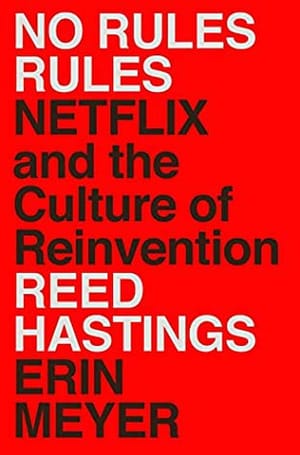
No Rules Rules: Netflix and the Culture of Reinvention (2020), co-written with organizational theorist Erin Meyer, is Hastings's only book. It elaborates the Netflix Culture Deck into a full management philosophy, with Meyer providing the comparative cross-cultural perspective — examining how Netflix's practices work differently in Japan, France, the Netherlands, and other countries with different professional norms around hierarchy, feedback, and autonomy.
The book is structured as a progression: build talent density, then build radical candor, then extend freedom. Each step is predicated on the previous one; the freedoms Netflix extends only work because the talent density and honesty create the conditions for responsible autonomy. Hastings is explicit that implementing the freedom elements without first building the foundation will not produce Netflix's results.
The book became a bestseller in multiple countries and was named one of the best business books of 2020 by The Financial Times and The Economist.
Podcasts and Interviews
Hastings has been a frequent guest on major business podcasts and interview platforms. Notable appearances include:
- The Tim Ferriss Show — a wide-ranging conversation about Netflix's culture, the keeper test, and the lessons of scaling a company
- Masters of Scale with Reid Hoffman — discussion of counterintuitive management ideas and the evolution of Netflix's culture
- How I Built This with Guy Raz — the founding story of Netflix, from DVD-by-mail to streaming
- The Knowledge Project with Shane Parrish — deep dive into decision-making, organizational design, and the intellectual influences behind the Netflix culture
- Ted Talk: "How Netflix Changed Entertainment — and Ourselves" — a widely viewed talk on the cultural and business implications of Netflix's streaming model
- Lex Fridman Podcast — conversation covering artificial intelligence, the future of entertainment, and the Netflix culture
- Stanford View from the Top — interview with Stanford Graduate School of Business students on leadership and company building
Professional Background
Current role: Executive Chairman of Netflix
Previous roles:
- CEO of Netflix (1997–2023)
- Co-founder and CEO of Pure Software (1991–1997)
Undergraduate: BA, Mathematics, Bowdoin College
Graduate: MS, Artificial Intelligence, Stanford University
Past: Microsoft, Facebook
Themes
- Radical transparency
- Talent density
- Freedom and responsibility
- Culture design
Influences
Popular Works
Awards
- Time 100 Most Influential People (multiple years)
Contributions
Famous Quotes
"The most important thing is to treat people like adults."
"Adequate performance gets a generous severance package."
Related Founders
Reed Hastings
Related Companies
Netflix