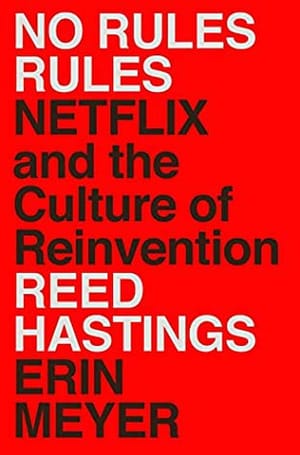
Reed Hastings co-founded Netflix in 1997 with Marc Randolph and served as its CEO for over twenty-five years. He is credited with two related but distinct achievements: building one of the most valuable entertainment companies in history, and creating one of the most studied company cultures in the technology industry. The second achievement may ultimately be as influential as the first.
Before Netflix, Hastings co-founded Pure Software in 1991, a developer of software debugging tools that grew rapidly, went public in 1995, and was acquired by Rational Software for approximately $750 million in 1997. The Pure Software experience gave Hastings the capital and the conviction to start Netflix — and, more importantly, the cautionary lesson that growing a company by adding rules and processes produces bureaucracy, not excellence.
Hastings transitioned to executive chairman of Netflix in January 2023, handing the CEO role to Greg Peters and Ted Sarandos. He remains the company's most influential intellectual architect — the person whose management philosophy permeates how Netflix operates at every level.
Netflix appears prominently in startup literature for two distinct reasons, and understanding the distinction helps founders extract the right lessons.
The first is Netflix's role in Clayton Christensen's disruption framework. The Blockbuster-Netflix story is the definitive modern case study of disruptive innovation — a low-end entrant offering a worse product on the dimensions the incumbent measured, but a better product for a neglected segment of customers, ultimately destroying the incumbent through a combination of structural advantage and the incumbent's rational but ultimately fatal defense of its existing profit pool. Christensen's The Innovator's Dilemma is updated in later editions to include Netflix as the primary contemporary example.
The second reason is the Netflix Culture Deck and No Rules Rules, which describe a management philosophy that stands in explicit opposition to how most companies are run. Hastings's argument that the standard management tools — approval processes, expense controls, formal performance reviews, vacation tracking — are solutions to the wrong problem has influenced how thousands of founders and operators think about company culture. The Netflix cultural model is referenced in a broad range of business literature as both a case study in what is possible and as a point of contrast for authors arguing for different approaches.
For founders building their first teams, both dimensions are relevant. The disruption story shows what it looks like to build a business model genuinely different from the incumbent's, and what happens to incumbents who can see the threat but cannot respond to it due to structural incentives. The culture story shows what it looks like to design an organization from first principles, rather than inheriting the standard corporate management playbook.
Netflix launched in April 1998. The first model was transactional — similar to Blockbuster's, just delivered by mail. The critical innovation came in September 1999 with the switch to a flat-rate subscription model: one monthly fee for unlimited rentals, no due dates, no late fees. This was not an incremental improvement on Blockbuster; it was a fundamentally different contract with the customer.
Blockbuster's business model depended in part on late fees — estimates suggest late fees represented approximately 16% of annual revenue, roughly $800 million. Netflix's subscription model was structurally incompatible with late fees; there were none to charge. This meant Netflix was not merely competing with Blockbuster but undermining the financial logic of Blockbuster's business.
In 2000, Netflix approached Blockbuster to propose an acquisition at $50 million. Blockbuster declined. Netflix went public in 2002. Blockbuster launched a competing DVD-by-mail service in 2004, which briefly threatened Netflix's position before the Blockbuster board, under pressure from investor Carl Icahn, cut the investment to protect existing store-based margins. Blockbuster filed for bankruptcy in 2010.
The streaming pivot, which Hastings began planning in the early 2000s based on projections about broadband penetration, represents the second act of the Netflix disruption story. Netflix launched streaming in 2007, built it into the dominant business while managing a challenging transition from DVDs, launched original content in 2013, and by 2020 had over 200 million global subscribers and more Emmy Awards than any traditional broadcast network.
Build talent density before extending freedom. The most important sequence in Hastings's management philosophy is the order of operations: talent density first, then radical candor, then freedom. Founders who implement the freedom elements without first building the team that can use that freedom responsibly will get bad outcomes. The freedoms work because of who Netflix hires, not in spite of who they hire.
Your business model alignment with customers matters more than your product. Blockbuster's problem was not that it had a bad product. Blockbuster stores were convenient, well-stocked, and familiar. The problem was that the financial model — late fees, inventory constraints, per-rental pricing — was misaligned with what customers actually wanted. Netflix's subscription model aligned the company's financial interest with the customer's interest: Netflix made money when customers kept subscribing, which meant keeping customers happy. Founders should ask: are there elements of our business model that put us in conflict with our customers' interests? Those are vulnerabilities.
Culture is a product. The Netflix Culture Deck is not a mission statement or an aspiration document. It describes specific practices, specific consequences, and specific reasoning. Hastings treats culture design with the same rigor he applies to product design: define the inputs (who you hire, how you pay them), define the processes (how feedback is given, how decisions are made), define the outputs (behavior, performance, retention), and measure whether the system is producing the intended results. Founders who treat culture as something that emerges naturally rather than something that is designed will get cultures that reflect whatever is easiest rather than whatever is best.
The incumbent's rational decision is often a fatal one. The Blockbuster board's decision to cut investment in Blockbuster Online to protect retail margins was rational by the metrics they were using. It was also the decision that ensured Blockbuster's bankruptcy. Hastings's career is a sustained argument that doing what is right for the long term requires accepting short-term costs that most organizations are not structurally able to accept. Founders who build organizations capable of accepting those short-term costs — by having investors who understand the strategy, by having employees who understand the trade-offs, by being explicit about the reasoning — will make better long-term decisions.
Current: Executive Chairman of Netflix
"The most important thing is to treat people like adults."
"Adequate performance gets a generous severance package."