James Charles Collins was born in 1958 in Boulder, Colorado, and has spent most of his career studying what separates truly great organizations from merely good ones. He is the author or co-author of six books that have collectively sold more than ten million copies, and his management concepts — Level 5 Leadership, the Hedgehog Concept, the Flywheel Effect, First Who Then What, and BHAG (Big Hairy Audacious Goal) — are among the most widely cited frameworks in business literature.
Collins is not a founder, not a CEO, and not a consultant in the conventional sense. He is a researcher who treats management questions with the rigor of an academic without publishing primarily in academic journals. His methodology — identifying companies with specific, measurable performance profiles and then systematically studying what they have in common — produces findings that are more persuasive than case studies or theory, and more accessible than academic research. The result has been an unusual combination of scholarly credibility and popular reach.
He lives in Boulder, Colorado, where he operates what he calls a "management laboratory" — a small team of researchers who work with him on multi-year studies. He is also an avid rock climber, and several of his metaphors for leadership and organizational performance are drawn from climbing.
Collins taught at the Stanford Graduate School of Business from 1988 to 1995, where he earned multiple teaching awards and developed the research methods that would characterize all his subsequent work. His approach at Stanford was already distinctive: he taught through Socratic questioning and case analysis rather than through lecture, and his research questions were empirical rather than theoretical. He wanted to know what great organizations actually did, not what management theory said they should do.
The Stanford period produced his first major academic recognition and his first book project. It was also where he began working with Jerry Porras, a colleague who would become his co-author on Built to Last.
In 1995, Collins left Stanford to devote himself entirely to research and writing. He established what he calls a management laboratory in Boulder — not an academic institution or a consulting firm, but a small, focused research operation dedicated to studying organizational excellence. The laboratory operates on a simple model: identify a research question with clear implications for how organizations should be built and led, design a rigorous study to answer it, and then communicate the findings as accessibly as possible.
The laboratory produced Good to Great (2001), which became one of the best-selling business books in history. The research for that book took five years and involved a team of twenty researchers who collectively worked over 15,000 hours analyzing data, conducting interviews, and coding findings. Collins is explicit that the research methodology matters as much as the findings: by starting with a measurable definition of greatness (sustained long-term stock performance relative to the market), establishing a comparison group (matched companies in the same industries that did not make the leap), and looking for patterns systematically, the research produces findings that are more than impressionistic.
Subsequent books — How the Mighty Fall (2009), Great by Choice (2011), and Turning the Flywheel (2019) — have continued the research program with different questions. Collins is currently at work on the sequel to Good to Great, examining what has happened to the original eleven great companies in the two decades since the book was published.
Collins also teaches, advises, and speaks extensively, but he is selective about his commitments. He has worked with nonprofit and social sector organizations — schools, hospitals, military units — to apply and test whether his frameworks for business organizations hold in different contexts. His monograph Good to Great and the Social Sectors (2005) argues that the core concepts apply broadly, with some translation required for organizations whose primary measure of performance is not financial.
Collins's research process is distinctive enough to be worth describing in some detail. Each major book begins with a research question that can be operationalized: What separates great companies from good ones? What causes great companies to decline? What distinguishes companies that thrive in uncertainty from those that don't? The question is then turned into a screen that can be applied systematically to a large dataset — usually Fortune 500 companies over a defined historical period.
The systematic screen produces a set of companies with the performance profile the study is looking for. A matched comparison group is selected from the same industries. Both groups are studied exhaustively: hundreds of interviews, decades of financial and news data, analysis of executive decisions and strategic choices. The team codes the findings against the research question — looking for patterns that appear consistently in the high-performing group and are absent from the comparison group.
This methodology has two important implications. First, it produces findings that are genuinely surprising — patterns that were not expected in advance, that emerge from the data rather than being imposed on it. Level 5 Leadership was not a concept Collins began with; it was a finding that confused the research team, who kept seeing the same pattern in great company leaders and trying to explain it away. Second, it is transparent about what it cannot claim: correlation from a specific historical period, not causal universals applicable to all organizations in all contexts.
Level 5 Leadership is Collins's term for the leadership style that characterized every great company in the Good to Great research. The "level" in the name refers to a hierarchy of leadership capability that Collins describes in the book: Level 1 is a capable individual, Level 2 is a contributing team member, Level 3 is a competent manager, Level 4 is an effective leader, and Level 5 is an executive who builds enduring greatness.
What distinguishes Level 5 is not technical competence or strategic brilliance — those are Level 4 characteristics. What distinguishes Level 5 is the combination of fierce professional will with personal humility. Level 5 Leaders are relentlessly demanding about results, unwilling to accept mediocrity, and absolutely committed to the organization's success. But they are modest about their own role, crediting the team for success and taking personal responsibility for failure. Their ambition is for the institution, not for themselves.
Collins acknowledges that this finding contradicted his expectations and the expectations of his research team. The comparison companies were frequently led by charismatic, high-profile CEOs who attracted enormous media attention and personal acclaim. The great companies were consistently led by people most outsiders had never heard of. The lesson Collins draws is that building an enduring organization requires leaders who subordinate their ego to the organization's needs — a quality that does not often coincide with the personality types that get celebrated in business culture.
The Hedgehog Concept is drawn from the essay by philosopher Isaiah Berlin, "The Hedgehog and the Fox," which distinguished between people who know one big thing (hedgehogs) and people who know many things but do not integrate them into a single vision (foxes). Collins applies the distinction organizationally: great companies find one defining concept and focus on it relentlessly, while comparison companies pursue multiple strategies simultaneously.
The three-circle model — passion, best in the world, economic engine — is a tool for finding the Hedgehog Concept. Collins is explicit that the concept is not a goal or a strategy; it is an understanding of what an organization can do, care about, and make money at that is so coherent that it simplifies thousands of decisions.
The Flywheel metaphor addresses a common misconception about how breakthrough performance happens. Most people — and most organizations — expect breakthroughs to feel like breakthroughs: a dramatic moment when everything changes. Collins's research found no such moments in the great companies' transitions. Instead, the great companies built momentum through consistent, disciplined effort in a coherent direction. The flywheel turns slowly at first, but with each turn, momentum builds. Eventually the flywheel is spinning so fast that it seems to be running on its own.
Collins later developed the flywheel concept into a standalone monograph, Turning the Flywheel (2019), which provides a framework for applying the concept to specific organizations. The key question is: what is the specific sequence of activities that reinforces itself to produce momentum? Amazon's flywheel — lower prices drive more customers, more customers drive more third-party sellers, more sellers provide more selection, more selection drives lower prices — is perhaps the most widely cited contemporary example.
The First Who, Then What principle is one of the most practically actionable findings from Good to Great. Collins found that great company leaders consistently thought about people before strategy: they focused first on getting the right people into the organization and the wrong people out, and only then on deciding where the organization should go.
The counterintuitive implication is that talent is more important than strategy. This is not because strategy doesn't matter — it does — but because the right people can figure out the right strategy while the wrong people cannot execute even the best strategy.
The Big Hairy Audacious Goal, introduced in Built to Last, is a long-range goal — typically ten to thirty years — that is clear, compelling, and nearly impossible. It is meant to serve as a guiding star for organizational effort: something so ambitious that it galvanizes people and provides direction for thousands of smaller decisions. Boeing's goal in the 1950s — to become the dominant commercial aircraft company in the world — is Collins's canonical example. At the time, Boeing was primarily a military contractor. The BHAG was audacious. They achieved it.
Built to Last: Successful Habits of Visionary Companies (1994) — co-written with Jerry Porras, this was Collins's first major book and the direct predecessor to Good to Great. The research question was: what do enduring, visionary companies have in common that explains their longevity? The study identified eighteen visionary companies — companies like 3M, Boeing, Disney, General Electric, Johnson & Johnson, and Merck — and compared them to matched controls that were successful but not visionary. The findings emphasized core ideology (a consistent set of values that guides decisions), BHAG (see above), and what Collins and Porras called "clock building" — creating organizations and systems that work, rather than "time telling" — being a brilliant individual leader.
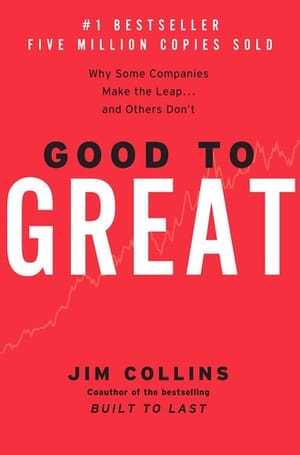
Good to Great: Why Some Companies Make the Leap... and Others Don't (2001) — the follow-up that addressed the question Built to Last had left open: how did the visionary companies become great in the first place? This is Collins's most widely read book and the source of most of his best-known concepts.
How the Mighty Fall: And Why Some Companies Never Give In (2009) — a study of organizational decline, motivated by the observation that several Good to Great companies had begun to struggle. Collins identifies five stages of decline: hubris born of success, undisciplined pursuit of more, denial of risk and peril, grasping for salvation, and capitulation to irrelevance or death. The most important finding is that the first two stages of decline are largely invisible from the outside — organizations look strong while the internal rot is setting in.
Great by Choice: Uncertainty, Chaos, and Luck — Why Some Thrive Despite Them All (2011) — co-written with Morten Hansen, this book examined companies that thrived in turbulent, unpredictable environments. The central concept is the "10X company" — organizations that outperformed their industry by at least ten times over a sustained period despite facing chaotic, uncertain conditions. The key finding was that 10X leaders were not more visionary or more creative than their peers; they were more disciplined, more empirical, and more prepared.
Turning the Flywheel: A Monograph to Accompany Good to Great (2019) — a short, practical guide to applying the flywheel concept to specific organizations. Collins walks through the process of identifying the components of an organization's specific flywheel and using that understanding to make better strategic decisions.
Collins appears infrequently compared to many public figures of his stature — he is protective of his research time and selective about commitments. Notable appearances include:
Current role: Author and Management Researcher at Jim Collins Labs
Previous roles:
"Good is the enemy of great."
"Greatness is not a function of circumstance. Greatness is largely a matter of conscious choice."
"First who, then what."