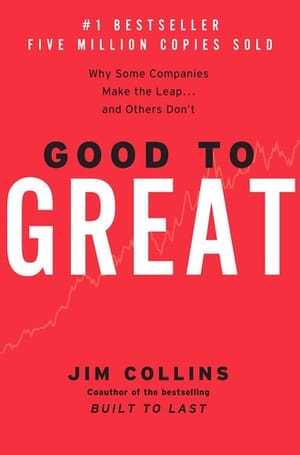
Walgreens appears in Jim Collins's Good to Great as the definitive case study for the Hedgehog Concept — the idea that great companies achieve sustained excellence by finding the single intersection of what they can be the best in the world at, what drives their economic engine, and what they are deeply passionate about, and then focusing on that intersection with relentless discipline.
Collins uses Walgreens to make a point that is central to the entire Good to Great argument: greatness is not about being in a glamorous industry, pursuing bold strategies, or making visionary leaps. Walgreens operates drugstores. It sells prescription medications, cosmetics, and convenience goods from retail locations on street corners. There is nothing inherently glamorous about any of that. And yet from 1975 to 2000, Walgreens generated cumulative stock returns fifteen times greater than the general market — better than Intel, better than General Electric, better than Coca-Cola. Collins asks, reasonably: how?
The answer, in his telling, is the Hedgehog Concept applied with extraordinary consistency over a very long time. Walgreens found something it could be the best in the world at, identified the financial metric that best measured its performance on that dimension, and made every significant decision in light of it. Not for a year, not for a five-year strategic plan, but for decades.
For founders, the Walgreens story is a useful counterweight to the narrative that success requires a revolutionary idea, a category-creating product, or a once-in-a-generation founder. Sometimes success requires finding the intersection where your capabilities, your economics, and your commitment converge, and then having the discipline to stay focused on that intersection when more exciting alternatives present themselves.
Charles R. Walgreen Sr. opened the first Walgreens drugstore in Chicago in 1901. The founding was unremarkable — there were thousands of independent pharmacies in American cities at the time, and Walgreen's store on the South Side of Chicago was by most external measures indistinguishable from its competitors. What Walgreen built over the first decades of the company's existence was a model for operational excellence in drugstore retailing: clear, consistent standards for service, inventory management, and customer experience, combined with a keen instinct for location selection.
The chain grew steadily through the early and middle decades of the twentieth century. By the time the Good to Great research period begins — around 1975 — Walgreens was a significant regional pharmacy chain but not yet a national force. It had approximately 700 stores, concentrated in the Midwest and Southeast. What would happen over the next twenty-five years — the period Collins's research focuses on — would transform it into one of the most successful retail companies in American history.
The critical period of Walgreens' transformation corresponds roughly to the tenure of Charles Walgreen III, who became CEO in 1971. The company's systematic expansion of the 1970s, 1980s, and 1990s was driven by a single strategic insight that Collins identifies as the core of Walgreens' Hedgehog Concept: the most profitable drugstores in America are not the biggest or the most elaborately stocked. They are the most conveniently located. A drugstore on a busy corner, with excellent traffic, easy parking, and consistent inventory, generates more profit per customer visit than a larger, more comprehensive store that is slightly less convenient to reach.
By 2000, Walgreens had approximately 3,500 stores in 43 states, with a consistent presence on high-traffic corners in suburban and urban retail locations. The 2014 merger with Alliance Boots — a European pharmacy chain — created Walgreens Boots Alliance, which became one of the largest pharmacy-led health and beauty businesses in the world.
Collins uses Walgreens to illustrate the Hedgehog Concept, and the contrast with Eckerd — Walgreens' matched comparison company in the research — is where the argument becomes most concrete.
The Hedgehog Concept in practice. Collins identifies Walgreens' Hedgehog Concept as achieving the most convenient drugstore experience with the highest profit per customer visit. The three-circle intersection:
What Walgreens could be the best in the world at: operating convenient, well-stocked drugstores in premium retail locations. Not the cheapest, not the most comprehensive, not the most innovative — the most convenient, most reliably executed, most profitably located.
What drove the economic engine: profit per customer visit. This is Collins's "X" denominator — the single financial metric that, if you improve it substantially, improves your overall financial performance most significantly. For Walgreens, the insight was that profitability correlated more strongly with the quality of each customer visit — the revenue and margin generated in a single trip to the store — than with total customer count or total revenue. This insight shaped location decisions (high-traffic corners to maximize visits), store design (optimized for in-and-out convenience), and inventory decisions (focus on the products that drive the highest per-visit revenue).
What Walgreens was deeply passionate about: Collins describes Walgreens' leaders as genuinely excited about the drugstore concept — not as a second-best business to be in, but as a craft. Finding the perfect corner, designing the perfect store, running a pharmacy with the highest possible efficiency and customer satisfaction — these were sources of genuine organizational pride.
The Eckerd comparison. Eckerd was a drugstore chain of similar size and geographic scope to Walgreens, matched by Collins as the comparison company. The contrast is instructive. Where Walgreens focused relentlessly on its Hedgehog Concept — executing the convenience drugstore model with ever-greater discipline — Eckerd pursued multiple strategies over the same period. It diversified into unrelated businesses, made acquisitions that diluted its core pharmacy focus, and reorganized repeatedly in response to competitive pressures. The result was inconsistent performance and eventual acquisition by J.C. Penney in 1997.
Collins emphasizes that Eckerd's leadership was not incompetent — the company made strategic decisions that made sense by conventional management standards. The problem was the lack of a coherent, consistent concept that guided those decisions. Without a Hedgehog Concept, each decision was evaluated in isolation rather than against a consistent strategic framework. The result was the doom loop: a series of strategic initiatives, none of which built on the previous one, none of which created the cumulative momentum of a flywheel.
The flywheel building. Collins's account of how Walgreens built its flywheel is a story of location economics. Each excellent corner location generated high customer traffic. High traffic generated high per-visit revenue. High per-visit revenue justified the premium cost of premium corners. The ability to pay for premium corners attracted better pharmacists and better managers. Better execution attracted more loyal customers. The flywheel turned, slowly at first and then with increasing momentum, as each element reinforced the others.
What made the flywheel work was consistency. Walgreens did not open stores in mediocre locations because it needed to grow faster. It did not diversify into higher-margin categories because it needed to improve its financial profile. It focused on the thing it could do best — the convenient, excellently executed drugstore — and let the flywheel momentum build over decades.
Mundane businesses can generate extraordinary results. Collins's point with Walgreens is partly contrarian: one of the best-performing stocks of the last quarter-century was a drugstore chain. Not a technology company, not a financial innovator, not a disruptive platform business — a company that sold prescription drugs and cosmetics from retail stores. The source of the outperformance was not the industry; it was the clarity and consistency of the focus. Founders looking for extraordinary businesses should not automatically rule out industries that look undramatic from the outside.
The economic engine denominator matters. Walgreens' insight that profit per customer visit was the right financial metric — not profit per store, not total revenue growth, not market share — changed how every decision in the organization was made. Finding the right denominator for your business is one of the most valuable strategic exercises you can do. Ask: if there is one metric that, if you could improve it substantially over the next five years, would transform your financial performance, what would it be? That is your denominator.
Discipline is more valuable than strategy. The history of Walgreens is a story of disciplined execution of a simple concept, repeated over decades, rather than strategic innovation. Eckerd had more strategies than Walgreens. Walgreens had more discipline than Eckerd. The discipline won. For founders, the implication is that the most important question about any strategy is not whether it is brilliant but whether you have the discipline to execute it consistently over a long enough period to build flywheel momentum.
Location and convenience compound. Walgreens' location strategy — find the best corner, pay premium for it, execute excellently — was not just a single-store insight. It was a compounding strategy: each excellent location made the brand more valuable, made it easier to attract the best pharmacists, made it easier to negotiate better terms with suppliers. The location advantage compounded over time in a way that a competitor trying to catch up in a single year could not replicate. For founders building businesses with physical locations, networks, or marketplaces, the question of what compounds over time is more important than the question of what is best in any given moment.