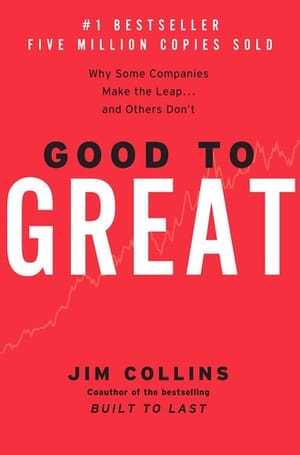
Wells Fargo appears in Jim Collins's Good to Great as one of the eleven companies that made a sustained, dramatic leap from good performance to great performance and held it for at least fifteen years. In Collins's research, Wells Fargo became the primary case study for Level 5 Leadership and the "Confront the Brutal Facts" principle — two of the book's most important concepts.
The Wells Fargo story that Collins tells is a story of a banking company in the 1980s that faced a brutal challenge — the deregulation of the banking industry — and responded with a discipline and clarity that most of its peers could not match. While other banks were denying the implications of deregulation or scrambling for short-term fixes, Wells Fargo acknowledged the situation directly, made hard decisions early, and built a culture capable of sustained long-term outperformance.
For founders, the Wells Fargo case study in Good to Great is most useful as an illustration of what it looks like to lead an organization through uncertainty without flinching from the facts of the situation. The lessons Collins draws are not banking-specific; they apply to any organization that faces a fundamental change in its competitive environment.
Wells Fargo & Company was founded in 1852 in San Francisco during the California Gold Rush by Henry Wells and William Fargo — the same men who had founded the American Express Company two years earlier. The company's original business was banking and express delivery services for the newly settled West, and the iconic image of the Wells Fargo stagecoach dates from this period.
Wells Fargo went through several periods of contraction and expansion over its first century, including a significant reorganization after the 1906 San Francisco earthquake. By the mid-twentieth century, it had become a significant regional bank concentrated in California. Its transformation into a nationally important financial institution began in earnest in the 1960s and 1970s under a series of leaders who restructured its operations and expanded its commercial banking footprint.
The critical leadership transition that Collins identifies happened in the 1970s and 1980s under Dick Cooley and then Carl Reichardt. Cooley brought in a remarkable group of leaders — people who, Collins notes, would have been recruited by any bank in the country — and built the management depth that enabled the company's sustained outperformance. Reichardt, who became CEO in 1983, continued and deepened this approach: rigorous cost discipline, relentless focus on core banking economics, and an unwillingness to chase growth for its own sake.
From 1983 to 1998, Wells Fargo generated cumulative stock returns approximately three times better than the general market. During this period, the California banking market faced enormous challenges: the savings-and-loan crisis of the late 1980s, the California real estate bust of the early 1990s, and intense competition from larger money-center banks. Wells Fargo navigated all of these while many competitors either failed or struggled badly.
The 1998 merger with Norwest Corporation — a Minnesota-based financial services company — significantly expanded Wells Fargo's national footprint. The 2008 acquisition of Wachovia during the financial crisis made Wells Fargo one of the four largest banks in the United States.
The 2016 fake accounts scandal, in which Wells Fargo employees were found to have opened millions of unauthorized customer accounts to meet aggressive sales targets, represented a serious breakdown of the culture and values Collins had identified as Wells Fargo's defining characteristics. The scandal resulted in significant regulatory penalties, the resignation of CEO John Stumpf, and ongoing reputational damage. It also prompted legitimate questions about whether the culture Collins identified in the 1980s and 1990s had been maintained through the company's subsequent growth.
Collins uses Wells Fargo to illustrate three of Good to Great's central concepts: Level 5 Leadership, Confronting the Brutal Facts, and the First Who, Then What principle.
Level 5 Leadership. Carl Reichardt is Collins's primary example of a Level 5 Leader — an executive who combined fierce professional will with personal humility. Reichardt was famous for his cost discipline: he famously kept the corporate offices unfurnished for years, refusing to spend money on decorations that served no operational purpose. He was equally famous for his willingness to make hard decisions early, before they were forced on him by circumstances. But Collins's research found that Reichardt consistently attributed the company's success to the quality of the people around him rather than to his own brilliance. He was demanding about results and modest about credit — the core definition of Level 5.
Collins also emphasizes Reichardt's predecessor, Dick Cooley, who spent years before the company's transition period building the management depth that enabled the transition. Cooley's approach to talent — bring in the best people available, even if you don't have a specific role for them, because excellent people will create value — is Collins's primary illustration of the First Who, Then What principle in the context of Wells Fargo.
Confronting the Brutal Facts. The banking deregulation of the 1980s was, Collins argues, a clear existential threat to the business model of California banks. Interest rate ceilings were being lifted, geographic restrictions were being relaxed, and banks would soon face competition from financial services companies that operated under different regulatory frameworks. Many banks responded to this threat by denying it, minimizing it, or deferring the hard decisions it implied.
Wells Fargo, under Reichardt, did the opposite. The company acknowledged directly that deregulation would compress margins, that competition would intensify, and that only banks with genuine operational discipline and cost efficiency would thrive in the new environment. From this acknowledgment came a set of decisions that were painful in the short term but positioned the company for sustained long-term performance: aggressive cost cutting, organizational restructuring, and a focus on fundamentals that did not deviate under competitive pressure.
Collins draws the contrast with BankAmerica, which was Wells Fargo's matched comparison company in the Good to Great research — a California bank with similar resources and opportunities that did not make the leap. BankAmerica, by Collins's account, responded to deregulation with a series of acquisitions, reorganizations, and strategic initiatives that created short-term activity without addressing the fundamental economics of the business. It eventually merged with NationsBank in 1998, ending its independent existence.
The Hedgehog Concept. Collins identifies Wells Fargo's economic engine denominator as "profit per employee" — the single metric that best captured the company's financial performance. The Hedgehog Concept for Wells Fargo was running a highly efficient banking operation: minimizing cost per transaction, maximizing revenue per employee, and doing the basic work of banking with a discipline and precision that most competitors could not match.
Brutal honesty about your competitive environment is a leadership responsibility. Reichardt's response to banking deregulation was not unique in recognizing the threat — most banking executives understood that deregulation would change the industry. What distinguished him was his willingness to act on that recognition before events forced his hand. Most leaders acknowledge threats but delay the hard decisions those threats imply, hoping the situation will improve on its own. The Wells Fargo case study suggests that acting early, before you are forced to, is one of the most valuable things a leader can do.
Build management depth before you need it. Dick Cooley's talent strategy — bring in excellent people even without a specific role for them — is counterintuitive by conventional management standards, which recommend hiring only for defined needs. Collins's argument is that in organizations where the quality of decision-making at every level determines performance, the option value of having excellent people available is very high. The cost of hiring someone excellent for a role you do not yet fully understand is much lower than the cost of needing excellent leadership in a crisis and not having it.
Cost discipline is a culture, not a program. Reichardt's refusal to spend money on anything that did not directly improve the business was not a cost-cutting initiative; it was a statement about values that permeated every decision in the organization. Cost discipline applied as a cultural principle — from the CEO's unfurnished office to the standards applied to every expense — produces results that cost-cutting programs cannot, because cultural principles are self-reinforcing in a way that programs are not.
The 2016 scandal as a counter-lesson. The Wells Fargo fake accounts scandal is a sobering reminder that the culture Collins identified was not permanent. Organizations can build excellent cultures and then allow them to erode under competitive pressure, growth, and changing incentive structures. For founders, the lesson is not that Collins was wrong about Wells Fargo in the 1980s and 1990s — the evidence for the culture he describes is well-documented — but that culture requires active maintenance. The conditions that created the culture in the first place need to be continuously reinforced, not taken for granted.