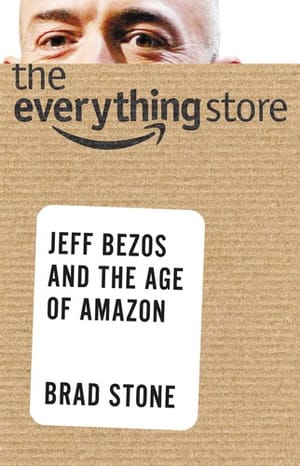
Brad Stone is a technology journalist, author, and senior executive editor at Bloomberg who has spent over two decades covering Amazon and Silicon Valley. He is best known for The Everything Store: Jeff Bezos and the Age of Amazon (2013), which won the Financial Times and Goldman Sachs Business Book of the Year Award and has sold over 1.5 million copies worldwide, making it one of the best-selling business biographies of the past two decades. He has written two subsequent books on major Silicon Valley companies — The Upstarts (2017) and Amazon Unbound (2021) — cementing his reputation as one of the most thorough and accessible chroniclers of the modern technology industry.
Stone's approach to technology journalism is defined by depth and duration. Where many technology reporters move from story to story in the daily news cycle, Stone has returned to the same companies — Amazon especially — over a span of decades, building the kind of deep knowledge of specific institutions that produces the best business journalism. His reporting on Amazon is the most comprehensive available from a journalist who is not an Amazon employee, drawing on hundreds of sources developed over twenty years of coverage.
He is distinguished from many technology journalists by his willingness to report on topics that technology companies actively work to suppress: the internal conflicts at Amazon, the aggressive supplier relationships, the management culture, the human costs of the company's performance standards. The Everything Store was controversial in Amazon's orbit precisely because it reported these things honestly rather than relying on official company narratives.
Stone began his journalism career in the mid-1990s, joining Newsweek as a technology reporter. The timing was significant: the mid-1990s were the first years of the commercial internet, and the explosion of new companies, new business models, and new technologies that characterized the period made technology journalism one of the most important beats in business news.
At Newsweek, Stone covered the early growth of companies including Amazon, which was founded in 1994 — the same period Stone was building his career. His early reporting on Amazon, from a period when the company was still a startup and Bezos was accessible and eager for press coverage, gave him a foundational understanding of the company's culture and strategy that informed his later reporting. He interviewed Bezos multiple times during this early period, building a professional relationship that would eventually evolve into the extensive access that made The Everything Store possible.
He covered the dot-com boom and bust, the emergence of broadband internet, the growth of search (Google went public in 2004), and the beginning of the social media era. This experience gave him a panoramic view of the technology industry across its most transformative decade — the context necessary to understand Amazon's specific story within the broader arc of the internet's development.
Stone joined Bloomberg Businessweek as a senior writer, where he spent the most productive period of his journalism career. Bloomberg Businessweek under editors like Josh Tyrangiel had developed a reputation for high-quality long-form journalism that combined narrative craft with original reporting, and Stone's work fit that profile: careful research, detailed narrative, and a willingness to challenge official company narratives when his reporting led him there.
His Amazon coverage at Bloomberg Businessweek was particularly notable. He wrote multiple cover stories about the company, investigating its warehouse working conditions, its relationships with third-party sellers, its expansion into new product categories, and the specific management practices that defined its culture. This sustained coverage, accumulated over years, gave him a depth of knowledge about Amazon that no other journalist had at the time he began writing The Everything Store.
He also covered Apple, Google, Facebook, Twitter, and the broader startup ecosystem. His coverage of the gig economy companies — Uber, Airbnb, Lyft, and others — provided the foundation for The Upstarts (2017), his second book.
The research for The Everything Store took approximately three years. Stone's stated approach was to build a comprehensive picture of Amazon from multiple angles: interviewing Bezos directly, interviewing dozens of current and former employees and executives, speaking with Amazon's suppliers and partners, and reviewing the documentary record of Amazon's history — court filings, SEC disclosures, press releases, and the extensive archive of Stone's own previous reporting.
He interviewed Bezos and his wife MacKenzie, who had worked at Amazon in its early years and was herself a Princeton-educated novelist with strong views about how the company's story should be told. He interviewed Amazon's first employees, its early investors, the publishers who negotiated with Amazon over ebook pricing, and the suppliers who experienced Amazon's market power from the receiving end.
The combination of access and independence that Stone achieved is one of the book's defining characteristics. He had enough access to understand Bezos's own perspective on key decisions; he also had enough independent sources — including people who had been harmed or alienated by Amazon — to challenge Bezos's perspective where his reporting led him to different conclusions. This balance is what produced a book that was both richly detailed and genuinely critical in places, rather than the official-narrative corporate biography that many major founders prefer to commission.
One of the more unusual episodes in the history of technology biography is MacKenzie Bezos's Amazon.com review of The Everything Store. Shortly after the book's publication, she posted a one-star review on Amazon's own website, challenging specific factual claims in the book and arguing that Stone had not given her or Bezos sufficient opportunity to correct errors before publication.
Stone responded publicly that he had given Bezos ample opportunity to review and respond to claims in the book, and that while he had made minor corrections where factual errors were identified, the core reporting stood. The public exchange between Stone and Bezos's wife was unusual — it was, in effect, a public argument about journalistic methodology conducted on the platform that the book was about.
The episode illustrated the specific challenges of unauthorized biography of living subjects who have strong interests in controlling their own narratives. Stone had documented things about Amazon's management culture and Bezos's personal behavior that Amazon's principals found unflattering, and the review was a way of publicly registering their objections without having to engage with the specific reporting claims directly.
The methodology Stone developed for The Everything Store reflects his view that the best business journalism is biographical at its core — that to understand a company, you need to understand the person who built it, and that understanding a person requires the same kind of sustained, multi-source reporting that investigative journalism applies to institutions.
He conducted extensive interviews with Bezos himself, which gave him direct access to Bezos's own account of key decisions and his reasoning at critical moments. But he treated those interviews as one source among many rather than as authoritative — the same way a good journalist treats any source's account of their own behavior.
The human sources he found most valuable were the former employees who had left Amazon under various circumstances — people who had been significant enough to observe Bezos directly and to understand the company's culture from the inside, but who were no longer bound by the employment relationship that constrains current employees' willingness to speak candidly. These sources gave Stone the accounts of Amazon's internal culture — the management style, the performance standards, the frugality practices, the supplier relationships — that make the book more than a collection of official narratives.
He also spent considerable time understanding the technical and operational dimensions of Amazon's business: how the fulfillment centers work, what the logistics network looks like from the inside, how AWS was actually built and marketed, what the Kindle development process involved. This technical depth is visible throughout the book and is part of what makes it a more reliable account than many business biographies, which often gloss over the specifics of how products and operations actually work.
Stone's philosophical approach to technology biography is rooted in a conviction that the most important thing a business journalist can do is maintain independence from the subjects they cover — not hostility, but independence. He has described his methodology as trying to understand companies the way a historian would: from multiple sources, with skepticism toward any single source's account, and with attention to the gap between how companies describe themselves publicly and how they actually operate.
This approach produces journalism that major technology companies often find uncomfortable, and Stone has had strained relationships with Amazon, Uber, and others over his coverage. He views this discomfort as a sign that the reporting is doing its job — that a business journalist who has no subjects uncomfortable with his coverage is probably not reporting independently enough.
He is also interested in the long-arc view of companies and industries — the understanding that the most important dynamics in technology often become visible only over periods of five to ten years or more. His sustained coverage of Amazon over two decades gave him a perspective on the company's evolution that shorter-term reporting cannot produce, and his willingness to return to the same subjects across multiple books reflects a belief that the most valuable journalism comes from deep, sustained engagement rather than the daily-news cycle.
In interviews and public appearances, Stone has described several things that surprised him about Amazon. The scale of Bezos's ambition from the very beginning — the explicit goal of building not just a bookstore but the "everything store," the explicit articulation of long-term customer obsession as the organizing principle — was more clearly articulated in the company's earliest documents than he expected to find.
He was also struck by the degree to which Amazon's management culture is genuinely unusual rather than merely presenting itself as unusual. The six-page memo practice, the working backwards process, the bar-raiser hiring methodology — these are not marketing language. They are actual practices that Amazon employees follow and that shape decisions in ways that are different from how most companies make decisions.
And he was struck by the genuine costs of the culture — the high attrition, the emotional toll on employees, the specific ways that Amazon's performance standards were experienced by people who were not thriving in the environment. He has described coming away from the research with a more complicated view of Amazon's accomplishments than he started with: impressed by what the company has achieved, but more attentive to the costs than the official narrative acknowledges.
The Everything Store: Jeff Bezos and the Age of Amazon (2013) — The definitive account of Amazon's founding and first two decades. Winner of the Financial Times and Goldman Sachs Business Book of the Year Award. Has sold over 1.5 million copies and is consistently cited as one of the essential texts in startup and management literature.
The Upstarts: How Uber, Airbnb, and the Killer Companies of the New Silicon Valley Are Changing the World (2017) — Applies the same investigative biography approach to Uber and Airbnb, the two companies that most dramatically illustrated the dynamics of the "gig economy" and the platform business model. Published during a period of intense scrutiny of both companies' cultures, the book provides the most comprehensive account available of how they were founded and how their cultures developed.
Amazon Unbound: Jeff Bezos and the Invention of a Global Empire (2021) — A sequel of sorts to The Everything Store, covering Amazon's transformation from 2013 to 2021: the growth of AWS into the most profitable major cloud platform, the acquisition of Whole Foods, the development of Alexa, the expansion into entertainment, and Bezos's eventual departure as CEO. More critical in tone than the first book, reflecting both the changes in Amazon's trajectory and Stone's more complete understanding of the company's impact on the industries it has disrupted.
Stone is a regular presence on technology and business podcasts, and his appearances provide among the most detailed public discussions of Amazon's strategy and culture available outside his books.
He has appeared multiple times on Kara Swisher's On with Kara Swisher and its predecessor Recode Decode, where his discussions of Amazon's competitive strategy, its relationship with regulators, and the evolution of Bezos's management philosophy have generated significant listener engagement. His conversation with Swisher following the publication of Amazon Unbound is particularly valuable for its discussion of how Amazon changed between the two books and what Bezos's legacy looks like in retrospect.
He has been interviewed by Terry Gross on NPR's Fresh Air for both The Everything Store and Amazon Unbound, with these conversations providing accessible entry points to the books for general audiences. He has also appeared on the Bloomberg Businessweek podcast, where his discussions of Amazon's expanding influence across industries — from retail to cloud computing to entertainment to healthcare — reflect his perspective as someone who has covered the company for over two decades.
For readers specifically interested in the journalism methodology behind the books, his conversations with the Columbia Journalism Review and with business school faculty who teach the books as case studies provide the most detailed discussions of how he approached the research and what the key reporting challenges were.
Current role: Senior Executive Editor at Bloomberg News
Previous roles:
"Amazon was not built by being nice. It was built by being relentlessly right about customers."