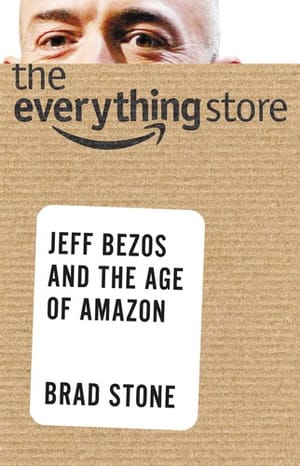
Amazon is the most widely studied company in startup and management literature, and it is studied from more angles than any other company in the startup canon. It appears as a case study in disruptive innovation, platform strategy, long-term thinking, organizational management, self-disruption, cloud computing, and the ethics of market power. No other company simultaneously provides lessons across so many dimensions of company building and management.
The primary text is Brad Stone's The Everything Store: Jeff Bezos and the Age of Amazon (2013), which covers the founding and first two decades. Stone's sequel, Amazon Unbound (2021), covers the following decade. But Amazon is also extensively documented in Bezos's own annual shareholder letters — available free online — which represent one of the most valuable first-person records of company building across decades available anywhere in business literature.
Amazon appears in Clayton Christensen's The Innovator's Dilemma framework (as both disruptor and, in the AWS case, disrupted-and-rebuilt company), in Porter's competitive strategy framework (as a case of cost leadership and platform strategy simultaneously), and in discussions of platform economics that address the specific dynamics of two-sided markets and the power they confer.
What makes Amazon uniquely valuable as a case study is the duration of its documented history and the consistency of its principles across that history. The principles Bezos articulated in Amazon's first shareholder letter in 1997 — customer obsession, long-term thinking, frugality, willingness to be misunderstood — are the same principles that drove Amazon's decisions in 2010, 2015, and 2020. This consistency across scale and time is rare in business history and is itself one of the most important things Amazon teaches.
Amazon was founded in July 1994 by Jeff Bezos in his garage in Bellevue, Washington. The company's first product was books — chosen for specific reasons: books were information products with near-infinite SKU count (over three million titles in print at any time), standard sizes and simple shipping requirements, and a fragmented retail market served by distributors who would drop-ship to customers, allowing Amazon to offer selection no physical store could match without holding large inventory.
Amazon.com launched publicly in July 1995. The early years were characterized by very rapid growth and very little profitability — Bezos's explicit strategy was to invest every dollar of revenue in infrastructure (technology, fulfillment centers, catalog expansion) rather than showing earnings, on the theory that building the infrastructure now would produce defensible competitive advantages that would be impossible to replicate later.
The company went public in May 1997 at $18 per share, raising $54 million. The IPO valuation was modest compared to what the company would eventually be worth — Amazon's market cap in 2024 exceeded $2 trillion. The 1997 shareholder letter that accompanied the IPO is the foundational document of Amazon's management philosophy and is still reprinted in every subsequent annual report.
The dot-com crash of 2000-2001 hit Amazon severely. The company's stock lost over 90% of its value. Analysts and journalists widely predicted that Amazon would go bankrupt, that its business model was unsustainable, and that the combination of thin margins and enormous capital investment would eventually destroy it. Amazon survived by aggressively cutting costs while maintaining its core infrastructure investments. The experience reinforced Bezos's conviction that short-term market sentiment and long-term customer value were different things, and that prioritizing the latter through periods of short-term pain was the only sustainable strategy.
The subsequent decade — 2001 to 2010 — was the period of Amazon's deepest infrastructure investment. The fulfillment center network expanded dramatically. Prime launched in 2005, offering free two-day shipping for an annual subscription fee. AWS launched in 2006. The Kindle launched in 2007. Each of these investments looked expensive relative to current profitability and each proved to be the foundation of significant future competitive advantage.
Brad Stone's The Everything Store covers Amazon's founding through the early 2010s and provides the most detailed available account of how the company's culture and strategy were developed.
The garage origins and the founding vision. Stone's account of the founding is particularly valuable for its documentation of Bezos's thinking before Amazon existed — the specific analysis of the internet's growth rate, the specific criteria for product selection, and the specific vision of what the "everything store" would eventually become. Bezos was not building a bookstore that hoped to become a retailer; he was building the infrastructure for universal commerce from the beginning, using books as the beachhead product.
Customer obsession in practice. The book documents specific decisions that illustrate customer obsession in action — the willingness to allow negative customer reviews (which some book publishers pressured Amazon to remove), the decision to build Prime even when the unit economics of free shipping were clearly negative, and the Kindle development project that deliberately cannibalized Amazon's most profitable product category. Each of these decisions reflected the same principle: optimize for the customer even when the immediate business impact is negative.
The dot-com crash survival. Stone's account of Amazon's survival of the dot-com crash is one of the most valuable sections for founders, because it documents the specific decisions that kept Amazon alive when most of its peer companies were dying. The combination of aggressive cost-cutting, maintenance of core infrastructure investment, and refusal to change the long-term strategy in response to short-term market pressure is the pattern that distinguishes the companies that survived the crash from those that didn't.
AWS invention. Stone's account of AWS's development — from the internal infrastructure problem that motivated it to the decision to sell the service externally — is the most complete available narrative of how one of the most significant product launches in technology history came to be. The key insight is that AWS was not a planned product strategy; it was an internal problem that happened to have external application. The willingness to recognize that internal solution and commercialize it — to turn a cost center into a profit center — is the kind of strategic opportunism that is difficult to plan for but important to execute when the opportunity presents itself.
The Kindle. Stone's account of the Kindle's development documents one of the cleanest cases of self-disruption in startup history. Bezos recognized that digital would happen to books regardless of what Amazon did, and that the only question was whether Amazon would be the agent of disruption or its victim. The decision to build the Kindle — to destroy Amazon's physical book business before digital competitors could do it — required acceptance of a significant near-term revenue loss in exchange for long-term platform control. The Kindle's success, and Amazon's subsequent dominance of the ebook market, validated the decision.
Amazon's Leadership Principles — a public document listing the sixteen principles that Amazon uses to evaluate hiring, promotions, and business decisions — have become one of the most studied management frameworks in startup culture. Several are particularly relevant to understanding how Amazon operates.
Customer obsession. "Leaders start with the customer and work backwards. They work vigorously to earn and keep customer trust." This is the foundational principle from which the others derive. Everything else in Amazon's management culture is in service of this principle.
Ownership. "Leaders act on behalf of the entire company, beyond just their own team. They never say 'that's not my job.'" The ownership principle is what produces Amazon's distinctive combination of small-team agility and large-company scope — everyone is expected to act as if the whole company is their responsibility.
Invent and simplify. "Leaders expect and require innovation and invention from their teams and always find ways to simplify." The "simplify" half of this principle is as important as the "invent" half — the commitment to reducing complexity is the organizational discipline that prevents bureaucratic calcification.
Think big. "Thinking small is a self-fulfilling prophecy. Leaders create and communicate a bold direction that inspires results." The explicit commitment to ambition — to setting goals that require genuine innovation rather than incremental improvement — is part of what has kept Amazon oriented toward large opportunities rather than optimizing its existing businesses.
Bias for action. "Speed matters in business. Many decisions and actions are reversible and do not need extensive study. We value calculated risk taking." This principle is the counterweight to the careful analysis that the six-page memo process encourages — the recognition that over-analysis and process can be as damaging to business outcomes as under-analysis.
Amazon's history offers several lessons that are particularly valuable for founders building businesses in competitive markets.
Choose your beachhead product for infrastructure reasons, not sentimental ones. Bezos chose books not because he loved books but because books were the product that best fit the capabilities he was building: centralized warehousing, broad selection, and direct-to-customer shipping. The specific product was a means to the end of building infrastructure. Founders who choose their beachhead product based on emotional attachment or market size alone, without thinking about what it teaches them and what infrastructure it requires them to build, often find that their first product doesn't give them the platform they need for the second.
Frugality and long-term investment are not contradictory. Amazon's culture of frugality — door desks, no executive perks, relentless cost management — coexisted with enormous multi-decade investments in fulfillment infrastructure, AWS, Prime, and the Kindle. The frugality was specifically applied to spending that didn't benefit customers; the investment was specifically directed toward building capabilities that would benefit customers for years or decades. The distinction is important: not all spending is created equal, and the discipline to cut spending that doesn't matter in order to invest in spending that does is one of the most valuable capabilities a company can build.
The most valuable assets are invisible on the balance sheet. Amazon's competitive advantages — the customer trust built by decades of reliable delivery and easy returns, the Prime membership relationships, the AWS customer relationships, the Kindle reading ecosystem — are not represented on the balance sheet as assets. They are the product of years of customer-obsessive investment that did not generate immediate financial returns. Founders who manage their companies based only on financial metrics visible on the balance sheet systematically underinvest in these invisible assets.