Who Is Jeff Bezos?
Jeff Bezos is the founder of Amazon, the company that transformed how people shop, how businesses deploy software, and how digital media is consumed. He built Amazon from a garage startup selling books in 1994 to the world's largest retailer and, through Amazon Web Services, the most profitable cloud computing platform in history. He served as Amazon's CEO for 27 years before stepping down in 2021, making him one of the longest-serving CEOs of a major technology company in history. Along the way, his annual letters to shareholders became some of the most widely read documents in business culture — a record of one of the most disciplined and consistent applications of long-term thinking in the history of public company management.
Bezos was born in 1964 in Albuquerque, New Mexico, and grew up partly in Texas. He studied electrical engineering and computer science at Princeton, graduating with honors, and joined the investment banking industry before moving to the quantitative trading firm D.E. Shaw, where he became one of the youngest senior vice presidents in the firm's history. He left D.E. Shaw in 1994 to found Amazon, using what he has described as the "regret minimization framework" — asking himself which choice he would regret more at age 80 — to justify leaving a highly lucrative career for a venture that almost everyone around him told him would fail.
Bezos's management philosophy, his intellectual frameworks, and his specific practices — the six-page memo, the working backwards process, the bar-raiser hiring standard, the Day One mentality — have been adopted by startups and large companies worldwide and are among the most studied management approaches in contemporary business education.
Amazon in Startup Literature
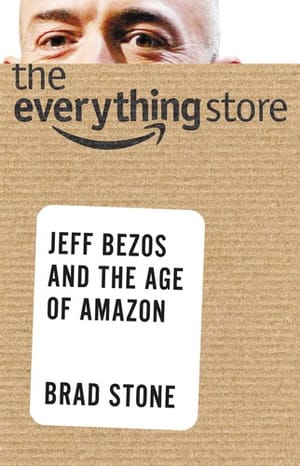
Amazon appears throughout startup literature, but the primary text is Brad Stone's The Everything Store: Jeff Bezos and the Age of Amazon (2013), which covers the company from its founding through the early 2010s. Stone's biography is supplemented by Bezos's own shareholder letters — published annually from 1997 to 2020 — which are available free on Amazon's investor relations site and constitute one of the most valuable first-person records of long-term company building available anywhere.
Amazon is also cited extensively in discussions of disruptive innovation (Clayton Christensen), platform strategy, the economics of two-sided markets, and the implications of extreme customer focus for competitive strategy. Its AWS division is the case study for cloud computing in virtually every business school course on digital transformation, and the Kindle's development is the standard reference for self-disruption strategy.
Bezos's own writing — the shareholder letters, the various speeches and interviews he has given — represents a significant body of material that is studied independently of the Stone biography. His 1997 letter to shareholders, published in the first year Amazon was public, articulated a set of principles about long-term thinking and customer obsession that Amazon has referred back to in every subsequent letter. The consistency between the principles stated in 1997 and Amazon's actual decisions over the following twenty-five years is one of the most striking examples in business history of a founder saying what they intend to do and then doing it.
Key Leadership Principles
Customer obsession. Bezos's definition of customer obsession is specific: the commitment to make every decision by asking what is best for the customer, not what is best for the business in the short term, on the assumption that what is best for the customer is ultimately what is best for the business over the long term. This principle drove decisions that made Amazon look irrational to short-term investors — accepting years of near-zero margins while building Prime, investing in AWS when it seemed like a distraction from retail, building the Kindle even though it cannibalized Amazon's book revenue. Each of these decisions was customer-obsessive in Bezos's framework, and each was correct.
Day One mentality. Bezos has a building in Amazon's Seattle campus named "Day 1," and the concept it represents is central to how he thinks about company management. Day One is the state of a startup: urgency, customer focus, willingness to experiment and fail quickly, avoidance of bureaucratic process. Day Two is the state of a large organization that has become defensive: process for its own sake, customer research that tells you what customers want rather than what they need, inability to make fast decisions. Bezos's obsession with avoiding Day Two — with maintaining the urgency and customer focus of a startup even as Amazon grew to hundreds of thousands of employees — is one of the defining characteristics of his management tenure.
Regret minimization framework. The decision framework Bezos used to leave D.E. Shaw has become one of the most widely adopted mental models for major life and career decisions in startup culture. The logic: when facing a difficult decision, project yourself to age 80 and ask which choice you would regret more. This framework biases toward action and against the paralysis of risk aversion — the recognition that inaction has costs just as action does, and that the regret of not having tried something important is often more painful than the regret of having tried and failed.
The six-page narrative memo. Bezos replaced PowerPoint presentations with six-page narrative memos as the standard format for business proposals at Amazon. The practice forces clarity of thinking: you cannot write a six-page memo about an idea you don't actually understand. It also creates a written record of decisions and the reasoning behind them, which is valuable for organizational learning. The "working backwards" variant of this — writing the press release announcing the successful outcome before building anything — forces clarity about what success looks like before resources are committed.
Two-pizza teams. Bezos's rule that teams should be small enough to be fed by two pizzas is a proxy for organizational structure: small teams are more agile, more accountable, and less prone to the coordination overhead and political dynamics that grow with team size. When a team gets large enough that two pizzas won't feed them, Bezos's prescription is to split the team rather than manage it more carefully. The rule reflects a genuine belief that organizational complexity is one of the primary enemies of effective execution.
Lessons for Founders
Jeff Bezos's career offers several lessons for founders that are particularly valuable precisely because they are demonstrated over decades rather than articulated as theory.
Long-term thinking is a genuine competitive advantage, not a slogan. Amazon operated at near-zero margins for years while building the infrastructure — logistics network, Prime membership, AWS, Kindle ecosystem — that eventually produced some of the highest profit margins in the industry. This was not strategic patience in the abstract; it was a specific calculation that investing in customer value now would produce defensible market position later. The discipline to maintain this orientation through twenty-plus years of analyst skepticism, investor pressure, and competitive challenges is one of the rarest capabilities in business.
Building the management operating system is as important as building the product. The specific practices Bezos installed at Amazon — the six-page memo, the working backwards process, the bar-raiser hiring standard, the Day One framework — are part of what allowed the company to maintain its culture and decision-making quality as it grew from a garage startup to a company with over a million employees. Founders who build only the product and neglect the organizational operating system find that the culture and decision-making quality they want do not survive scale.
Self-disruption is the only reliable defense against disruption. Amazon's decision to build the Kindle — cannibalizing its own book business before digital competitors could do it — is one of the cleanest examples in startup literature of a company choosing to disrupt itself rather than waiting to be disrupted. This requires a specific kind of intellectual honesty: the willingness to acknowledge that your current business model is vulnerable to a technology shift and to invest in that shift even though doing so destroys short-term value. Most established companies cannot make this decision because the organizational incentives run in the opposite direction.
Career
Current: Executive Chairman of Amazon; Founder of Blue Origin
- CEO of Amazon (1994–2021)
- VP at D.E. Shaw (investment firm, 1990–1994)
Related Companies
Amazon
Key Themes
- Customer obsession
- Long-term thinking
- Frugality
- Two-pizza teams
- Day one mentality
Famous Quotes
"Your margin is my opportunity."
"We are stubborn on vision. We are flexible on details."
"Obsess over customers, not competitors."
Further Reading