Steve Jobs is the most studied founder in the history of technology entrepreneurship. Not because he was the most successful by revenue, or the most admired by employees, or even the most visionary in terms of predicting the future — but because he represents something rare and almost mythological: a founder who got thrown out of his own company, rebuilt himself in the wilderness, and returned to create something far more transformative than he had managed the first time.
For startup founders, Jobs is not a comfortable figure to study. He was often cruel, frequently dishonest, and notoriously difficult to work for. But the results he produced — and the philosophies he developed to get there — remain the most discussed in entrepreneurship circles. The Macintosh. The iMac. The iPod. The iPhone. These are not just product launches; they are case studies in how design, distribution, and narrative combine to make a category-defining company.
If you want to understand how a founder can build something that reshapes entire industries, you study Steve Jobs. If you want to understand what that kind of intensity costs — personally and organizationally — you study him even more carefully.
Steve Jobs and Steve Wozniak founded Apple Computer on April 1, 1976. Jobs was 21. Wozniak, the technical genius of the pair, had built a personal computer from scratch. Jobs recognized the commercial opportunity and turned it into a product and a business.
The Apple I sold a few hundred units. The Apple II, launched in 1977, sold millions and made Apple one of the fastest-growing companies in American history. By the time Apple went public in December 1980, Jobs was worth over $200 million on paper — one of the largest IPOs in US history at the time.
The early years at Apple established Jobs's operating style: relentless focus on the product experience, deliberate aesthetic choices at every level, and an aggressive belief that the people building the product should be the best in the world. He famously described the Macintosh team as "pirates" — people willing to break conventional thinking to do something great.
The Apple Lisa, launched in 1983, was a commercial failure. Priced at nearly $10,000 (over $30,000 in today's dollars), it was the first personal computer with a graphical user interface and a mouse — but it was too expensive, too slow, and the market wasn't ready.
The Macintosh, launched on January 22, 1984 with the now-legendary Super Bowl commercial, was Jobs's corrective. Smaller, cheaper, and accompanied by a genuine narrative about changing the world, it was a genuine breakthrough in human-computer interaction. But sales slowed after the initial surge, and tension between Jobs and CEO John Sculley — whom Jobs had personally recruited from Pepsi — came to a head.
In 1985, the Apple board sided with Sculley and removed Jobs from operational control. Jobs resigned from Apple in September 1985. He was 30 years old and had just been fired from the company he had founded.
The years between Apple firings are where Jobs's story becomes genuinely instructive for founders. He didn't retreat. He founded two companies: NeXT Computer (building high-end workstations for universities and businesses) and acquired a small computer graphics division from Lucasfilm for $10 million, which he turned into Pixar Animation Studios.
NeXT the hardware company was a commercial failure. The machines were expensive, the software was technically brilliant, and the market never materialized. But the NeXT operating system — NEXTSTEP — was not a failure. It became the technological foundation for what would eventually become macOS and iOS. Every iPhone runs software with architectural roots in what Jobs built at NeXT.
Pixar was a different story. Under Jobs's ownership and with John Lasseter and Ed Catmull as creative and technical leaders, Pixar produced Toy Story (1995), the first fully computer-animated feature film. The film was a cultural and commercial phenomenon. Pixar's IPO in 1995 made Jobs a billionaire — before he ever returned to Apple.
Apple acquired NeXT in December 1996 for $429 million, primarily for the NEXTSTEP operating system. Jobs returned as an advisor, then as interim CEO in September 1997.
What followed is without parallel in the history of technology business. Jobs found a company burning through cash, drowning in product lines, and losing the narrative war to Microsoft. He cut the product line from dozens of models to four, built the iMac (1998) — a computer that made design fashionable — and began rebuilding Apple's brand.
Then, in rapid sequence: the iPod (2001), iTunes (2003), the iPhone (2007), the App Store (2008), the iPad (2010). Each was not merely a new product but a new platform — an ecosystem that locked in users, created network effects, and generated recurring revenue. Apple's market cap grew from under $2 billion when Jobs returned to over $350 billion at his death in October 2011.
At the time of his death, Jobs's estate was valued at approximately $10.2 billion. The largest component was not Apple stock — it was Disney stock. When Disney acquired Pixar in 2006 for $7.4 billion, Jobs received approximately 138 million Disney shares, making him Disney's largest individual shareholder.
His Apple stake, though iconic in the public imagination, was relatively modest: he held approximately 5.5 million Apple shares at death, worth roughly $2.1 billion at the time. He had famously sold most of his Apple equity after returning, keeping only a token 1 share (later increased as equity compensation).
The Reality Distortion Field. The phrase was coined by Bud Tribble, an early Apple engineer, borrowing from Star Trek. It described Jobs's ability to convince people — employees, partners, press, and customers — that whatever he wanted to happen was not only possible but inevitable. This was partly charisma, partly intellectual domination, partly his genuine conviction that most limitations were artificial. For founders, the lesson is double-edged: the ability to project certainty in the face of uncertainty is genuinely valuable; the refusal to accept real constraints is genuinely dangerous.
Design as function, not decoration. Jobs's design philosophy, developed in partnership with Jony Ive, was rooted in the work of Dieter Rams and the Bauhaus tradition. Good design, to Jobs, meant that every unnecessary element had been removed and every remaining element served a purpose. "Design is not just what it looks like and feels like," he said. "Design is how it works." For startup founders building products, this remains one of the most actionable ideas in the canon.
A players only. Jobs believed — and said explicitly — that B players hire C players (to avoid being threatened), while A players hire other A players. His obsessive involvement in hiring decisions, especially early in the Macintosh project, was based on a conviction that the quality of the first 50 employees determines the quality of the next 500. This is now a cliché in startup culture because it is largely true.
The intersection of liberal arts and technology. Jobs frequently returned to the idea that Apple stood "at the intersection of the humanities and the sciences." He had studied calligraphy at Reed College (after dropping out), and he traced the elegance of Macintosh fonts directly to that experience. His interest in Bob Dylan, in Zen Buddhism, in Edwin Land's Polaroid — these were not affectations. They were inputs into a design sensibility that technical people alone could not produce.
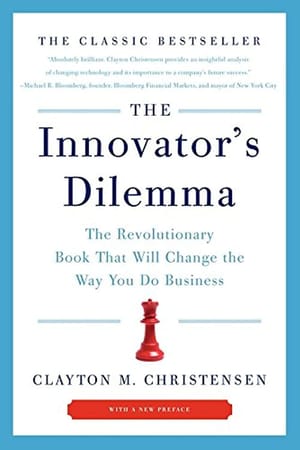
Clayton Christensen's The Innovator's Dilemma (1997) uses Apple as one of its most recurring and illuminating examples — not as a single data point, but as a company that illustrates both sides of disruptive innovation.
Christensen uses Apple to show how a company can be simultaneously a disruptor and a company that fails to respond to disruption. The original Apple II disrupted the minicomputer industry from below — it was a cheap, simple machine that incumbents like Digital Equipment Corporation dismissed as a toy for hobbyists. But as Apple grew and Jobs's design ambitions increased, Apple itself became a sustaining-technology company — building expensive, high-performance machines for premium users. The trajectory from Apple II to Lisa to Macintosh is a case study in how early disruptors get pulled upmarket by their best customers and their own success, making themselves vulnerable to the next wave from below.
Christensen also uses the Apple context to explore what happens when established companies try to respond to disruption from within. The Lisa was an attempt to bring graphical computing to market — but inside an organization optimized for a different kind of product and a different kind of customer. The tensions Jobs faced at Apple in the early 1980s are, in Christensen's framework, almost structurally inevitable: a company cannot simultaneously serve its existing customers optimally and cannibalize its own products with genuinely disruptive alternatives.
Jobs's return to Apple in 1997 and the subsequent product launches — particularly the iPod and iPhone — are interesting counterexamples. The iPod did not disrupt Apple's existing products; it created an entirely new category. The iPhone destroyed the iPod (and the standalone camera and the GPS device and eventually much else). Jobs reportedly said internally that the iPhone would cannibalize iPod sales and that they had better do it before someone else did. This is Christensen's lesson operationalized: the founders who survive disruption are the ones willing to disrupt themselves.
Peter Thiel's From 0 to 1 engages with Jobs less as a case study and more as a figure representing a particular type of founder — the one who builds a monopoly through unique vision rather than incremental competition. Thiel's framework of "secrets" — things that are true but not widely believed — applies directly to Jobs's bet that people would pay a premium for beautiful, integrated technology at a time when the entire industry was racing to commoditize hardware.
Was Jobs a good manager?
By conventional measures, no. He was known for humiliating employees publicly, taking credit for others' work, and making decisions based on aesthetic intuition that sometimes proved disastrously wrong (the Lisa, the NeXT Cube). But conventional management metrics may be the wrong frame. Jobs was exceptional at selecting people, setting a vision compelling enough to attract them, and creating organizational conditions where great work felt meaningful. The people who survived working for him tend to describe it as the most demanding and most formative experience of their careers.
What can founders learn from Steve Jobs?
The most transferable lessons are: (1) maintain taste as a competitive advantage — the discipline to eliminate rather than add; (2) control distribution as aggressively as you control the product; (3) the narrative around your product is part of the product; (4) be willing to cannibalize your own best-selling product before someone else does; (5) the quality of your first team compounds — don't compromise on it. What founders should not try to replicate is the personal cruelty, the reality distortion when applied to actual engineering constraints, or the belief that exceptional vision excuses contempt for people.
Current: Co-founder and former CEO of Apple (1976–1985, 1997–2011)
"Stay hungry, stay foolish."
"Design is not just what it looks like and feels like. Design is how it works."
"Innovation distinguishes between a leader and a follower."