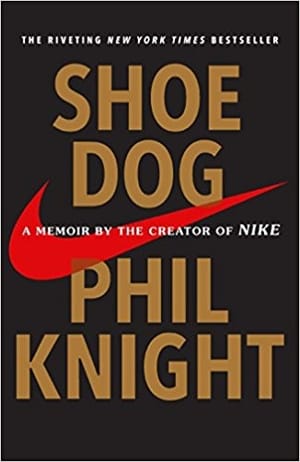
Phil Knight co-founded Nike in 1964 with a $50 loan from his father and spent the next sixteen years building it without ever being certain it would survive. The company was cash-flow negative for most of its first decade, came within days of permanent collapse at least twice, and relied on supplier credit, banking relationships, and Knight's refusal to accept defeat to make it from one season to the next. The story is documented in his 2016 memoir Shoe Dog, which is one of the most honest accounts of startup survival in the business literature.
Knight stepped down as CEO in 2004, served as chairman until 2016, and remains chairman emeritus. Nike's revenue in 2024 exceeded $51 billion. Knight's personal net worth is approximately $40 billion.
Nike appears in startup literature primarily through Shoe Dog, Knight's 2016 memoir, which has become required reading for founders who want an unvarnished account of what the early years of building a company actually look like. It has been praised by Warren Buffett, Jeff Bezos, and virtually every prominent founder who has commented on it.
The specific elements of the Nike story that startup literature most frequently cites:
The cash flow crisis as a permanent condition, not an episodic event. Knight describes, in granular detail, how Nike was structurally cash-flow negative for most of its first decade — how every dollar of growth required more capital than the company had, how the company survived year after year by managing supplier relationships and banking lines that were almost always at or over their technical limits. This is one of the most honest accounts of what growth-stage cash management actually looks like in a founder memoir.
The early team as co-founders in everything but legal designation. Jeff Johnson, Bob Woodell, and the other early Nike employees are described with a specificity and generosity that is unusual in founder memoirs. Knight's acknowledgment that Nike was built by a team, not by a founder, resonates with anyone who has built a company and knows how much of what looks like founder achievement is actually team achievement.
The product-first philosophy. Bill Bowerman's relentless product experimentation — which led to the waffle sole, the lightweight training flat, and dozens of other innovations — is the foundation of Nike's brand. Knight's account of how product quality preceded and enabled brand building is a counterweight to the marketing-led narrative that most people associate with Nike's success.
Conviction without certainty. Knight's central psychological argument is that he never knew Nike would work — he doubted constantly, feared constantly, and continued anyway because the alternative was unacceptable. This is one of the most useful descriptions of founder psychology available, because it normalizes the doubt that most founders feel but that the startup culture narrative rarely acknowledges.
The structure of Nike's founding is useful as a case study for several reasons:
The thesis was clear and specific. Knight's Stanford paper — Japanese manufacturing quality plus American marketing plus a direct distribution channel could beat Adidas in the US market — was a specific, testable business hypothesis. Not a vague aspiration but a concrete prediction about where a market opportunity existed and how to capture it. The thesis turned out to be correct, though the execution was harder and more dangerous than the thesis suggested.
The first product came before the company. Knight visited Onitsuka Tiger before Blue Ribbon Sports existed. He arranged a distribution agreement before he had capital, a team, or a business plan. The product came first; the company was built around it. This is a less common founding sequence than the typical "idea first, product second, customer third" pattern, and it has specific advantages: Knight had evidence of product quality before he had committed significant resources, and his supply relationship was established before his competitors could replicate it.
The co-founder relationship was the product of circumstance. Knight and Bowerman did not meet as business partners — they met as coach and athlete. Bowerman invested in Blue Ribbon Sports partly as a favor to Knight and partly out of genuine interest in the product. The partnership produced complementary capabilities: Knight managed the business; Bowerman managed the product. The complementarity was not planned but proved essential. For founders evaluating co-founder relationships, the Knight-Bowerman dynamic is a useful illustration of how effective partnerships look different from planned collaborations.
Manage your banking relationship proactively, not reactively. Knight's most important operational skill in Nike's early years was not business strategy or marketing — it was relationship management with his bank and his suppliers. He communicated honestly about the company's financial situation, cultivated personal relationships with the people making credit decisions, and worked to resolve problems before they became crises. Most founders avoid these conversations until they are forced to have them; Knight's approach of having them continuously, even when things were technically fine, gave him the standing to ask for help when things were genuinely difficult.
Hire people who believe before there is anything to believe in. Jeff Johnson joined Nike before it had a real product, a real brand, or a realistic path to profitability. He stayed because he believed in what they were building. Knight argues, implicitly throughout the book, that this kind of commitment — which cannot be created by compensation alone — is the difference between a founding team that survives the hard years and one that does not. Finding people who have this level of commitment requires being honest about the risks and the mission, not selling the opportunity as safer or more certain than it is.
Product quality is a precondition for brand building, not a consequence of it. Nike's brand is famous for its marketing — "Just Do It," Michael Jordan, the Swoosh. But the brand was built on a foundation of genuine product quality that preceded and enabled the marketing. The waffle sole, the lightweight training flat, the innovations that Bowerman developed in his garage — these gave Nike something real to market. For founders building consumer brands, the temptation to invest in brand before product is a path to a brand that cannot be sustained.
Survive long enough for the opportunity to appear. Nike came within days of failure at least twice. If either crisis had ended differently, Nike would not exist. Knight's ability to survive those crises — through a combination of relationship management, financing creativity, and psychological refusal to accept defeat — is what gave the company the time to grow into the opportunity that his original thesis identified. Survival is not a secondary objective in early-stage company building; it is the primary one.
Current: Chairman Emeritus of Nike
"Don't tell people how to do things, tell them what to do and let them surprise you with their results."
"Winning means being unafraid to lose."
"The cowards never started and the weak died along the way. That leaves us."