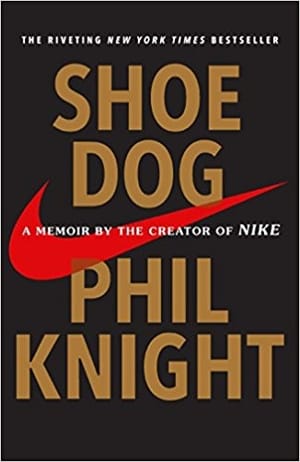
Nike's founding story — told by Phil Knight in his 2016 memoir Shoe Dog — is one of the most gripping accounts of startup survival in business literature. The company that generated over $51 billion in revenue in 2024 and is the most recognizable sports brand in the world began as Blue Ribbon Sports: a one-person operation selling Japanese running shoes out of the trunk of a car at track meets in the Pacific Northwest, funded by a $50 loan from Phil Knight's father.
Nike appears in startup literature primarily through Shoe Dog, and what the book contributes is not a strategic framework or a management philosophy but something more specific: an honest account of what it actually feels like to build a company for sixteen years without ever knowing whether it will survive. Knight describes the fear, the doubt, the near-failures, and the relentless persistence in a way that most founders recognize from their own experience but rarely see described by someone who eventually succeeded at the scale Knight did.
For founders, Nike is important as both an inspiration and a case study. As an inspiration: if Knight could build a $150 billion global brand starting from a $50 loan, a handshake deal with a Japanese shoe company, and a team that barely had enough money to make payroll, then the circumstances you are starting from are probably not the limiting factor. As a case study: Nike's specific problems — cash flow management in a growth business, the relationship between product quality and brand building, the role of early team members in establishing company culture — are generalizable to many types of businesses.
Blue Ribbon Sports was founded in January 1964 in Portland, Oregon, by Phil Knight and his college running coach, Bill Bowerman. The founding capital was $500 — $250 from each partner. Knight borrowed his share from his father.
The business model was straightforward: distribute Onitsuka Tiger running shoes in the United States through a direct sales approach to coaches and athletes, undercutting the German-made Adidas shoes that dominated the American market on price while matching them on quality. Knight had arranged the distribution agreement during a visit to Japan after his Stanford MBA, presenting himself to Onitsuka's management as a representative of an American company (which did not yet exist) and shaking hands on a deal that would define the next decade.
For the first several years, Knight operated the business out of his car while holding down an accounting job to pay his bills. He recruited Jeff Johnson as the first full-time employee in 1965. Johnson operated the East Coast distribution from his car and apartment in California, developed personal relationships with runners and coaches, and wrote detailed letters to Knight about the state of the business that became the model for the company's customer intelligence. Bill Bowerman contributed product expertise, testing every shoe that came from Japan, modifying them, and sending his modifications back to Onitsuka.
The business grew rapidly but was chronically undercapitalized — a problem that Knight describes in detail throughout Shoe Dog and that came closest to ending the company in 1975 (when Nissho Iwai, the Japanese trading company that had become Nike's primary financier, threatened to call Knight's loans) and 1977 (when the US government assessed $25 million in back import duties that would have exceeded the company's entire net worth).
The transition from Blue Ribbon Sports to Nike happened in 1971, when it became clear that the distribution relationship with Onitsuka Tiger was ending. Knight needed a new brand. Jeff Johnson suggested the name Nike — the Greek goddess of victory. Carolyn Davidson, a design student, designed the Swoosh logo for $35. The first Nike shoes were produced by Nissho's manufacturing contacts in Japan rather than Onitsuka, and launched at the 1972 US Olympic Trials in Eugene.
Nike went public on December 2, 1980. The IPO was oversubscribed, valued the company at approximately $178 million, and ended the financial precarity that had defined the company's first sixteen years. Knight describes the IPO as the end of the story that matters — the story of building the company before it was certain to survive.
The post-IPO history of Nike — the Air Jordan signing in 1984, the "Just Do It" campaign launched in 1988, the international expansion, the controversies over manufacturing practices in the 1990s, the acquisitions of Converse and Hurley — are the history of a large, established company, not of a startup. Knight does not cover them in Shoe Dog, and they are a different kind of story from the founding years.
Shoe Dog covers the years from Knight's Stanford MBA paper in 1962 to the 1980 IPO. The specific elements of the Nike story that Ries describes in the most useful detail for founders:
The cash flow problem as a permanent condition. Knight is explicit that Nike was cash-flow negative for most of its first decade because it was growing faster than it could finance. Every dollar of growth required more capital than the company had — more shoes ordered, more inventory financed, more of the revenue cycle to wait through before cash came in. He managed this by maximizing supplier credit (Onitsuka, then Nissho Iwai), pushing his bank relationship as far as it would go, and growing relentlessly because the scale he needed to operate profitably was always slightly out of reach.
Knight describes the specific conversations with his banker — the negotiations over credit line extensions, the moments when the bank threatened to call his loans, the personal relationship that ultimately determined whether the company survived — with a candor that most business memoirs avoid. The lesson is that banking relationships are not administrative; they are strategic. Knight spent significant time cultivating them precisely because they were one of his primary survival tools.
The Bowerman partnership and product innovation. Bowerman is the hero of the product story. He dissected shoes, rebuilt them, tested them himself, and sent his modifications to Japan with specific requirements. The waffle sole — developed by pressing urethane into his wife's waffle iron to create a new tread pattern — became the first Nike shoe's defining innovation and the foundation for a line of training shoes that established Nike's reputation with serious runners.
Knight's account of Bowerman's process is instructive: it was empirical, persistent, and unaffected by what the conventional wisdom about shoe design said was possible. Bowerman tested what worked rather than accepting what was already done. For founders building physical products, the model of rigorous, hands-on product testing that Bowerman exemplifies is more widely applicable than the specific shoe design context.
The early team as the culture. The Nike origin story is not a founder-alone story. Jeff Johnson, Bob Woodell, Penny Parks, and the other early employees described in Shoe Dog contributed to the company's survival in ways that Knight acknowledges were not adequately compensated or publicly credited at the time. Johnson in particular — who named the company, worked for low pay on demanding terms for years, and contributed to virtually every operational function — appears in the book as a co-founder in everything but legal designation.
Knight's belated generosity in acknowledging these contributions is itself a lesson: the people who build something alongside a founder in the early years, when there is no certainty and little reward, deserve more credit than the conventional founder narrative typically provides.
The near-death experiences as psychological tests. The 1975 credit crisis and the 1977 customs investigation are the book's most dramatic episodes, and they are told not as adventure stories but as accounts of genuine fear. Knight describes, in both cases, the possibility that the company would simply end — that he would have to tell his employees that there was no more money, that the thing they had built together was over. He describes considering and rejecting surrender. He describes finding solutions that he was not certain existed until he found them.
The psychological lesson is the one that most founders take away from Shoe Dog: the difference between founders who survive the hard years and founders who do not is often not intelligence or strategy but the refusal to accept that the situation is unresolvable. Knight did not know how to survive each crisis when it arrived. He refused to accept that he could not find a way.
Know your cash conversion cycle. Nike's chronic cash flow problem was structural, not operational: the company had to pay for inventory months before it received revenue from selling it. Knight managed this by maximizing the time between when he owed money (to suppliers) and when he received money (from customers), and by cultivating financing relationships that could bridge the gap. Every founder in an inventory-based business should understand their cash conversion cycle in detail before they start growing aggressively.
The founding team sets the culture permanently. The people who joined Blue Ribbon Sports and Nike before it was clear the company would survive established ways of working, values, and relationships that have persisted through the company's entire history. Knight's early team members were passionate about running, honest in their communication, willing to do whatever was necessary, and committed to the mission over the long term. These characteristics, collectively, defined Nike's culture in ways that deliberate culture initiatives have never fully replicated. For founders, the implication is that early hiring decisions are cultural decisions, not just operational ones.
Brand is built on product, not the other way around. Nike's brand became one of the most valuable in the world. But in the years that Shoe Dog covers, there was almost no branding — no "Just Do It," no Michael Jordan, no celebrity endorsements of significance. There was just the product: shoes that Bowerman had designed and tested and modified until they were genuinely better than the competition. The athletes who won races in Nike shoes talked about them. The coaches who saw athletes win in them recommended them. The brand grew from the product's performance, not from a brand strategy imposed on the product. For founders building consumer brands, this sequence — product first, brand second — is more common in genuinely durable brands than the reverse.
Survive. Everything else is secondary. Knight's primary contribution to startup psychology is the argument that survival — not growth, not profitability, not market share — is the first objective. A company that survives has options. A company that does not survive has none. The specific mechanisms Knight used to survive are particular to his situation, but the orientation — treat survival as the primary objective, subordinate everything else to it during the dangerous early years — is universally applicable.