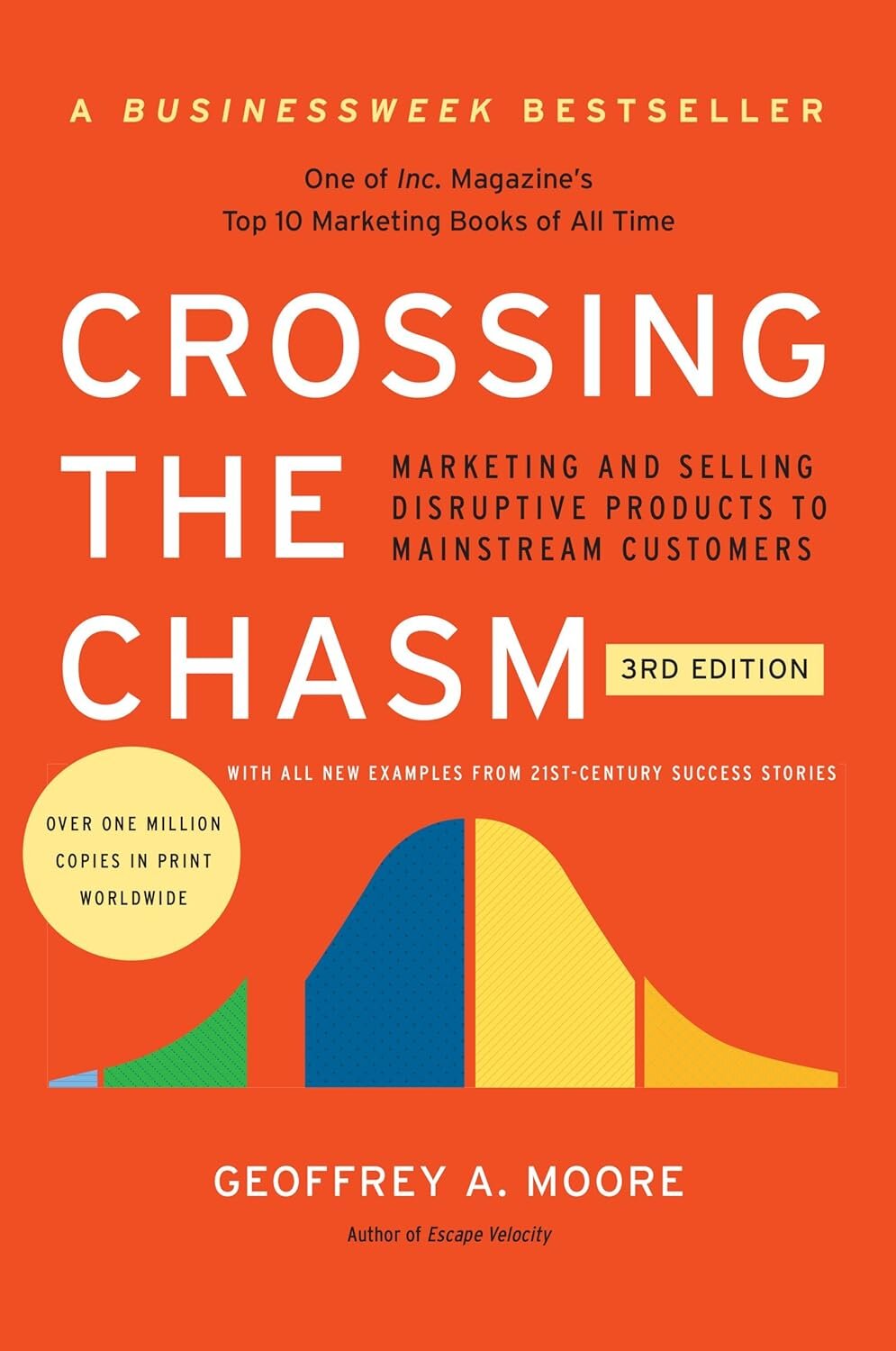
What Is Crossing the Chasm?
Crossing the Chasm: Marketing and Selling Disruptive Products to Mainstream Customers (1991, revised 2014) by Geoffrey Moore is one of the most durable and practically useful books in the startup library. First published over thirty years ago, it introduced a framework for understanding why technology products fail to move from early enthusiast markets to mainstream commercial adoption — and what companies must do to make that transition successfully.
The book's central insight is deceptively simple: there is a fundamental gap between early adopters and mainstream customers, and that gap is not a linear progression but a chasm. Early adopters buy on vision and potential; they tolerate incomplete products because they understand the technology and can see where it's going. Mainstream customers — what Moore calls the "early majority" or pragmatists — buy on proven value, established references, and vendor stability. They don't care about the technology; they care about whether it works, whether others like them have used it successfully, and whether the vendor will be around in five years. These are entirely different purchase decisions, driven by entirely different psychology, and the marketing and sales approach that succeeds with one will systematically fail with the other.
The result of this gap is what Moore calls the chasm — and it has killed more technically excellent startups than any competitor has. Companies that build real products that early adopters love are often convinced, by that early success, that mainstream adoption will follow naturally. It doesn't. The early adopter community and the mainstream community are not connected in the ways founders assume, and the techniques that build early adopter traction actively undermine credibility with pragmatists.
Crossing the Chasm tells you why this happens and what to do about it.
The Technology Adoption Lifecycle
The foundation of Moore's framework is the Technology Adoption Lifecycle — a bell curve that describes the sequence in which different types of customers adopt a new technology. The curve is divided into five segments:
Innovators (Technology Enthusiasts): The first 2-3% of the potential market. They adopt new technology because they love new technology — they want to explore what it can do, find its edge cases, and be the first to understand it. They don't need business justification; the technology itself is the justification. Innovators are valuable for early feedback, reference points, and as proof that the product works, but they are not a commercial market.
Early Adopters (Visionaries): The next 10-15%. They adopt new technology because they see strategic advantage in being an early user — they believe the technology will give them a competitive edge if they deploy it before their rivals do. They buy on vision and are willing to tolerate incomplete products, integration challenges, and rough edges in exchange for being ahead of the market. They are the first commercially meaningful customer segment.
Early Majority (Pragmatists): The next 30-35%. This is the mainstream market — the large mass of customers who represent genuine commercial scale. They buy technology when it has proven value, established references, and a stable vendor ecosystem. They don't buy on vision; they buy on evidence. They are risk-averse and consensus-driven: they don't want to be the first to adopt something new, they want to be the last to miss something that has been proven.
Late Majority (Conservatives): The next 30-35%. They adopt when the technology has become standard and is available as a simple, packaged solution that requires minimal expertise to deploy. They are often skeptical of technology in general and adopt only when the cost of not adopting exceeds the cost of change.
Laggards: The final 10-15%. They resist technology adoption until they have no choice — they are the last to adopt and often only do so when the technology is embedded in products they already use.
The Chasm: Why Early Adopter Success Doesn't Predict Mainstream Adoption
The original Everett Rogers model of technology diffusion presented the adoption lifecycle as a smooth bell curve — the implication being that success with early adopters naturally flows into success with the early majority. Moore's crucial revision was to identify the gap between early adopters and the early majority as qualitatively different from the other transitions on the curve.
The reason is psychological and sociological. Early adopters and pragmatists have fundamentally different relationships to risk, novelty, and reference communities.
Early adopters are change agents. They want to adopt new technology precisely because it's new, and they want to do it before anyone else in their industry does. Their reference community is other early adopters across industries — technology visionaries who talk to each other about what's new and promising. They don't need references from people in their own industry who have already deployed the product, because being first is part of the value proposition.
Pragmatists are the opposite. They do not want to be early. They want to be proven. Their reference community is other pragmatists in their own industry — people with similar businesses, similar risk profiles, and similar definitions of success. When a pragmatist is evaluating a new technology, the question they most need answered is: "Who else in my industry has deployed this, and what happened?" And the answer they need is not "a visionary company in your space tried it" — it's "three companies like yours have deployed it and here are their specific results."
This creates a catch-22 that Moore calls the chasm. To get your first pragmatist reference, you need pragmatist references. Early adopters cannot serve as references for pragmatists — their risk tolerance, evaluation criteria, and definition of success are too different. A pragmatist who hears "Company X, a visionary early adopter, deployed this and was happy" does not conclude that they should deploy it; they conclude that it's still too early and they should wait.
The D-Day Strategy: Crossing with a Beachhead
Moore's prescription for crossing the chasm is built around a single insight: you cannot cross the chasm by trying to sell to the whole mainstream market simultaneously. You must pick one specific niche and win it completely before expanding.
The military metaphor he uses is D-Day: the Allied invasion of Normandy in 1944. The invasion did not attempt to land troops across the entire French coastline simultaneously. It concentrated overwhelming force on a single beachhead — Normandy — with the specific goal of establishing a defensible position from which to expand. The entire subsequent liberation of Western Europe depended on winning that first beachhead.
The same logic applies to crossing the technology chasm. Pick one niche. Concentrate all your resources — sales, marketing, product, customer success — on becoming the dominant solution for that one specific segment. Win it completely: get every reference, understand every use case, build the complete ecosystem that segment needs. Then use that beachhead as the reference platform from which to expand into adjacent segments.
The critical discipline is choosing the right beachhead. Moore provides detailed guidance on this: the beachhead segment should be large enough to generate meaningful revenue if you win it, small enough that you can plausibly dominate it with finite resources, characterized by a specific pain point that your product addresses particularly well, and connected to adjacent segments that you can expand into once you've established dominance.
The Whole Product Concept
One of the book's most practically useful frameworks is the Whole Product concept. Moore argues that the gap between what early adopters need and what mainstream customers need is not primarily about the core product — it's about the surrounding ecosystem of support, integration, services, and standards that make a product genuinely usable in a production environment.
Early adopters are willing to assemble the Whole Product themselves. They'll hire consultants, write custom integration code, work around missing features, and fill in the gaps with effort and expertise. This is part of the value they provide as early customers: they help the vendor understand what the Whole Product needs to include.
Pragmatists will not assemble the Whole Product themselves. They need it to arrive complete — the core product, plus the implementation services, the third-party integrations, the training materials, the customer support infrastructure, the complementary products that work with it, and the standards compliance that their industry requires. If any piece of the Whole Product is missing, many pragmatists will simply not buy, regardless of how good the core product is.
This means that the product investment required to cross the chasm is often not in the core product — it's in building out the ecosystem that makes the core product complete. For some companies, this means building partnerships with systems integrators and consultants. For others, it means investing in an app marketplace. For others, it means working with standards bodies to get the product certified against relevant industry standards.
Positioning for the Chasm
The book's treatment of positioning is among its most enduring contributions to marketing practice. Moore argues that the positioning decisions that work for the early market — positioning around the technology, emphasizing what's new and different, appealing to the buyer's desire for competitive advantage — are exactly wrong for the mainstream market.
Mainstream customers don't want to hear about what's new. They want to hear about what works. They want to be positioned in terms of their specific pain point and how the product eliminates it, not in terms of the technology and what it makes possible. They want to know who else like them has used it. They want to understand where the vendor fits in the competitive landscape and why this vendor, rather than an established alternative, is the right choice.
This requires a positioning pivot that many technology companies resist. Founders who have spent years explaining their technology to enthusiastic early adopters often struggle to make the shift to the customer-problem-first messaging that pragmatists respond to. The technology that seemed exciting and differentiated to the early adopter market seems incomplete and risky to the pragmatist market — unless it's positioned correctly.
The Book's Enduring Relevance
Crossing the Chasm was first published in 1991, when the technology industry looked very different from today. Enterprise software was deployed on-premise. SaaS didn't exist. Cloud computing was science fiction. The specific product examples in the first edition are dated.
But the framework has proven remarkably durable, because the underlying psychology it describes — the difference between early adopters and pragmatists, and the reference dynamics that govern mainstream adoption — has not changed. Moore updated the book in 2014 to address SaaS, mobile, and cloud computing, but the revision mainly updated the tactical examples while leaving the strategic framework intact. The chasm is still there; it just manifests differently in a world of freemium SaaS trials and product-led growth.
For enterprise software founders, the chasm framework remains one of the most practically useful tools available. The beachhead strategy, the Whole Product concept, and the positioning pivot from technology to customer pain point are directly applicable to any startup trying to move from enthusiast pilots to mainstream enterprise contracts.
What Founders Take Away
The core lesson of Crossing the Chasm is that early traction is not proof of mainstream viability. The early adopter community and the mainstream market are not connected in the ways founders typically assume, and the product and go-to-market approach that succeeds with one will often fail with the other.
The practical implication is that founders who have built something that early adopters love need to make a series of deliberate transitions to cross the chasm: choosing a specific beachhead segment, building the Whole Product for that segment, accumulating references within the segment, and repositioning their messaging around customer pain points rather than technology novelty. Each of these transitions requires discipline and restraint — the discipline to focus on one segment rather than selling to everyone, and the restraint to invest in ecosystem building rather than just building more product.
Companies that execute this transition well — that successfully cross the chasm from the early market to the mainstream — often find that the mainstream market is dramatically larger and more profitable than the early market was. That's the prize for crossing. The challenge is that very few companies make the crossing successfully, because very few founders understand what it requires until they've already fallen into the chasm.