Who Is Geoffrey Moore?
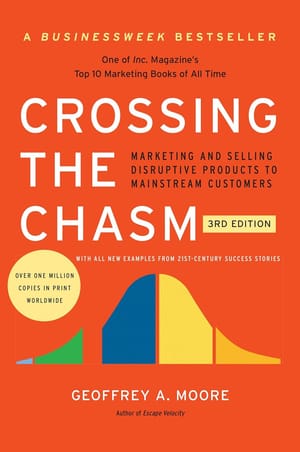
Geoffrey Moore is a management consultant, author, and venture partner best known for Crossing the Chasm (1991) — the book that gave the technology industry its most enduring and widely used framework for understanding how technology products move from early enthusiast markets to mainstream commercial adoption. Published over three decades ago and revised in 2014, the book remains required reading at virtually every major business school and is consistently cited by technology executives, venture capitalists, and startup founders as one of the most practically useful books in the startup library.
Moore's background is unusual for someone who became so influential in the technology industry. He is not an engineer, a programmer, or a former technology executive. He studied American literature at Stanford, earned a PhD in the same subject from the University of Washington, and began his career as a college English professor before pivoting to management consulting in the early 1980s. This humanistic background shows in his writing — Crossing the Chasm is more clearly written, more elegantly structured, and more reader-friendly than most business books of its era — but it also shaped his analytical approach, which draws more on sociology and psychology than on quantitative analysis.
The core insight of his work is rooted in human behavior: specifically, in the observation that different types of people make purchasing decisions based on fundamentally different criteria, and that the transition from one customer type to another is not gradual but discontinuous. This insight, which seems obvious once articulated, was genuinely novel when Moore first published it and has proven to be one of the most durable frameworks in technology strategy.
Career
Academic Background and the Shift to Consulting
Moore earned his BA from Stanford University in 1967 and went on to complete a PhD in American Literature at the University of Washington. He taught English at Olivet College in Michigan for several years before deciding that the academic career path was not where he wanted to spend his professional life.
In the early 1980s, Moore moved into management consulting, initially working with technology companies in the San Francisco Bay Area. The timing was fortuitous: the personal computer revolution was generating explosive growth in the technology industry, and technology companies were desperately in need of the kind of strategic marketing guidance that Moore was developing. The 1980s enterprise software boom — the rise of companies like Lotus, Ashton-Tate, WordPerfect, and then the next generation of database and networking companies — gave Moore a front-row view of the recurring pattern that would become the framework for Crossing the Chasm.
The Pattern That Became the Book
The pattern Moore observed repeatedly was this: a technology company would build a genuinely innovative product, find enthusiastic early adopters who loved it, generate press coverage and industry buzz, and then — when it was time to scale beyond the early adopter community into mainstream commercial markets — hit a wall. The sales that came easily in the early market became extremely difficult in the mainstream market, even when the product was clearly better than established alternatives.
Different clients, different products, different industries — the same pattern. Moore spent years analyzing why, and the answer he developed is the core of Crossing the Chasm: the early adopter and mainstream buyer have fundamentally different purchase criteria, and the technique that succeeds with one systematically undermines credibility with the other.
Crossing the Chasm was published by HarperCollins in 1991. The initial print run was modest, but the book spread rapidly through word of mouth in the enterprise technology community — exactly the kind of reference-based adoption that Moore himself described as the key mechanism for crossing the chasm in pragmatist markets. By the mid-1990s, it had become a standard text in Silicon Valley and at business schools, and it has remained in print continuously since.
TCG Advisors and Client Work
Following the success of Crossing the Chasm, Moore co-founded The Chasm Group (later TCG Advisors), a consulting firm that applied the chasm framework to specific client situations. The firm worked with technology companies across the spectrum from startups to large enterprises, helping them identify their beachhead segments, build whole product ecosystems, and develop the positioning and sales strategies needed to cross from the early market to the mainstream.
Moore's clients over the decades have included Salesforce, Microsoft, SAP, Oracle, Cisco, and hundreds of smaller technology companies. His consulting work has consistently focused on the go-to-market challenges that emerge when a technology company has product-market fit in the early market but struggles to convert that traction into mainstream commercial scale.
He also served on the boards and advisory boards of numerous technology companies, giving him a practitioner's perspective on the chasm-crossing challenge that is reflected in the specificity and practicality of his frameworks.
Wildcat Venture Partners
In later years, Moore transitioned from pure consulting to a role as a venture partner at Wildcat Venture Partners, a San Francisco-based firm. In this capacity, he works directly with early-stage technology companies, applying the chasm framework not just at the consulting level but at the investment and board advisory level. The role allows him to observe early-stage companies at close range and to see the chasm problem manifest in its earliest form — before companies have made the mistakes that many of his consulting clients came to him to fix.
Ideas and Philosophy
The Technology Adoption Lifecycle and the Chasm
Moore's central intellectual contribution is his revision of Everett Rogers's Technology Adoption Lifecycle to identify the chasm between early adopters and the early majority as qualitatively different from the other transitions on the curve.
Rogers's original model, published in Diffusion of Innovations (1962), described technology adoption as a smooth bell curve with five segments (innovators, early adopters, early majority, late majority, laggards) and presented each transition as a gradual progression. Moore argued that this model, while descriptively accurate for many types of social change, systematically misrepresented how technology products were adopted commercially.
The specific gap between early adopters and the early majority is not gradual, Moore argued — it is a chasm. The two groups have fundamentally different buying psychology, different risk tolerances, different reference communities, and different definitions of value. Early adopters buy on vision and competitive advantage; pragmatists buy on proven ROI and peer references. Early adopters are connected to other early adopters across industries; pragmatists are connected to other pragmatists within their own industry. The recommendations that carry weight with early adopters have no standing with pragmatists, and vice versa.
This analysis explains a pattern that had previously been puzzling to technology executives: why did some products generate tremendous buzz and enthusiastic early adoption and then fail to scale into the mainstream market? The answer, in Moore's framework, is that they crossed from innovators to early adopters — a natural transition — and then fell into the chasm rather than crossing it.
The Beachhead Strategy
Moore's prescription for crossing the chasm is the beachhead strategy: concentrate overwhelming force on a single, well-chosen niche market and win it completely before expanding. The beachhead approach is counterintuitive for founders who see a large potential market and want to pursue all of it simultaneously. The temptation is to cast a wide net and let early traction determine where to focus. Moore argues that this approach systematically fails because it produces shallow penetration across many segments rather than deep, reference-generating dominance in any single segment — and it is deep dominance in a specific segment, with specific reference customers, that generates the credibility to expand.
The beachhead segment must meet several criteria: it must be large enough to generate meaningful revenue, small enough to dominate with finite resources, characterized by a specific pain point that the product addresses particularly well, and populated by people who communicate with each other (so that wins in the segment generate word of mouth that spreads).
The Whole Product Model
One of Moore's most practically useful frameworks is the Whole Product concept — the observation that what pragmatist customers need to buy is not just the core product but the complete solution package: the product itself, plus the implementation services, the third-party integrations, the support infrastructure, the training materials, the ecosystem of complementary products, and the standards compliance that their industry requires.
Early adopters assemble the Whole Product themselves — they have the technical skill and the risk tolerance to work with incomplete solutions. Pragmatists will not. For a pragmatist, a product that requires significant assembly and integration work is not a product that is "almost complete" — it is a product that does not yet exist in a form they can buy.
This means that the investment required to cross the chasm is often not in the core product but in building the ecosystem around the core product. This is a difficult message for product-focused founders who believe that building a better core product is always the right investment. Sometimes it is; often, at the chasm, it isn't.
Inside the Tornado and Zone to Win
Crossing the Chasm is part of a trilogy that Moore calls the "high-tech marketing" series. The second book, Inside the Tornado (1995), deals with what happens after a company successfully crosses the chasm — when the mainstream market adopts the technology rapidly and the challenge shifts from establishing traction to managing hypergrowth while maintaining quality. The third, Zone to Win (2015), addresses the challenge of large, established technology companies managing transformational new product lines alongside their existing mature businesses.
Together, the three books provide a framework for technology company strategy across the entire product lifecycle — from early market to chasm crossing to tornado growth to mature market management. The series has been particularly influential in enterprise software strategy, where the lifecycle dynamics Moore describes are most clearly visible.
Escape Velocity
Escape Velocity (2011) addresses a different problem: how large, established technology companies can free themselves from the gravitational pull of their existing products and customers to pursue genuinely new opportunities. The book argues that established companies systematically underinvest in new market categories because their management processes, resource allocation systems, and performance metrics are all calibrated to serve existing businesses.
The escape velocity concept — borrowing from physics the idea of the minimum speed needed to break free of a gravitational field — describes the conditions under which a new initiative can receive enough resources and attention to succeed despite the organizational gravitational pull of the existing business. This framework has been particularly influential in large enterprise technology companies trying to manage the transition from legacy on-premise products to cloud and SaaS offerings.
Books
Crossing the Chasm (1991, revised 1999 and 2014) — The defining work on technology adoption lifecycle and the strategic challenge of moving from early adopter to mainstream markets. Has sold over 1 million copies and remains the most widely cited text in enterprise technology go-to-market strategy.
Inside the Tornado: Strategies for Developing, Leveraging, and Surviving Hypergrowth Markets (1995) — The second book in the high-tech marketing series, dealing with the hypergrowth phase that follows successful chasm crossing. Covers strategies for managing rapid growth, maintaining product quality under velocity pressure, and positioning for post-tornado market maturation.
The Gorilla Game: Picking Winners in High Technology (1998, with Tom Kippola and Paul Johnson) — An application of the chasm framework to technology investing, arguing that winner-take-most markets produce "gorilla" companies with durable competitive advantages that investors should identify and hold.
Living on the Fault Line: Managing for Shareholder Value in Any Economy (2000) — An application of the high-tech marketing framework to shareholder value creation, arguing that technology companies in the chasm-to-tornado phase command premium valuations that must be supported by disciplined market development.
Dealing with Darwin: How Great Companies Innovate at Every Phase of Their Evolution (2005) — An extension of the lifecycle framework to innovation strategy, examining how the type of innovation that creates value changes as a product category moves through the adoption lifecycle.
Escape Velocity: Free Your Company's Future from the Pull of the Past (2011) — Addresses the challenge of large established companies pursuing transformational new opportunities while managing existing mature businesses.
Zone to Win: Organizing to Compete in an Age of Disruption (2015) — The most recent major work, arguing that large technology companies must reorganize around "zones" that separate the management of mature businesses from the pursuit of new opportunities, and that the failure to make this separation is why many established companies fail to navigate technological transitions.
Podcasts and Interviews
Moore is a regular presence on technology strategy podcasts and in the enterprise technology media. He has appeared frequently on the a16z Podcast, where his conversations with Andreessen Horowitz partners on the application of the chasm framework to cloud, SaaS, and AI companies have attracted large audiences among founders and investors.
He has been interviewed extensively by the MIT Sloan Management Review, the Harvard Business Review, and the Stanford Graduate School of Business, where his frameworks are taught in the entrepreneurship and technology strategy curricula. His interviews with business school faculty often provide the most detailed exploration of the theoretical foundations of his frameworks and how they have evolved over thirty years of application.
Moore also speaks frequently at Gartner and Forrester technology industry conferences, where his frameworks on market development and chasm crossing are directly applicable to the enterprise technology buyers and sellers who make up those audiences. His talks at those events, many of which are available on YouTube, provide accessible introductions to the major concepts in his books.
For first-time readers approaching his work, the most efficient path is to read Crossing the Chasm first and then, if it resonates, to explore Inside the Tornado and Zone to Win for the complete framework across the technology product lifecycle. The core insight — that the chasm exists, that it requires specific strategies to cross, and that those strategies are counterintuitive for founders who have succeeded in the early market — is accessible in the first book and remains the most important thing Moore has to say.
Professional Background
Current role: Venture partner at Wildcat Venture Partners; Author and management consultant
Previous roles:
- Managing Director at TCG Advisors
- Faculty at Regis University
Undergraduate: BA, American Literature, Stanford University
Graduate: PhD, American Literature, University of Washington
Themes
- Technology adoption
- Chasm crossing
- Beachhead strategy
- Whole product
- Market development
Popular Works
- Crossing the Chasm (1991)
- Inside the Tornado (1995)
- Zone to Win (2015)
- Escape Velocity (2011)
Contributions
Famous Quotes
"The chasm represents the gulf between the early market and the mainstream market."
"Without a beachhead, you cannot cross the chasm."