No company in startup literature is referenced more often per founder produced than PayPal. The founding team went on to build Tesla, SpaceX, LinkedIn, YouTube, Yelp, Palantir, and Andreessen Horowitz. The "PayPal Mafia," as Fortune magazine called them in a famous 2007 cover story, is the most productive alumni network in Silicon Valley history.
For startup founders, PayPal matters in two distinct ways: as a case study in the brutal challenges of building a payments network from scratch, and as the proving ground for a generation of founders whose ideas about company-building shaped the books on this site.
PayPal's founding story is more complicated than most accounts suggest. It did not begin as PayPal.
In December 1998, Max Levchin, Peter Thiel, Luke Nosek, and Ken Howery founded Confinity — a company initially focused on cryptography software for Palm Pilots. The payments feature was almost an afterthought: they built a demo that let two Palm Pilots "beam" money to each other, and users responded more enthusiastically than to anything else the company had built. The team pivoted to payments.
Meanwhile, in March 1999, Elon Musk founded X.com — a far more ambitious vision of an internet bank that would handle all of someone's financial life. X.com also had a money-transfer feature. The two companies were racing each other and hemorrhaging cash on referral bonuses to acquire users.
In March 2000, Confinity and X.com merged. Musk became CEO of the combined company. Six months later, in a move still debated among those involved, Musk was removed as CEO by the board while he was on his honeymoon — with Thiel returning in his place.
Under Thiel, the company refocused on its core payments product, solved a catastrophic fraud problem that had nearly destroyed the business, and went public in February 2002. Three months later, eBay acquired PayPal for $1.5 billion. Most of the founding team received eight-figure payouts.
In 2015, eBay spun PayPal back out as an independent public company. It now processes hundreds of billions of dollars annually and has over 400 million active accounts.
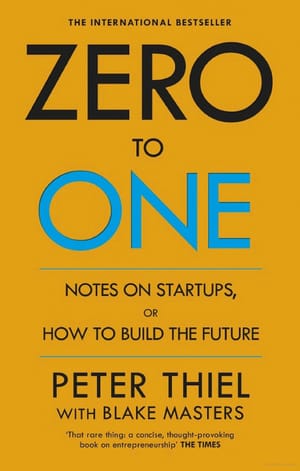
Peter Thiel's From 0 to 1 is inseparable from the PayPal experience. Thiel draws on the founding story repeatedly to illustrate his core arguments about company building.
On building a monopoly. Rather than trying to replace all of finance — X.com's original vision — Thiel narrowed PayPal's focus to eBay power sellers, a specific and reachable group with a genuine pain point. Once PayPal dominated that community, expansion was natural. The lesson: start small, dominate your niche, expand from there.
On the last mover advantage. One of the book's counterintuitive arguments is that it's better to be the last company to enter a market than the first. PayPal illustrates this: many companies were trying to build internet payments in 1999–2000. PayPal survived and won not because it was first, but because it solved the fraud problem, built network effects among eBay sellers, and was still standing when the dot-com crash wiped out its competitors.
On secrets. Thiel argues that every great company is built on a "secret" — something true about the world that most people don't yet believe. PayPal's secret was that individuals, not just businesses, would transact money online, and that the friction of traditional bank transfers was a problem worth solving. That insight was not obvious in 1999.
On the founding team. Thiel is candid that the PayPal team was unusually cohesive and capable. Many had known each other from Stanford. They shared a libertarian-inflected worldview about financial freedom. That ideological coherence contributed to the company's resilience through crisis — when everything was going wrong, the team kept working because they believed in what they were building.
Fortune's 2007 cover story listed eleven PayPal alumni who had gone on to build or invest in some of the most important companies in Silicon Valley:
The aggregate value created by this group is in the hundreds of billions of dollars. Why did one company produce so many successful second acts?
First, selection effects: Thiel and Levchin recruited exceptionally carefully. The people who made it through were unusually talented to begin with.
Second, the experience itself was educational. The fraud crisis — in which the company was losing millions of dollars a month to organized fraud rings — forced engineers to develop adversarial problem-solving skills that had no equivalent in normal tech companies.
Third, the payout created capital. Most early employees received meaningful amounts from the eBay acquisition — enough to fund next ventures, take risks, and invest in each other's companies. Musk famously put his entire $180M payout into SpaceX and Tesla simultaneously.
Fourth: they kept working with each other. Thiel invested early in LinkedIn and Facebook. Hoffman joined boards of companies Thiel funded. The network compounded.
Define your market to be winnable. PayPal didn't try to replace banks. It focused on a specific community, dominated it, and expanded from there. Most failed startups try to boil the ocean from day one.
Solve the hard operational problem. PayPal nearly died because of fraud. Solving it — better than every competitor could — became a competitive moat. Your startup's hardest operational challenge might be your biggest advantage if you can crack it.
The founding team is the company. The people Thiel and Levchin recruited in 1999–2001 went on to build hundreds of billions in value. The lesson is not that you need Stanford PhDs — it's that founding teams with shared values, complementary skills, and genuine intellectual respect for each other compound dramatically over time.
Survive long enough to win. Half of PayPal's competitors failed in the dot-com crash. The company survived by being slightly less profligate with cash and slightly better at solving its core product problem. Longevity itself is a competitive strategy.
Musk founded X.com, which merged with Confinity — the company that built the PayPal product. After the merger Musk was briefly CEO, then was replaced by Thiel. He was a co-founder of the combined company in the sense that X.com merged with Confinity, but the PayPal product was built by the Confinity team.
Multiple reasons: Musk wanted to switch the company's technical infrastructure from Unix to Windows (which the engineering team strongly opposed), there were management style concerns, and there was strategic disagreement. Thiel, returning as CEO, refocused the company on its core payments product.
Musk retained the domain. He used it as the basis for Twitter's rebrand after his 2022 acquisition — reflecting his original vision for an everything-finance platform, though the current X is a social media company.