Who Are W. Chan Kim and Renée Mauborgne?
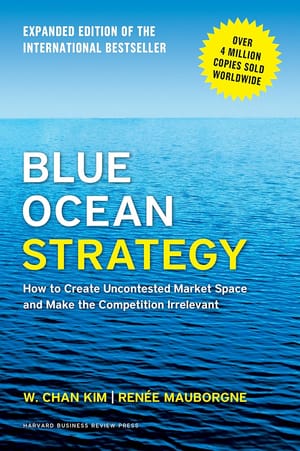
W. Chan Kim and Renée Mauborgne are co-directors of the INSEAD Blue Ocean Strategy Institute and professors at INSEAD, the international business school in Fontainebleau, France. They are best known for Blue Ocean Strategy (2005), one of the bestselling and most widely translated business books ever written, with over 4 million copies sold in 46 languages.
Their central contribution to management thinking is the concept of value innovation — the simultaneous pursuit of differentiation and low cost to create new demand, rather than compete for existing demand. The metaphor of "blue oceans" (uncontested markets) versus "red oceans" (existing markets bloodied by competition) has become standard vocabulary in business strategy worldwide.
Kim, originally from South Korea, and Mauborgne, French-American, have been research partners at INSEAD for over three decades. Their collaboration produced not only the Blue Ocean framework but also 15 years of empirical research covering 150 strategic moves across 30 industries — one of the most comprehensive studies of corporate strategy ever undertaken.
Academic Background and Career
Both Kim and Mauborgne hold chaired professorships at INSEAD. Kim holds the Boston Consulting Group Bruce D. Henderson Chair in Strategy and International Management; Mauborgne holds the INSEAD Distinguished Fellow and Affiliate Professor position.
Their research began in the early 1990s, when they started tracking strategic moves — not companies or industries, but specific decisions about where to compete and how to create value. By the mid-1990s they had identified a consistent pattern: the companies that achieved breakaway growth were not the ones that outcompeted rivals, but the ones that found new spaces where competition was irrelevant.
They published early findings in the Harvard Business Review through the 1990s, including papers on "Value Innovation: The Strategic Logic of High Growth" (1997) and articles on fair process and organizational change. These laid the groundwork for the 2005 book.
Blue Ocean Strategy: The Research
The book is grounded in one of the largest empirical studies of business strategy ever conducted. Kim and Mauborgne analyzed 150 strategic moves across 30 industries from 1880 to 2000 — covering everything from automobiles and computing to circus entertainment and wine. They were not looking at companies; they were looking at specific decisions to enter new market spaces.
Their key findings:
- The most successful growth moves consistently created new demand rather than captured existing demand from competitors.
- These moves achieved lower cost and higher value simultaneously — breaking the assumption that differentiation must come at a cost premium.
- The specific industry or company size did not predict success; the nature of the strategic move did.
- First movers into a blue ocean enjoyed a revenue and profit advantage that persisted significantly even after competitors entered.
Key Frameworks
The Strategy Canvas
A visualization tool that maps what factors an industry competes on and how much it invests in each. Drawing the canvas for your industry and your competitors reveals how similar everyone looks — and where the opportunity lies to differentiate meaningfully. A strong blue ocean strategy produces a curve that diverges visibly from competitors.
The Four Actions Framework and ERRC Grid
Four questions that force simultaneous cost reduction and value creation:
- Eliminate: Which factors that the industry takes for granted should be completely eliminated?
- Reduce: Which factors should be reduced well below the industry standard?
- Raise: Which factors should be raised well above the industry standard?
- Create: Which factors should be created that the industry has never offered?
Eliminating and reducing lowers cost. Raising and creating increases value. Done together, they produce value innovation.
The Six Paths Framework
Six systematic lenses for discovering blue ocean opportunities:
- Look across alternative industries
- Look across strategic groups within your industry
- Look across the chain of buyers
- Look across complementary product and service offerings
- Look across functional or emotional appeal to buyers
- Look across time (emerging trends)
Tipping Point Leadership
Implementing a blue ocean strategy inside an existing organization requires overcoming cognitive, resource, motivational, and political hurdles. The tipping point leadership framework provides a way to execute transformation without requiring unlimited resources or consensus — by focusing energy on the people and activities that will have disproportionate influence on the change.
Books
Blue Ocean Strategy (2005, expanded 2015)
The original book establishing the framework. The 2015 expanded edition added new examples, addressed criticism about sustainability, and included a chapter on how to align the three strategy propositions — value, profit, and people.
Blue Ocean Shift (2017)
A more implementation-focused follow-up. Where the original book explained what blue ocean strategy is and why it works, Blue Ocean Shift explains how to execute a blue ocean move inside an organization, with a step-by-step process and tools for building teams around the change.
Blue Ocean Leadership (Harvard Business Review, 2014)
An HBR article applying the blue ocean framework to leadership: rather than competing for talent in the conventional way, organizations can apply value innovation to the way they motivate and deploy people — creating new "blue oceans" of leadership that unlock hidden potential.
Memorable Quotes
"The only way to beat the competition is to stop trying to beat the competition."
"Value innovation is the cornerstone of blue ocean strategy. Instead of focusing on beating the competition, you focus on making the competition irrelevant by creating a leap in value for buyers and your company, thereby opening up new and uncontested market space."
"Companies need to go beyond competing. To seize new profit and growth opportunities, they also need to create blue oceans."
"The strategic move, and not the company or the industry, is the right unit of analysis for explaining the creation of blue oceans and sustained high performance."
Who Should Read Their Work
Founders and executives who feel trapped competing on the same dimensions as competitors — where every gain requires beating someone else. The Blue Ocean framework reframes the question from "how do we win the competition?" to "can we make this competition irrelevant?"
Product and growth teams looking for structured ways to identify new market opportunities. The Strategy Canvas and Six Paths are practical workshop tools, not just theoretical concepts.
Business school students and consultants who want a rigorous empirical counterpart to Porter's competitive strategy framework. Kim and Mauborgne's research is as methodologically serious as Porter's, but reaches different conclusions about where sustainable advantage comes from.
Frequently Asked Questions
How does Blue Ocean Strategy relate to Porter's competitive strategy?
Porter's framework — five forces, generic strategies, value chain — is designed for understanding competition within existing markets. Kim and Mauborgne's framework is designed for escaping those markets entirely. They are more complementary than contradictory: use Porter to understand the red ocean you're in, use Kim and Mauborgne to find a way out of it.
Is Blue Ocean Strategy still relevant in the age of AI and platforms?
Yes — arguably more so. Platform businesses and AI-enabled products have dramatically lowered the cost of building and distributing software, which means the bottleneck to growth has shifted from production to differentiation. The question of how to create demand in a world where supply is abundant is exactly what Blue Ocean Strategy addresses. The frameworks translate directly to questions like: what if we looked at the buyer chain differently, or combined offerings that are currently separate?
What is the difference between Blue Ocean Strategy and disruption?
Christensen's disruption starts from a technology or cost advantage that lets an entrant serve ignored customers with an initially inferior product, which eventually improves and takes over the mainstream. Blue Ocean Strategy starts from buyer value — redesigning what is offered to create new demand. Both result in new competitive spaces, but the mechanism is different. Disruption is technology-driven from below; Blue Ocean is value-driven from the demand side.
Professional Background
Current role: Co-directors, INSEAD Blue Ocean Strategy Institute; Professors at INSEAD
Previous roles:
- Boston Consulting Group professors at INSEAD (both)
- Visiting scholars and lecturers at major business schools worldwide
Themes
- Value innovation — breaking the differentiation vs. low-cost trade-off
- Creating uncontested market space rather than competing in existing markets
- The Strategy Canvas and competitive visualization tools
- The Four Actions Framework (Eliminate, Reduce, Raise, Create)
- Tipping point leadership for organizational change
- Fair process and execution of strategic transformation
Popular Works
- Blue Ocean Strategy (2005, expanded 2015)
- Blue Ocean Shift (2017)
- Blue Ocean Leadership (HBR, 2014)
Awards
- Thinkers50 #1 Strategy Thinkers (multiple years)
- Thinkers50 Strategy Award
- Blue Ocean Strategy named one of the most influential management books of the past two decades by multiple publications
Contributions
Cultural Impact: Coined the terms 'blue ocean' and 'red ocean' as strategic metaphors now used globally in business, policy, and education
Famous Quotes
"The only way to beat the competition is to stop trying to beat the competition."
"Value innovation is the cornerstone of blue ocean strategy. Instead of focusing on beating the competition, you focus on making the competition irrelevant."
Related Companies
Cirque du Soleil