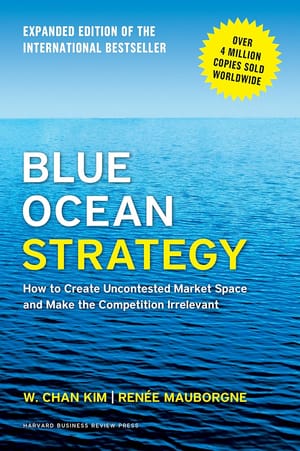
Cirque du Soleil opens Blue Ocean Strategy — not as a footnote or supporting example, but as the book's central case study. Authors W. Chan Kim and Renée Mauborgne use Cirque to introduce and illustrate the entire blue ocean framework before explaining its theory. That choice is deliberate: Cirque du Soleil did something that almost no company does cleanly enough to be used as a teaching example. It created a new market from scratch, making its old competitors irrelevant in the process.
The story is simple enough to summarize in two sentences, but the strategic logic behind it rewards careful examination. A group of street performers from Quebec decided to stop competing in the dying circus industry and start competing — successfully — against Broadway shows and Las Vegas entertainment. They did it without better performers, without bigger budgets, and without a proven playbook. They did it by changing the rules entirely.
Cirque du Soleil was founded in 1984 in Baie-Saint-Paul, Quebec, by Guy Laliberté and a group of street performers who had been working the festival circuit. Laliberté was a fire-breather and stilt-walker. The company had essentially no money. Its first major opportunity came from a Canadian government grant to celebrate the 450th anniversary of Jacques Cartier's discovery of Canada — a tour that required performing across the country on a shoestring budget.
The early years were precarious. The company nearly went bankrupt several times. Laliberté has recounted that at one point he had to choose between paying the performers and paying to get the equipment across the US border. He paid the performers.
The breakthrough came in 1987, when Cirque performed at the Los Angeles Arts Festival. The show was a sensation. Hollywood producers and entertainment industry buyers who had been skeptical of a Canadian circus act were watching something they had never seen before: acrobatics performed with theatrical narrative, original music, elaborate costumes, and an atmosphere closer to opera than to the circus tent.
From that moment, Cirque's growth was extraordinary. By the 2000s, the company was running 19 simultaneous touring and resident shows across the world, employing over 5,000 people, and generating revenues of over $800 million annually. Its Las Vegas resident shows — O, Mystère, Kà, Love — became institutions.
The COVID-19 pandemic nearly destroyed the company. With all shows shut down globally in March 2020, Cirque filed for creditor protection in June 2020, laying off 95% of its workforce. It emerged from bankruptcy in late 2020 under new ownership — acquired by a consortium including Caisse de dépôt et placement du Québec and Investissement Québec — and began the long process of rebuilding its touring portfolio. By 2023 it had returned to profitability.
Kim and Mauborgne open Blue Ocean Strategy with Cirque not because it's a technology company or because it followed a rigorous strategic planning process. They open with it because it illustrates something rare: a company that looked at a declining industry and, rather than compete harder within it, reconstructed the industry's value proposition entirely.
The circus industry was dying. By the 1980s, traditional circus was in structural decline. Animal welfare concerns were rising. The novelty of traditional circus acts — tightrope walkers, clowns, animal trainers — had worn off with mass media exposure. Top-tier performers were commanding higher fees while audiences were shrinking. The industry's profitability was deteriorating.
The standard competitive response would have been wrong. Most companies facing this situation would have tried to compete better within the existing framework: higher-profile animal acts, bigger-name performers, lower ticket prices, better marketing. This is what Kim and Mauborgne call "red ocean" strategy — fighting for a larger share of a shrinking or existing market.
Cirque asked a different question. Instead of asking "how do we beat Ringling Bros?" they asked "why do people pay for entertainment?" The answer led them across industries. People paid for Broadway shows because of narrative and artistic production value. People paid for concerts because of music. People paid for dance because of physical artistry. What if you combined all of those things, while eliminating the elements of traditional circus that were costly and unpopular?
The ERRC Grid applied to Cirque. Kim and Mauborgne's "Eliminate-Reduce-Raise-Create" framework structures this analysis precisely:
Eliminate: Animal acts (expensive, increasingly controversial, not actually what audiences came for). Star performers (top-dollar individual acts who could demand outsized pay). Aisle concession sales (cheap and distracting). Multiple show arenas (the traditional three-ring format split attention).
Reduce: Thrills and danger (traditional circus emphasized near-death spectacle; Cirque reduced this). Fun and humor (clowns were a circus staple; Cirque reduced slapstick in favor of more sophisticated comedy).
Raise: Unique venue (Cirque created its own distinctive big-top environment). Production quality (costumes, lighting, and set design at levels unprecedented for circus).
Create: Theme (each Cirque show has a narrative arc and a conceptual identity — O is about water, Love is about the Beatles). Refined viewing environment (wine at intermission, plush seating, no peanuts). Artistic music and dance (original compositions, live performance, choreography as central element). Multiple productions (rather than one show, Cirque creates a catalog of distinct experiences).
The result was a new buyer group. Traditional circus drew children and families, and competed for entertainment budget against other family entertainment. Cirque drew adults and corporate clients, and competed for entertainment budget against theater and concerts. The companies that had dominated traditional circus — Ringling Bros., Barnum & Bailey — were suddenly irrelevant competitors. Cirque wasn't playing their game anymore.
The ERRC grid is Blue Ocean Strategy's most practical tool for founders. Cirque du Soleil is its cleanest demonstration.
The key insight the Cirque example illustrates is that blue ocean strategy is not just differentiation (offering more or better) and not just cost leadership (offering the same for less). It's value innovation — simultaneously pursuing differentiation and cost reduction by eliminating and reducing things the industry takes for granted.
Cirque eliminated animal acts and star performers — two of the most expensive elements of traditional circus — which dramatically reduced costs. At the same time, it invested heavily in production quality, original music, and themed narratives — which allowed premium pricing. The resulting value proposition was unlike anything competitors offered at any price point.
This is why Cirque du Soleil could charge a Broadway-level ticket price while costing far less to operate than Ringling Bros. It wasn't cheaper circus. It wasn't better circus. It was a completely different product category.
Look across industries, not just at your competitors. Cirque's breakthrough came from studying what theater, music, and dance offered — not what circus offered. Your best ideas for your own industry may come from understanding what buyers value in completely different industries.
The ERRC grid is applicable to any business. What does your industry spend money on that customers don't actually value? What could you add that customers would pay for but no one in your industry currently provides? Working through the four quadrants forces you to question assumptions that competitors all share.
Declining industries can be blue oceans. The conventional wisdom says to enter growing markets. Cirque proves that a dying market, reframed, can be a new market with no competition at all.
Non-customers are your largest market. Traditional circus wasn't reaching adult theatergoers, not because those people didn't want entertainment, but because circus didn't offer what they valued. Identifying your non-customers — and understanding what would bring them to you — can unlock bigger markets than taking share from existing competitors.
Not in the way the framework implies. Laliberté and the founders were street performers responding to survival pressures and artistic instincts, not McKinsey consultants running strategy workshops. Kim and Mauborgne's contribution is the retrospective analytical framework that makes the logic legible — which is itself useful, even if the original decisions were made intuitively.
It faces much more competition than it did in the 1990s. Other entertainment companies have adopted theatrical circus formats. Its core innovation has been imitated. But Cirque's brand, catalog of shows, and Las Vegas residencies maintain a differentiated market position. The blue ocean is more crowded than it was, but Cirque created it.
Yes — Kim and Mauborgne apply it explicitly to technology markets in later chapters of the book. The canonical tech example is the Nintendo Wii, which eliminated cutting-edge graphics and targeting of hardcore gamers (both expensive), while creating motion controls and targeting families (opening a new buyer group). The Cirque logic translates directly.