Who Is Peter Thiel?
Peter Thiel is a co-founder of PayPal, the first outside investor in Facebook, the co-founder of Palantir Technologies, and the author of Zero to One (2014) — one of the most influential books on startups ever written. He is perhaps best known in the entrepreneurship world for a single question, posed at the start of his Stanford course on building companies: "What important truth do very few people agree with you on?" That question is the seed of his entire intellectual framework: that real innovation comes from contrarian insight, not from doing what everyone else is doing, only better.
Thiel is a graduate of Stanford University (philosophy, BA) and Stanford Law School (JD), a former securities litigator, a chess prodigy in his youth, and one of the most controversial figures in technology and politics. His ideas about monopoly, the nature of competition, and what separates truly valuable companies from commodity businesses have shaped how a generation of startup founders and venture capitalists think about building companies.
Career
PayPal and the PayPal Mafia (1998–2002)
In 1998, Thiel co-founded PayPal with Max Levchin and a small group of engineers. The company solved a real problem — secure digital money transfer — at exactly the right moment, as eBay's marketplace was exploding and sellers needed a reliable payment mechanism. PayPal grew rapidly, fought off competitors, survived near-death experiences with fraud, and went public in 2002. Shortly after the IPO, eBay acquired PayPal for $1.5 billion.
What happened next is one of the most remarkable second-chapter stories in Silicon Valley history. The PayPal alumni — including Elon Musk, Reid Hoffman, David Sacks, Keith Rabois, Jeremy Stoppelman, Chad Hurley, Jawed Karim, and others — went on to found or fund LinkedIn, YouTube, Yelp, SpaceX, Tesla, Palantir, Yammer, and dozens more. The network became known as the "PayPal Mafia," and Thiel remains its most visible member.
Facebook Investment (2004)
In 2004, a 19-year-old Mark Zuckerberg was looking for early funding for a social network called "The Facebook." Sean Parker, then Facebook's president, connected him with Thiel, who invested $500,000 for roughly 10.2% of the company. It was a small check for Thiel at the time. When Facebook went public in 2012, Thiel's stake was worth approximately $1 billion — one of the best angel investments in history. He remained on Facebook's board until 2022.
Palantir Technologies (2003–present)
In 2003, Thiel co-founded Palantir Technologies with Alex Karp, Nathan Gettings, Joe Lonsdale, and Stephen Cohen. The company's core product was data integration and analysis software for intelligence agencies — tools that could connect disparate data sources to help analysts identify terrorist networks and prevent attacks. The name comes from the all-seeing stones in Tolkien's The Lord of the Rings.
Palantir remained private for 17 years, bootstrapped largely through U.S. government contracts, and went public in 2020 at a valuation of approximately $22 billion. Thiel serves as Chairman.
Founders Fund (2005–present)
Thiel founded Founders Fund in 2005, a venture capital firm that invests in technology companies built by technical founders. The fund's early portfolio is remarkable: SpaceX (when launching rockets was considered nearly impossible), Airbnb, Lyft, Spotify, Stripe, and dozens of others. Founders Fund became known for its willingness to bet on ambitious, technology-heavy companies that other VCs found too risky or too unconventional.
The fund's mission statement — "We wanted flying cars, instead we got 140 characters" — is a pointed critique of the tech industry's tendency toward consumer internet applications at the expense of deeper scientific and engineering progress.
Thiel Fellowship (2010–present)
In 2010, Thiel launched one of his most provocative initiatives: the Thiel Fellowship, which pays promising young people under 23 a grant of $100,000 to skip or leave college and pursue entrepreneurial projects for two years. The fellowship was designed as a direct challenge to the assumption that university education is the best path for exceptional people who want to build things. Fellows have included founders of companies such as Luminar Technologies, Figma (early), and Vitalik Buterin (Ethereum).
Key Ideas and Frameworks
Zero to One vs. One to N
The central distinction in Thiel's thinking is between two types of progress:
Horizontal progress (1 to n) is copying what already works — taking something that exists in one place and replicating it everywhere. Globalization is horizontal progress. This is incremental improvement.
Vertical progress (0 to 1) is doing something entirely new — creating something that has never existed before. Technology is vertical progress. This is the only kind of progress that truly changes the world.
Thiel argues that most companies compete in existing markets, doing things slightly better than competitors — which leads to price competition, thin margins, and commoditization. The rare companies that do something genuinely new can achieve the kind of dominance that produces lasting value.
Competition Is for Losers
One of Thiel's most provocative arguments is that competition, widely celebrated in economics and business culture, is actually destructive for businesses. Competing in a crowded market forces companies to differentiate on price, destroys margins, and leaves everyone worse off financially.
The goal, he argues, should be to build a monopoly — not in the illegal, rent-seeking sense, but in the sense of creating a company so good at what it does that no one can reasonably compete with it. Google's dominance in search, for example, allows it to generate enormous profits. Airlines, despite serving hundreds of millions of customers, are perpetually near bankruptcy because they compete on price.
The strategic implication: start by dominating a small, specific market. You can't take over everything at once. Amazon started with books. Facebook started with Harvard students. Find the niche where you can win completely, then expand.
The Power Law
In venture capital — and in life — outcomes are not distributed normally. They follow a power law: a small number of investments produce the vast majority of returns. Thiel argues that the best VCs understand this and concentrate their portfolios accordingly. Every investment in a fund should have the potential to return the entire fund. This insight has profoundly shaped how modern venture capital is practiced.
The power law also applies to careers, companies, and skills: a few choices matter enormously; most choices barely matter at all.
Secrets
Thiel asks: what do you know that most people don't? What is true but not yet believed? Every great business is built on a secret — a belief about what the world will look like, or what customers want, that is not yet widely accepted. Airbnb's secret was that strangers would trust each other enough to share homes. Google's secret was that web pages could be ranked by the links pointing to them.
If a secret is too obvious, competition will crowd the space. If it's too weird, no one will believe you. The sweet spot is beliefs that are true, not yet proven, and just within the range of what smart people can be persuaded to believe.
Definite vs. Indefinite Optimism
Thiel categorizes worldviews along two axes: optimistic/pessimistic and definite/indefinite. Definite optimism — the belief that the future will be better, and that we know specifically how — is the mindset behind the greatest human achievements. The Apollo program was definite optimism. So was building the interstate highway system or sequencing the human genome.
Indefinite optimism — the belief that things will generally get better, without any specific vision — produces incremental improvement but no transformation. He argues that contemporary Silicon Valley and American finance have drifted into indefinite optimism: everyone is doing diversified portfolios and A/B tests rather than betting on specific visions of the future.
Books
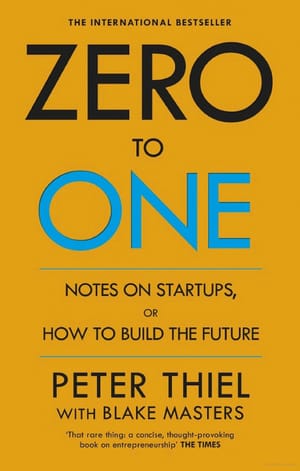
Zero to One (2014)
Thiel's only book began as lecture notes from his Stanford class on building startups (CS183), compiled and edited by student Blake Masters, whose original notes went viral online. The book is short, dense with ideas, and deliberately provocative. It does not offer a step-by-step startup playbook; it offers a set of questions and frameworks for thinking about whether the thing you're building actually matters.
It remains one of the handful of books that serious startup founders are expected to have read.
Why Peter Thiel Still Matters to Founders
Thiel's influence is larger than his bibliography would suggest because his ideas became embedded in startup culture. Founders repeat his language even when they have not read him directly: monopoly versus competition, secrets, the power law, definite optimism, and going from zero to one. These phrases became part of how startups justify market selection, product ambition, and venture-scale outcomes.
He also matters because he sits at the junction of three different roles that rarely live in one person. He is a founder who built a consequential company, an investor who repeatedly backed outlier outcomes early, and an intellectual who tries to turn business judgment into a coherent worldview. That combination makes his writing unusually durable. Readers do not treat Zero to One as a motivational book; they treat it as an argument about what kinds of companies deserve to exist.
For founders, the real value is not that Thiel supplies a checklist. It is that he trains a way of thinking. He pushes founders to ask whether they are entering a crowded market with no structural edge, whether their product is ten times better in a way that matters, and whether they know something important about the future that other smart people still dismiss. Those questions are uncomfortable, which is why they remain useful.
Criticisms and Limitations of His Framework
Thiel's ideas are powerful, but they can also be misused. The most common mistake is treating "competition is for losers" as an excuse to avoid hard markets rather than a prompt to look for real differentiation. Some founders hear the phrase and conclude that any competitive market is beneath them, when the real point is that a company needs a defensible wedge and a path to durable advantage.
His framework also tends to favor venture-scale, winner-take-most outcomes. That makes it highly relevant for startups trying to build large technology companies, but less useful for smaller businesses, services firms, or companies that succeed through discipline rather than intellectual contrarianism. Thiel is writing for founders who want to build something category-defining. He is not writing for everyone.
There is also a style risk. Thiel's contrarian posture can attract founders who enjoy sounding unconventional more than they enjoy finding truth. A fake secret is worse than no secret at all. His work is most valuable when it makes founders more rigorous, not more performative.
Recommended Reading Path
The best way to read Thiel is to pair Zero to One with books that answer the operational questions he leaves open. Read Thiel for market structure and strategic ambition. Read Ben Horowitz for management under pressure. Read Eric Ries for experimentation and product discovery. Read Christensen for why incumbents fail. Together they form a much more complete founder education than any one of them does alone.
Memorable Quotes
"Competition is for losers." — The argument that competing in an existing market is a trap; the goal is to create a market you own.
"What important truth do very few people agree with you on?" — The opening question of his Stanford class, and the foundation of his framework for identifying genuine innovation.
"The most contrarian thing of all is not to oppose the crowd but to think for yourself." — A meta-point about intellectual independence.
"A startup is the largest endeavor over which you can have definite mastery." — The case for why founding a company is, for the right person, a uniquely powerful lever on the world.
Who Should Read Zero to One
Zero to One is essential reading for anyone building a startup who wants a framework for evaluating whether their company is genuinely innovative or just competitive. It is particularly valuable for:
- First-time founders thinking about market selection and why they shouldn't compete in markets that already exist
- Investors who want a framework for evaluating whether a company can achieve the kind of monopoly returns that justify venture-scale investment
- Product strategists thinking about differentiation and long-term defensibility
- Anyone wrestling with contrarian conviction — the difficulty of believing something that is true but unpopular
It is less useful as an operational guide — Thiel does not write about how to build a product, manage a team, or scale operations. For those topics, pair it with Ben Horowitz's The Hard Thing About Hard Things or Marty Cagan's Inspired.
FAQs
Is Peter Thiel's "monopoly" idea actually legal?
Yes. Thiel is not advocating anticompetitive practices in the illegal sense. He's making an analytical point: the most profitable and durable businesses are those that have achieved such a strong market position — through innovation, network effects, switching costs, or proprietary technology — that they face little meaningful competition. Winning legally through superior product is his argument, not price-fixing or market manipulation.
Did Peter Thiel really write Zero to One?
Thiel gave the course at Stanford; his student Blake Masters took comprehensive notes that became widely read online. Thiel then worked with Masters to turn those notes into the book. Both are credited as co-authors, though the ideas are Thiel's.
What is the Thiel Fellowship and is it a good idea?
The fellowship is a two-year, $100,000 grant for people under 23 who leave or skip college to pursue entrepreneurial projects. Thiel's argument is that university is an expensive, time-consuming option that is right for many people but catastrophically wrong for a small number of highly capable individuals who would learn more — and achieve more — by building something. The fellowship is designed for that small number, not as a broad alternative to education.
What is Peter Thiel's relationship with Silicon Valley?
Complicated. Thiel has been a central figure in Silicon Valley for 25 years, but he has also been openly critical of its political culture and orthodoxies. His support for Donald Trump's 2016 presidential campaign created deep rifts with many in the tech world. He moved from San Francisco to Miami in 2021, citing what he described as the groupthink and monoculture of the Bay Area. His ideas remain hugely influential even among people who strongly disagree with his politics.
Professional Background
Current role: President, Thiel Capital; Partner, Founders Fund; President, Thiel Foundation
Previous roles:
- Co-founder and CEO, PayPal (1998–2002)
- Co-founder and Chairman, Palantir Technologies (2003–present)
- First outside investor and board member, Facebook (2004–2022)
- Managing Partner, Clarium Capital Management
- Clerk for Judge J.L. Edmondson, U.S. Court of Appeals, 11th Circuit
- Securities litigation attorney, Sullivan & Cromwell
Undergraduate: BA, Philosophy, Stanford University (1989)
Graduate: JD, Stanford Law School (1992)
Themes
- Monopoly vs. competition
- Definite vs. indefinite optimism
- The Power Law
- Secrets and contrarian thinking
- Technology and globalization
- Founding team dynamics
Influences
- René Girard
- Leo Strauss
- Friedrich Nietzsche
- Ludwig von Mises
Popular Works
- Zero to One: Notes on Startups, or How to Build the Future (2014)
- The Education of a Libertarian (Cato Unbound, 2009)
Awards
- New York Times bestseller (Zero to One)
Philanthropy
- Thiel Foundation — funds the Thiel Fellowship and Breakout Labs
- Major donor to libertarian and conservative causes including the Cato Institute and Seasteading Institute
Contributions
Famous Quotes
"Competition is for losers."
"What important truth do very few people agree with you on?"
"A startup is the largest endeavor over which you can have definite mastery."
"The most contrarian thing of all is not to oppose the crowd but to think for yourself."
Related Founders
Elon Musk
Related Companies
PayPal
Links