Jason Fried is the co-founder and CEO of Basecamp (originally 37signals), the bootstrapped software company that has operated profitably and without venture capital for over two decades. He is the author of three books — Getting Real (2006), Rework (2010), and It Doesn't Have to Be Crazy at Work (2018) — that together constitute the most sustained and articulate argument in startup literature for building software businesses that prioritize sustainability, simplicity, and sanity over growth at all costs.
Fried occupies an unusual position in the startup world. He is deeply embedded in the technology business — Basecamp is a real software company with real customers and real revenue — but he is also one of the industry's most persistent critics. His arguments against venture capital, corporate growth culture, meetings, open-plan offices, and workaholism have made him both influential and controversial. Founders who have raised venture capital tend to view him with a mixture of admiration and defensiveness; those who haven't tend to view him as a prophet.
What makes Fried's perspective valuable is not that his model is right for every business — it clearly isn't — but that he has built something genuinely successful on fundamentally different assumptions from those that dominate startup culture. Basecamp is evidence that there is more than one viable path to building a durable software business. In a world where the default narrative is raise venture capital, grow fast, and exit big, Basecamp's stubborn profitability and independence are worth studying carefully.
Career
The University of Arizona and the Early Web
Fried grew up in Chicago and studied finance at the University of Arizona. He did not study computer science, which is notable: Fried is not a programmer by training, though he has spent his career working alongside some of the best programmers in the world. His background in finance gave him a particular sensitivity to the economics of business — to unit costs, margins, and the relationship between revenue and survival — that has been a persistent theme in how he thinks about company building.
After college, Fried returned to Chicago and founded 37signals in 1999. The name was cryptic by design — it referred to a famous 1977 study of potential signals from extraterrestrial intelligence — but the business was practical: 37signals was a web design firm, building websites and web applications for clients at a time when the commercial internet was just beginning to become a real business.
37signals: From Web Design to Software Products
The late 1990s and early 2000s were a formative period for small web design agencies. The dot-com boom created massive demand for web presence, and the bust created a shakeout that rewarded shops that had built real skills rather than just riding the wave. 37signals survived the bust partly because of the quality of its work and partly because it had built an unusual culture — remote-first (Fried was in Chicago, co-founder David Heinemeier Hansson joined from Denmark), asynchronous, and focused on doing fewer things better rather than taking every client project available.
The company became known in the early web design community for its thinking about simplicity in design and in business process. Fried wrote essays on the 37signals blog — Signal v. Noise — that were read widely in the web design and software development communities. The blog became one of the most influential in the industry, attracting a readership that was interested not just in web design but in the broader questions of how to build software products and how to run a small company well.
Basecamp: The Internal Tool That Became a Product
The moment that changed 37signals was the decision to build Basecamp. The agency needed a way to manage client projects — to track tasks, upload files, communicate with clients, and maintain a shared record of decisions — without the complexity of traditional project management software. In 2003, Fried tasked David Heinemeier Hansson with building a simple web-based project management tool for internal use.
Hansson built Basecamp in Ruby, a programming language he chose for its expressiveness and productivity. In building Basecamp, he also built a web framework that abstracted the common patterns of web application development into reusable components — the framework that would become Ruby on Rails. The details of this are covered more in the Basecamp company entry, but the key point is that the decision to build Basecamp as an internal tool rather than a client project, and to build it in Ruby rather than the then-standard PHP or Java, had consequences far beyond 37signals.
Basecamp launched publicly in 2004 and found immediate commercial success. Small businesses and web teams recognized immediately that it solved a real problem in a way that was significantly simpler and more humane than competing tools. The product's philosophy — opinionated, simple, fast, with a minimal feature set that covered the essentials and nothing more — was a direct expression of Fried's philosophy about software: that complexity is a bug, not a feature, and that most tools include far more than most users need.
Within a year of launching Basecamp, 37signals had more revenue from software subscriptions than from client services. The transition from agency to software product company was not dramatic — it happened gradually as the product revenue grew and the agency work became less central. By the mid-2000s, 37signals had effectively become a software company that happened to still do some web design.
Getting Real and the Emergence of a Philosophy
In 2006, Fried and Hansson published Getting Real — initially as a PDF sold directly on the 37signals website for $19. The book described their approach to building software: start small, ship early, accept constraints as advantages, build for the customer you have rather than the customer you imagine, and avoid the feature bloat that makes most enterprise software nearly unusable.
Getting Real was an immediate success in the web development community. It was downloaded hundreds of thousands of times and influenced a generation of developers who were building web applications in the mid-2000s. The book's direct, opinionated voice was unusual in business writing — it didn't hedge, didn't caveat, didn't offer the "on the other hand" balance that most business books favor. It said what it meant, which made it both controversial and memorable.
The success of Getting Real established Fried as a voice in the startup world beyond his core audience of web designers and developers. It also demonstrated a business model — direct sales of digital products without distribution intermediaries — that Fried would use throughout his career.
Rework: Going Mainstream (2010)
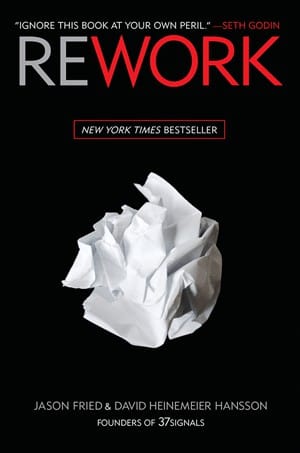
Rework (2010), published by Crown Business, was a mainstream expansion of the Getting Real philosophy. It took the core arguments about simplicity, constraints, and anti-workaholism and packaged them for a broader business audience. The book became a New York Times bestseller and has sold over two million copies worldwide.
Rework's success brought Fried significantly more public attention and put Basecamp's philosophy in dialogue with the dominant startup narrative in a way that Getting Real had not. The book's publication coincided with the emergence of the lean startup movement and the early days of Y Combinator's influence, creating a productive tension between Fried's bootstrapping model and the VC-funded hypergrowth model that was becoming dominant in Silicon Valley.
The Rename and the HEY Email Product
In 2014, 37signals renamed itself Basecamp — adopting the name of its flagship product. The decision reflected a strategic focus: rather than maintaining a portfolio of software products (which had included products like Highrise, Backpack, and Campfire at various points), the company would concentrate on Basecamp and do it exceptionally well.
In 2020, Basecamp launched HEY — an email client with a strong point of view about how email should work. HEY reimagined the inbox with features like the Imbox (important messages), the Feed (newsletters and mass emails), and the Paper Trail (receipts and confirmations), arguing that treating all emails the same way was a fundamental design error. The product was controversial — its launch coincided with a high-profile dispute with Apple over App Store fees — but attracted a dedicated user base.
In 2024, Basecamp launched the "Once" product line — software sold as a one-time purchase that customers install on their own servers, rather than as a subscription SaaS product. Once represented a direct challenge to the SaaS subscription model that had become dominant in enterprise software, arguing that customers were better served by owning their software than by paying indefinitely for access.
Ideas and Philosophy
The Calm Company Concept
Fried's most developed intellectual contribution beyond his product philosophy is what he calls the "calm company" — a business built on sustainable work practices, reasonable expectations, and a deliberate rejection of the urgency theater that characterizes most startup culture.
The calm company philosophy holds that urgency is usually manufactured rather than genuine. Most deadlines are arbitrary. Most priorities are not actually high priority. Most decisions do not need to be made immediately. The culture of constant urgency — always-on communication, instant response expectations, emergency meetings for non-emergencies — creates chronic stress, diminishes deep work, and produces worse decisions than a culture that allows people to think carefully before acting.
This is a provocative position in an industry that treats urgency as a signal of seriousness. Fried's counter-argument is that companies with manufactured urgency are often performing busyness rather than producing genuine output. The metrics that matter — customer satisfaction, product quality, revenue per employee — often favor calm companies over urgent ones.
Bootstrapping vs. Venture Capital
Fried is one of the most consistent critics of venture capital in the startup world, not as a universal condemnation but as a challenge to its status as the default option for ambitious software founders. His argument is that VC comes with specific requirements — large outcomes, rapid growth, eventual exit — that are incompatible with certain types of businesses and certain founders' values.
The specific types of businesses that Fried argues don't need VC are profitable software businesses in markets that don't require massive capital investment to achieve competitive scale. If you can build a product that customers pay for from the beginning, and if the cost of serving those customers is less than the revenue they generate, you don't need external capital to fund operations. You need external capital only to fund growth faster than your organic revenue would allow — and Fried's argument is that for many businesses, growing at the pace that organic revenue allows is perfectly adequate.
Asynchronous Work and the Future of Remote
Long before the COVID-19 pandemic made remote work universal, Fried and Hansson were arguing for asynchronous work as a superior alternative to the synchronous, office-centric model that dominated corporate culture. Their argument was based on the observation that knowledge work — programming, writing, design, analysis — requires sustained concentration that is systematically destroyed by the interruptions and context-switching that office environments generate.
The asynchronous model — where communication happens through written messages that people respond to in their own time, rather than through real-time conversation that requires immediate attention — allows each person to do their best thinking without constant interruption. It also creates a written record of decisions and reasoning that is valuable for organizational memory and new employee onboarding.
Constraints as Creativity Engines
Running through all of Fried's work is a consistent argument that constraints are advantages rather than disadvantages. A small team cannot have long meetings — there's no one to spare. A bootstrapped company cannot build features that don't generate revenue — there's no runway to fund unprofitable experiments. A remote team cannot rely on hallway conversations — it must build communication infrastructure that works without physical proximity.
Each of these constraints forces a higher quality of decision-making. The small team must decide what to build more carefully because they have fewer people to build it. The bootstrapped company must focus on customer value more ruthlessly because customer revenue is what keeps the lights on. The remote team must communicate more deliberately because unclear communication cannot be resolved with a tap on the shoulder.
Books
Getting Real (2006) — The founding document of Fried's philosophy, written for web developers and designers building web applications. Available free online, it remains one of the most widely read texts in the web development community. Its arguments for simplicity, early shipping, and feature restraint have influenced thousands of products.
Rework (2010, with David Heinemeier Hansson) — The mainstream articulation of Fried's anti-growth-culture philosophy. A New York Times bestseller with over two million copies sold. Its short, punchy essays make it accessible to a broad business audience, and its willingness to take clear positions on contested questions makes it more memorable than most business books.
It Doesn't Have to Be Crazy at Work (2018, with David Heinemeier Hansson) — The most developed articulation of the calm company concept. Less focused on founding and more focused on managing an existing company — the organizational practices, communication norms, and cultural values that produce sustainable, high-quality work over long periods. Particularly relevant for founders who have built something and are now trying to figure out how to keep it healthy as it grows.
Podcasts and Interviews
Fried is a regular presence in the entrepreneurship podcast world, though he is selective about where he appears and prefers longer-form conversations to short media appearances. He has appeared multiple times on Tim Ferriss's The Tim Ferriss Show, where his conversations about remote work, company culture, and the decision not to take VC capital have generated significant listener response.
He has been interviewed extensively on The Knowledge Project with Shane Parrish, where his discussions of decision-making and organizational design are among the most practically useful in the show's catalog. His conversation with Parrish on the structure of calm company practices is one of the clearest articulations of the philosophy in any format.
Fried maintains an active presence on the HEY World newsletter platform and writes regularly on topics including software design, organizational culture, and his ongoing experiments with Basecamp's products. His writing is direct, specific, and often willing to name names and take unpopular positions — which makes him one of the more interesting public voices in startup culture regardless of whether you agree with his conclusions.
He and DHH co-hosted The REWORK Podcast and The Rework Podcast for several years, discussing the ideas in the books with guests and in direct conversation. The episodes remain available and constitute one of the most accessible entry points into the full Fried-Hansson philosophy for anyone who prefers audio to text.
Professional Background
Current role: Co-founder and CEO of Basecamp
Previous roles:
- Co-founder of 37signals (1999–2014, rebranded as Basecamp)
Undergraduate: BS, Finance, University of Arizona
Themes
- Bootstrapping
- Anti-VC
- Calm company
- Asynchronous work
- Simplicity
- Profitable software
Popular Works
- Getting Real (2006)
- Rework (2010)
- It Doesn't Have to Be Crazy at Work (2018)
Contributions
Famous Quotes
"Plans are guesses."
"Meetings are toxic."
"Real entrepreneurs ship."
"Workaholism is a disease."
Related Founders
Jason Fried
Related Companies
Basecamp