Reid Hoffman is the co-founder of LinkedIn, a partner at Greylock Partners, a prolific angel investor, and the author of three books on entrepreneurship and the future of work. He is one of a handful of people who can claim to have been central to two of the most significant technology companies of the early internet era — as Executive Vice President at PayPal and as the founder and first CEO of LinkedIn. His intellectual framework, articulated most clearly in Blitzscaling (2018), has shaped how an entire generation of startup founders and venture investors think about market dynamics, network effects, and the strategic use of speed.
Hoffman occupies an unusual position in Silicon Valley. He is simultaneously a practitioner — someone who has built major companies from scratch — and a theorist, someone who has spent decades thinking carefully about why certain companies succeed at scale while others, equally well-funded and equally talented, fail. His podcast Masters of Scale, his books, and his public writing have made him one of the most influential voices in startup culture, even as his profile remains somewhat lower than contemporaries like Elon Musk or Peter Thiel.
What makes Hoffman interesting to students of entrepreneurship is not just what he built, but how he thinks. He approaches business problems the way a philosopher would — with careful attention to definitions, first principles, and the underlying structures that produce observable outcomes. This background is not accidental: before he was an entrepreneur, he was a Rhodes Scholar studying philosophy at Oxford, and that training shows in the precision of his frameworks.
Career
Oxford, Philosophy, and the Road Not Taken
Hoffman was born in 1967 and grew up primarily in the San Francisco Bay Area, though he was born in Stanford. He attended Stanford University, where he studied Symbolic Systems — an interdisciplinary major combining computer science, philosophy, linguistics, and cognitive science — and graduated in 1990. He won a Rhodes Scholarship and spent two years at Wolfson College, Oxford, earning a master's degree in philosophy.
At Oxford, Hoffman considered pursuing an academic career. He was genuinely interested in philosophy as a discipline, not merely as intellectual decoration. But he came to the conclusion — one that he has articulated in interviews many times — that academia's impact was too narrow. If he wanted his ideas to influence how millions of people live and work, building and investing in technology companies would give him more leverage than writing papers for a small audience of specialists. He returned to California and joined the workforce.
Apple and Socialnet (1994–2000)
After Oxford, Hoffman's first job was at Apple, where he worked on user interface design and product strategy for several years. He left Apple to work at Fujitsu before making his first attempt at founding a company. In 1997, he co-founded Socialnet.com, one of the earliest attempts to build an online social network. The concept was ahead of its time — Hoffman has described it as a social network for real-world networks, connecting people through shared interests, relationships, and activities.
Socialnet was not a success. It never found the right product-market fit, grew slowly, and ultimately failed to achieve the critical mass needed to make its network effects valuable. But the experience taught Hoffman more than any success could have: he learned firsthand why early social networks struggled, what the requirements for network-effect-driven growth actually were, and what it felt like to build something that almost worked but didn't. These lessons directly informed LinkedIn's design several years later.
PayPal and the PayPal Mafia (1999–2002)
While Socialnet was struggling, Hoffman joined PayPal in 1999, initially as a board member and then as Executive Vice President. PayPal was a different kind of company — fast-moving, combative, deeply technical, and led by a group of people who all believed they were building something historically significant. Hoffman has described the PayPal experience as a masterclass in startup intensity.
At PayPal, Hoffman worked alongside Peter Thiel, Elon Musk, Max Levchin, David Sacks, Keith Rabois, and others who would go on to build or fund much of the modern technology industry. The so-called "PayPal Mafia" is now famous, but in 1999 it was just a group of very smart people trying to solve the problem of digital money transfer while fighting fraud, regulatory challenges, and well-funded competitors simultaneously.
PayPal was acquired by eBay in 2002 for $1.5 billion. Hoffman's stake from the acquisition gave him the capital to pursue LinkedIn without depending on external funding in the early days.
LinkedIn: Founding and the Early Years (2002–2008)
Hoffman founded LinkedIn in 2002, operating out of his living room with a small founding team. The concept was simple in principle: a social network designed specifically for professional relationships, career management, and business development. But the execution required solving the chicken-and-egg problem that kills most social networks — a network with no users is worthless, but you need users to make the network valuable.
LinkedIn solved this through a combination of virality and focus. Rather than trying to be a general social network, it concentrated on a specific use case — professional profiles and connections — and optimized everything for that use case. The key early growth mechanism was the address book import: users could import their email contacts and see which ones were already on LinkedIn, creating immediate social proof and driving invitations.
The company launched publicly in May 2003 and grew to one million users in its first year. The growth was not explosive by later standards, but it was steady and defensible — LinkedIn was building genuine value for its users in the form of career visibility and professional connections, not just entertainment or distraction.
Hoffman served as CEO until 2008, building the company from 0 to approximately 33 million members and guiding it through its first profitable year. He then transitioned to Executive Chairman, bringing in Dan Nye and later Jeff Weiner to run the company's operations.
Greylock Partners and the Investment Career (2009–present)
In 2009, Hoffman joined Greylock Partners as a partner. His early investment record at Greylock included Facebook (he joined the board as part of a Series D investment) and a direct early investment in Airbnb that became one of the most profitable venture bets of the 2010s. He has also invested in Zynga, Digg, IronPort, Xapo, and dozens of other companies.
As an investor, Hoffman applies the same blitzscaling framework he later articulated in his book: he looks for companies in markets with network-effect potential, founders who understand the winner-take-most dynamics of their market, and teams capable of sustaining the organizational chaos that rapid growth creates. He has been a particularly active investor in companies that are reinventing professional services — the tools, platforms, and networks that people use to build and manage their working lives.
LinkedIn's Acquisition and the Microsoft Era (2016)
In June 2016, Microsoft acquired LinkedIn for $26.2 billion — at the time the largest acquisition in Microsoft's history. The deal valued LinkedIn at approximately 87 times its annual earnings, a premium that reflected both the strategic value of LinkedIn's data and professional network and Microsoft's belief that the acquisition would accelerate its enterprise software business.
Hoffman served on Microsoft's board until 2022. He has expressed satisfaction with how the acquisition played out — LinkedIn retained its brand, culture, and independence within Microsoft, and the company has continued to grow, surpassing one billion members by 2024.
Inflection AI (2022–present)
In 2022, Hoffman co-founded Inflection AI with Mustafa Suleyman, a co-founder of Google DeepMind. The company built Pi, a conversational AI assistant focused on emotional intelligence and personal support — a different approach to AI than the productivity-focused tools that dominated the early ChatGPT era. In 2024, Microsoft acquired key assets and personnel from Inflection, with Suleyman joining Microsoft to lead its AI division. Hoffman remains an active investor and thinker in the AI space.
Reid Hoffman Net Worth
Hoffman's net worth is estimated at approximately $2.5 to $3 billion, derived primarily from three sources: his LinkedIn stake at acquisition, his Greylock investments (particularly early Airbnb and Facebook), and his various board and advisory positions. He has donated substantial amounts to political and philanthropic causes, including significant donations to Democratic candidates and organizations working on disinformation and election integrity.
Ideas and Philosophy
Network Effects as the Foundation
Hoffman's intellectual framework begins with network effects. He has spent more time thinking about network effects than almost any other practitioner in Silicon Valley, and his analysis is more nuanced than the standard "network effects = winner takes all" summary.
In his framework, different types of network effects have different competitive properties. Direct network effects (like telephone networks) are the strongest form — each user directly increases value for every other user. Indirect network effects (like operating system platform effects, where more users drive more app developers, which drives more users) are still strong but can be disrupted by platform switching. Data network effects (where more users generate more data, which improves the algorithm, which attracts more users) are the emerging dominant form in AI-era companies.
Understanding which type of network effect your business has, and how defensible that effect is, shapes every subsequent strategic decision — whether to blitzscale, how much to invest in growth vs. profitability, and which competitors to take seriously.
Blitzscaling Theory
Hoffman's central intellectual contribution is the blitzscaling framework, articulated across his book, his courses at Stanford and Stanford GSB, and hundreds of public lectures and interviews. The framework's core insight is that in markets with strong network effects, the strategic value of market position exceeds the financial value of profitability at any given moment — and therefore companies in those markets should rationally accept losses in order to grow faster.
This is a contrarian position. Standard business education teaches that sustainable growth comes from profitable unit economics and disciplined capital allocation. Blitzscaling explicitly rejects this for specific market conditions, arguing that the cost of capital is less than the cost of ceding market position.
Hoffman is careful to note that blitzscaling is not universally applicable — it's a specific strategy for specific market conditions. He is critical of companies that blitzscale markets that don't have the network effects or winner-take-most dynamics to justify the strategy.
The Startup of You
One of Hoffman's recurring themes, developed most fully in The Start-up of You (2012), is the idea that individuals should manage their careers the way entrepreneurs manage startups — with a clear competitive differentiation, adaptive investments in skills and relationships, and a bias toward taking risks early rather than waiting for certainty. The book argues that the implicit social contract of lifetime employment at a single company is gone, and that individuals who don't adapt to this new reality will fall behind.
This framework has been influential in the career development space, though critics have noted that it places the burden of career risk management on individuals rather than institutions, which has some uncomfortable political implications.
The Alliance Model
The Alliance (2014), co-authored with Ben Casnocha and Chris Yeh, argues for a new model of the employer-employee relationship built on explicit, time-limited "tours of duty." Rather than pretending that either lifetime employment or gig-work casualness is the answer, Hoffman proposes a middle path: structured commitments between employer and employee that are honest about what each party offers and expects, for a defined period.
The book emerged from Hoffman's observation that the most effective talent relationships he saw — both at LinkedIn and among Greylock's portfolio companies — involved this kind of explicit negotiation about mutual expectations and timeframes. It remains one of the clearest frameworks for talent management in a world where long-term loyalty is no longer the default assumption.
Books
The Start-up of You (2012, with Ben Casnocha) — Hoffman's argument that individuals should apply startup thinking to their own career management. The book became a New York Times bestseller and influenced a generation of MBA students and young professionals.
The Alliance: Managing Talent in the Networked Age (2014, with Ben Casnocha and Chris Yeh) — A framework for employer-employee relationships based on explicit tours of duty and mutual investment. Less widely read than Blitzscaling but considered by many people in HR and talent management to be the more practically useful book.
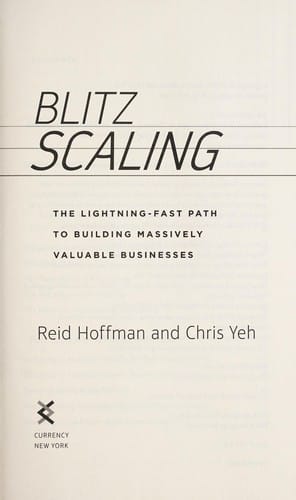
Blitzscaling: The Lightning-Fast Path to Building Massively Valuable Businesses (2018, with Chris Yeh) — The definitive articulation of Hoffman's framework for hypergrowth in winner-take-most markets. Based on a Stanford GSB course that Hoffman taught with John Lilly, the book combines case studies of LinkedIn, Airbnb, Amazon, and other blitzscaling companies with a rigorous framework for understanding when and how to prioritize speed over efficiency.
Podcasts and Interviews
Hoffman is the creator and host of Masters of Scale, one of the most successful business podcasts in the world. Launched in 2017, the show features Hoffman interviewing founders and CEOs about how they built their companies — with a particular focus on the counterintuitive decisions that enabled growth. Guests have included Mark Zuckerberg, Sheryl Sandberg, Arianna Huffington, Eric Schmidt, and dozens of other major figures in technology and business.
The show's format is distinctive: Hoffman presents a thesis at the beginning of each episode (for example, "the best way to build a company is to do things that don't scale") and uses the interview and historical examples to test and illustrate that thesis. The production quality is high, and the show has won multiple podcast industry awards.
Hoffman has also been a frequent guest on Tim Ferriss's podcast, discussing everything from his daily habits to his philosophy of risk-taking and his views on AI and the future of work. His conversation with Ferriss on The Tim Ferriss Show is among the most-downloaded episodes in the show's history.
He has appeared on NPR's How I Built This with Guy Raz, on Kara Swisher's Recode Decode, and in long-form interviews with Bloomberg, the Financial Times, and dozens of other publications. His public talks at Stanford, at TED, and at various startup conferences are widely viewed on YouTube, and his LinkedIn posts on entrepreneurship and AI regularly reach hundreds of thousands of readers.
Hoffman's public persona is unusual for a Silicon Valley figure: he is genuinely intellectually curious, willing to engage with critics, and comfortable discussing the limitations of his own frameworks. He has acknowledged mistakes in his LinkedIn tenure, expressed concerns about the social effects of social media, and been more forthcoming about the potential harms of blitzscaling than most practitioners would be. This intellectual honesty has made him more credible as a theorist, even among people who disagree with his conclusions.
Professional Background
Current role: Partner at Greylock Partners; Co-founder of Inflection AI
Previous roles:
- Executive Vice President at PayPal
- Co-founder and CEO of LinkedIn (2002–2008)
- Executive Chairman of LinkedIn (2008–2016)
- Member of Apple's board-level advisory group
Undergraduate: BS, Symbolic Systems, Stanford University
Graduate: MA, Philosophy, Oxford University (Rhodes Scholar)
Current: Greylock Partners
Past: Microsoft, Airbnb, Edmodo
Themes
- Network effects
- Blitzscaling
- Talent management
- Platform strategy
Influences
Popular Works
- Blitzscaling (2018)
- The Alliance (2014)
- The Start-up of You (2012)
Awards
- Forbes Midas List (multiple years)
- Time 100 Most Influential People
Contributions
Famous Quotes
"An entrepreneur is someone who jumps off a cliff and builds a plane on the way down."
"If you are not embarrassed by the first version of your product, you've launched too late."
Related Founders
Reid Hoffman
Related Companies
LinkedIn