Who Is Peter Zeihan?
Peter Zeihan is an American geopolitical analyst, author, and speaker who argues that the era of global free trade is ending — and that most of the world's governments, corporations, and supply chains are not prepared for what comes next. A former senior analyst at Stratfor, one of the world's leading geopolitical intelligence firms, he has spent two decades building a systematic framework for understanding how geography, demographics, and energy shape the rise and fall of nations.
His books — including The Accidental Superpower (2014), The Absent Superpower (2016), Disunited Nations (2020), and The End of the World Is Just the Beginning (2022) — have attracted a large following among business executives, investors, military strategists, and policy professionals looking for an analytical framework that goes deeper than news cycle analysis. He is not forecasting individual events; he is mapping structural forces that play out over decades.
For startup founders and entrepreneurs, Zeihan's work is relevant at two levels: strategically (understanding which industries and geographies face structural headwinds or tailwinds as deglobalization accelerates) and practically (understanding why supply chains, food systems, and energy grids may become less reliable and more expensive in the years ahead).
Background and Career
Education and Early Career
Zeihan studied international studies at James Madison College, Michigan State University's residential college focused on public affairs and international relations. He joined Stratfor shortly after graduating, initially as a researcher and analyst, eventually rising to a senior analyst position that Stratfor described as VP-level.
Stratfor — the Strategic Forecasting company — is a private intelligence firm based in Austin, Texas, that provides geopolitical analysis to corporations, financial institutions, and governments. It was founded by George Friedman, whose book The Next 100 Years developed a similar geography-first approach to geopolitical forecasting. Zeihan spent over a decade at Stratfor, developing and refining the analytical framework he would later apply in his books.
Zeihan on Geopolitics (2012–present)
In 2012, Zeihan left Stratfor and founded his own firm, Zeihan on Geopolitics, through which he consults with corporations on geopolitical risk and speaks to audiences around the world. His clients include companies doing supply chain risk analysis, agricultural firms, financial institutions, and government entities.
He is based in Colorado and produces a high-volume stream of short video analyses (through his YouTube channel and newsletter) on current geopolitical events, viewed through his structural framework. The YouTube channel has attracted hundreds of thousands of subscribers and serves as an accessible introduction to his longer-form work.
The Core Framework: Geography, Demographics, and the American Order
Zeihan's analytical framework rests on three interconnected pillars:
Geography as the Foundation of Power
The most fundamental layer of Zeihan's analysis is physical geography. He argues that geography shapes everything: trade routes, agricultural potential, military defensibility, national cohesion, and the likelihood of internal conflict. A nation's geography is not something it can change, which makes geography unusually predictive over long time horizons.
The United States, in Zeihan's framework, has the most advantageous geography in human history: the largest network of navigable inland waterways in the world (the Mississippi-Missouri-Ohio-Tennessee system), which allows cheap internal transportation of goods without road or rail infrastructure; two ocean buffers that make invasion virtually impossible; enormous arable land with multiple growing seasons; and a temperate climate that produces stable food surpluses. No country has all of these simultaneously.
The European powers, by contrast, have navigable rivers but they flow across international borders — which historically required military force to control. China has rivers, but they flow parallel to each other rather than connecting into a network. Russia has geography that is defensible but deeply inhospitable.
Demographics as Destiny
The second pillar is demographics — specifically, the age structure of populations. Zeihan argues that demographics is the most powerful and most ignored force in geopolitics and economics. The reasoning is straightforward: the economic output, consumption patterns, and tax base of a country are determined by its working-age population. As populations age and the ratio of workers to retirees shifts, economic models that depend on growth become unsustainable.
His most dramatic claims concern China, which he believes faces a demographic collapse of historic proportions as a result of the one-child policy. The Chinese labor force is aging rapidly, the population is expected to decline, and the social obligations (pensions, healthcare) for an enormous elderly population will fall on a shrinking cohort of workers. Zeihan argues this makes China's continued economic rise structurally impossible over a 20–30 year horizon, regardless of policy choices.
Japan faces a similar dynamic but is further along the curve. Europe's demographics, particularly Germany's, pose similar long-term challenges. The United States, partly because of immigration, has a more favorable demographic profile than most wealthy nations.
The Bretton Woods Order and Its Unraveling
The third pillar is what Zeihan calls the Bretton Woods order — the system of global free trade, security alliances, and institutions (the IMF, World Bank, WTO) that the United States established after World War II.
Zeihan's argument is that the US didn't build this system out of altruism. It built it to contain Soviet expansion during the Cold War: by giving other countries access to American markets and American security guarantees, it built a coalition of allies and client states that were economically integrated and militarily aligned against the Soviet Union. The system required American spending on global naval presence, but the strategic returns were worth it.
With the Soviet Union gone, Zeihan argues, the strategic rationale for the Bretton Woods order has largely evaporated. The US no longer needs global allies to the same degree; its shale revolution has made it energy-independent; and its geography gives it economic self-sufficiency that other countries lack. He argues the US is withdrawing from global security and trade commitments — not because any particular administration chose to, but because the structural incentive that created those commitments no longer exists.
As the American security umbrella shrinks, so does the global order it supported. Trade routes become dangerous without naval protection. Supply chains that depend on political stability across multiple countries become unreliable. Countries that built their economic models on export-led growth (Germany, China, South Korea, Japan) face fundamental challenges when the export markets become less accessible.
Books
The Accidental Superpower (2014)
The first book establishes the geography-of-power framework and applies it primarily to the United States. The "accidental" in the title is Zeihan's argument that American power is less the result of deliberate policy than of structural geographic advantages that were present before the country existed. This book is the best introduction to his framework.
The Absent Superpower (2016)
Focuses on the implications of the American shale revolution — the technological development that made the US energy independent for the first time in generations. The "absent superpower" refers to Zeihan's prediction that an energy-independent US would become progressively less interested in maintaining global order, with destabilizing consequences for energy-importing regions.
Disunited Nations (2020)
A country-by-country analysis of who is positioned to succeed (or fail) in a post-American world order. Zeihan evaluates Russia, China, France, Germany, Japan, Turkey, Iran, Saudi Arabia, and others through his geography-demographics lens. The assessments are often counter-intuitive and occasionally provocative (he is notably bullish on France and bearish on China).
The End of the World Is Just the Beginning (2022)
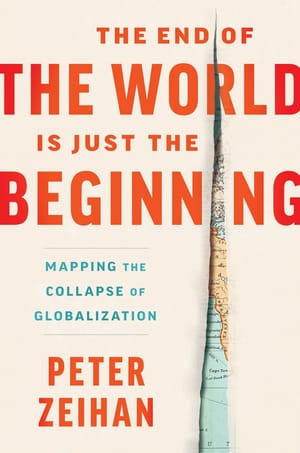
His most ambitious book and his bestseller. The subtitle — "Mapping the Collapse of Globalization" — describes the project: a systematic account of what happens to different sectors (agriculture, manufacturing, energy, finance, transportation) as the global supply chains built over the past 70 years begin to fragment. It was published shortly before the supply chain disruptions of COVID became widely understood, and it reads as prescient in that context.
What He Gets Right — and Where Critics Push Back
Zeihan's framework is genuinely useful for its structural clarity and long-term orientation. His analysis of demographics is rigorous and based on data that is not contested. His geography-as-foundation argument is grounded in centuries of historical evidence.
Critics point to several weaknesses. His tone is often presented as more certain than the underlying analysis warrants — he describes specific outcomes with confidence that complex systems rarely justify. His assessments of China have been contested by China scholars who argue he understates the regime's adaptive capacity. His timelines have sometimes been wrong: he has predicted various inflection points that have not materialized on schedule. And his framework, while powerful for structural analysis, can underweight the role of institutions, leadership, and policy choices in shaping outcomes.
The honest position is that Zeihan offers one of the most useful structural lenses available for long-term geopolitical risk analysis, and it should be used as one input among several rather than as a complete predictive model.
Memorable Quotes
"Geography is destiny." — The foundation of his entire analytical approach.
"The world the Americans made is coming apart. What comes next won't look anything like what we've grown used to." — On deglobalization as a structural, not cyclical, shift.
"Demographics is the most powerful — and most ignored — force in geopolitics." — His case for why the aging of populations in major economies makes their economic challenges structurally irreversible.
Who Should Read His Work
Zeihan is most valuable for:
- Founders and executives building companies with significant exposure to international supply chains, who need a framework for evaluating geographic and political risk
- Investors in sectors like energy, agriculture, manufacturing, and logistics that will be directly affected by deglobalization trends
- Anyone thinking about where to build, source, or sell over a 10–20 year horizon
- People who want a non-consensus view on China, Europe, and Russia from someone who has built a systematic (if sometimes overstated) case for pessimism about their long-term trajectories
Start with The Accidental Superpower for the framework, then The End of the World Is Just the Beginning for the applied analysis.
FAQs
Is Zeihan predicting the end of civilization?
No. His titles are intentionally dramatic, but the content is more measured. "The end of the world is just the beginning" means the end of the particular world order created after 1945 — not the end of human civilization. He's arguing for regional fragmentation and supply chain reorganization, not apocalypse. Some sectors and countries will actually do better in a deglobalized world than they do now (he argues the US is one of them).
How reliable are his predictions?
Mixed. His structural analysis — demographics, geography, energy — is generally solid and grounded in data. His specific timeline predictions have sometimes been off, and he has made confident claims that haven't materialized as described. The honest way to use his work is as a framework for stress-testing assumptions about supply chain stability and geopolitical risk, not as a precise forecast.
What does Zeihan mean by deglobalization?
The fragmentation of global supply chains and trade networks that were built under American security guarantees since 1945. As the US becomes less interested in maintaining global naval presence and security commitments, the world that depended on that commitment — global shipping, rule-based trade, cross-border supply chains — becomes less stable. Companies that built supply chains around cheap goods from China or Eastern Europe are exposed to this structural shift.
How does Zeihan's view on China differ from mainstream opinion?
Most mainstream analysis focuses on China's economic trajectory over the past 40 years and extrapolates continued growth. Zeihan's argument is that China's demographic trajectory — the rapid aging of its population as a consequence of the one-child policy — makes continued growth structurally impossible regardless of policy choices. He is among the most bearish serious analysts on China's long-term future. He has been making this argument since the early 2010s; the question of timing remains open.
Professional Background
Current role: Founder and CEO, Zeihan on Geopolitics; author and speaker
Previous roles:
- Senior Analyst (VP-level), Stratfor (2000–2012)
- Geopolitical analyst and researcher
Undergraduate: BA, International Studies, James Madison College, Michigan State University
Themes
- Deglobalization
- Demographics and aging populations
- Geography and national power
- Energy security and the shale revolution
- Supply chain vulnerability
- The post-Bretton Woods world
Influences
- George Friedman (Stratfor founder)
- Alfred Thayer Mahan (sea power theory)
- Halford Mackinder (heartland theory)
Popular Works
- The Accidental Superpower: The Next Generation of American Preeminence and the Coming Global Disorder (2014)
- The Absent Superpower: The Shale Revolution and a World Without America (2016)
- Disunited Nations: The Scramble for Power in an Ungoverned World (2020)
- The End of the World Is Just the Beginning: Mapping the Collapse of Globalization (2022)
- The Absent Superpower (2016)
Awards
- New York Times bestseller (The End of the World Is Just the Beginning)
Contributions
Famous Quotes
"Geography is destiny."
"The world the Americans made is coming apart. What comes next won't look anything like what we've grown used to."
"Demographics is the most powerful — and most ignored — force in geopolitics."
Links