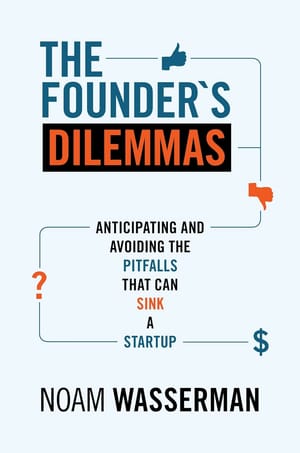
Noam Wasserman spent over a decade studying what actually kills startups — and his answer surprised most people. It's rarely the product. It's rarely the market. Most of the time, startups fail because of the decisions founders make about each other: who to start with, how to split the equity, who gets to be CEO, and when to bring in outside money. His research, covering more than 10,000 founders across technology, life sciences, and consumer industries, turned those findings into The Founder's Dilemmas (2013), one of the most data-driven and practically useful books in startup literature.
Background and Academic Career
Wasserman trained at the Wharton School of the University of Pennsylvania before completing his PhD at Harvard Business School, where he went on to teach for more than fifteen years. As Senior Associate Dean for Research, he built one of the most extensive datasets ever assembled on founding decisions — tracking founders longitudinally to understand how early choices played out over years, not just in hindsight.
In 2019, he moved to the USC Marshall School of Business, where he holds the Dean Trent and Marion Anderson Professorship in Entrepreneurship and leads the Founder Central Initiative, a research and education program focused on the human side of starting companies.
The Research Behind the Book
What sets Wasserman apart from most business authors is his methodology. Rather than interviewing successful founders and working backwards — which introduces survivorship bias — he tracked thousands of founding teams from the start, recording the decisions they made and following what happened next.
The patterns he found were consistent enough to be predictive:
- 73% of founding teams split equity within the first month, often equally and without structured vesting. This single decision is one of the strongest predictors of later conflict.
- Founding with close friends or family increases instability. Each additional prior social tie between co-founders raised the likelihood of a founder leaving by approximately 28% — the opposite of what most people assume.
- Most founder-CEOs are eventually replaced, often involuntarily, and the timing is usually tied to a funding event or a growth inflection point the founder wasn't prepared for.
These weren't anecdotes. They were patterns across thousands of companies, which is what gave the book its unusual authority.
Key Frameworks
Rich vs. King
Wasserman's most widely cited framework distinguishes between two fundamentally different goals founders have, even if they don't articulate them:
- Rich — building financial value, even if it means giving up equity and control
- King — maintaining control over the company, even if it limits how big the company grows
His data showed that founders who prioritize control tend to build smaller companies and generate less personal wealth. Founders who give up control — bringing in co-founders with real equity, raising outside capital, accepting board oversight — tend to build more valuable companies and make more money. The founders who end up both rich and king are the exceptions, not the rule.
The framework is useful not because it tells you which to choose, but because it forces founders to be honest about what they actually want — and to make decisions that are consistent with that goal.
The Three Rs System
Wasserman's second major framework addresses founding team alignment through three interconnected dimensions:
- Relationships — the nature of the personal connection between co-founders (friends, family, former colleagues, strangers)
- Roles — who does what, who is CEO, how decisions get made
- Rewards — how equity and compensation are divided
His argument is that instability and conflict almost always trace back to a mismatch among these three. A team of close friends (relationship) that tries to impose a strict hierarchy (roles) will have friction. A founder doing the majority of the work (roles) while receiving equal equity to a part-time partner (rewards) will build resentment. Getting all three into alignment early — and revisiting that alignment as the company evolves — is one of the most protective things a founding team can do.
Life Is a Startup (2019)
Wasserman's second book extends the same research lens beyond entrepreneurship. Life Is a Startup: What Founders Can Teach Us About Making Choices applies the decision-making frameworks from startup founding to personal life decisions — career transitions, relationships, family choices. The core argument is that the same traps founders fall into (rushing decisions, avoiding difficult conversations, letting inertia drive choices that should be deliberate) appear throughout major life decisions.
The book was praised for making academic research on decision-making accessible and personally relevant, though it reached a broader general audience rather than the entrepreneurship-specific readers of The Founder's Dilemmas.
Teaching and Influence
Wasserman's Harvard Business Review article "The Founder's Dilemma" (February 2008), published before the book, became one of the most widely read pieces in the publication's history. It introduced the Rich vs. King framework to a broad business audience and is now assigned in entrepreneurship courses at universities worldwide.
His courses at Harvard and USC have trained thousands of founders, and his research is regularly cited by venture capitalists, accelerators, and startup advisors as foundational reading on founding team dynamics.
Why His Work Matters
Most startup advice focuses on the product, the market, or the funding. Wasserman's contribution was to focus rigorously on the founding team itself — and to do it with data rather than anecdote. The uncomfortable truth his research surfaces is that most of the decisions that eventually sink startups are made in the first few weeks, when everything still seems fine and nobody wants to have an awkward conversation.
His books don't make those conversations unnecessary. They make them easier to have, and harder to avoid.
The Founder's Dilemmas in Practice
What makes Wasserman's work unusually useful is that it travels well from theory to operating reality. A lot of startup writing becomes vague the moment it leaves the page. Wasserman's frameworks usually do the opposite. Once you understand Rich versus King, you start seeing it everywhere: in founder conflicts over hiring an experienced executive, in disputes about board control, in resistance to raising capital, and in fights over whether a co-founder should step aside for a stronger CEO.
The same is true of the Three Rs. A founding team that looks healthy on the surface can be unstable underneath because the relationships, roles, and rewards no longer match. A friend from college may still hold large equity despite contributing little to the company. A founder who expected to lead product may find that the CEO role has quietly become permanent for someone else. An early equal split may begin to feel unfair once one founder is carrying the company and another has become peripheral. Wasserman's value is that he treats these situations as predictable patterns rather than personal failures.
That is why accelerators, VCs, and founder coaches keep coming back to his work. He gives them a language for diagnosing team risk before the company reaches a crisis point.
What Makes His Research Different
Most startup storytelling is built backward from successful companies. That creates glamorous lessons but weak evidence. Wasserman's approach is different because he follows decisions longitudinally. He does not only ask what founders say worked. He tracks what they chose early and what those choices produced later.
This matters because startup mythology consistently underrates mundane structural mistakes. Founders love to imagine that the decisive variable is vision, hustle, product instinct, or fundraising charisma. Wasserman keeps returning to the harder and less glamorous truth: a startup can have a strong product idea and still die because the founding team made sloppy decisions about equity, authority, and alignment.
That research posture makes him one of the few startup authors who feels more like a serious observer of the category than a participant in its self-marketing.
Lessons Founders Should Apply Early
The strongest use of Wasserman is as preventive reading. Founders should not wait until conflict exists to study his work. The point is to make a few conversations happen earlier and with more precision.
Teams should clarify:
- why each founder is joining
- whether the company goal is maximum growth, maximum control, or some negotiated middle
- how equity reflects future contribution rather than present goodwill
- what happens if one founder leaves, underperforms, or becomes misaligned
- who is actually CEO, and under what conditions that could change
None of this guarantees harmony. It does reduce the number of avoidable explosions. Wasserman's central insight is that ambiguity feels polite in the short term and becomes destructive in the long term.
Limits of His Framework
Wasserman is strongest on founding-team design and governance. He is weaker on product, distribution, customer acquisition, and the creative chaos of building something people want. That is not a flaw so much as a boundary. He is not trying to be a universal startup guru. He is trying to explain one of the least glamorous and most consequential parts of startup life.
Some founders will also find his work emotionally cold because it reduces intimate conflicts to patterns and trade-offs. But that coolness is part of the value. When a team is caught in ego, resentment, or loyalty, it helps to have a framework that forces the conversation back to incentives and structure.
Why He Belongs on This Site
Wasserman belongs in any serious startup reading list because he covers a layer of company-building that founders usually postpone until it is too late. Books like Zero to One help founders think about ambition. Books like The Lean Startup help them think about learning. Wasserman helps them think about the human architecture of the company itself.
That may be less glamorous than product vision or market timing, but it is often more decisive. Startups do not only fail because markets reject them. They also fail because the people at the center of the company stop being able to work, decide, and trust each other effectively. Wasserman made that problem legible.
Talks & Interviews
Stanford eCorner — The Founder's Dilemmas (October 2012)
Wasserman's most widely shared public talk, recorded at Stanford as part of the Entrepreneurial Thought Leaders series. He covers the core frameworks from the book — Rich vs. King, equity splits, co-founder dynamics — with the full dataset behind them. Available as both video and podcast.
Founder's Dilemmas Podcast (2022–ongoing)
A podcast Wasserman co-hosts with entrepreneur Charlie Harary, structured around the themes of the book. Seasons include interviews with founders such as Uri Levine (Waze co-founder) and deep-dives into equity, roles, and investor dilemmas.
Lean Startup — "Life Lessons We Can Learn From Founders"
A conversation on how the frameworks from The Founder's Dilemmas extend to personal decisions, tied to the release of Life Is a Startup.
Charles Koch Foundation — "Life Is a Startup" Interview
A written interview covering the key ideas from his second book and how an entrepreneurial decision-making mindset applies beyond business.
Harvard Business Review — "The Founder's Dilemma" (2008)
The original article that introduced the Rich vs. King framework to a broad business audience, before the book. One of the most-read pieces in HBR history.
Professional Background
Current role: Dean Trent and Marion Anderson Professor of Entrepreneurship, USC Marshall School of Business; Founder and Director, Founder Central Initiative
Previous roles:
- Senior Associate Dean for Research, Harvard Business School
- Professor, Harvard Business School (2003–2019)
Undergraduate: BS, Wharton School, University of Pennsylvania
Graduate: PhD, Harvard Business School
Themes
- Co-founder selection and team dynamics
- Equity splits and the dangers of the equal split
- Rich vs. King — the wealth vs. control trade-off
- CEO succession and founder replacement
- Investor dilemmas and the cost of outside capital
Popular Works
- The Founder's Dilemmas: Anticipating and Avoiding the Pitfalls That Can Sink a Startup (2013)
- Life Is a Startup: What Founders Can Teach Us About Making Choices (2019)
- The Founder's Dilemma — Harvard Business Review (February 2008)
Contributions
Cultural Impact: His 2008 HBR article 'The Founder's Dilemma' became one of the most-read pieces in Harvard Business Review history and is used in entrepreneurship courses worldwide
Famous Quotes
"Most startup failures are self-inflicted."
"Founders who want to get rich should give up control early, and those who want to stay in control should be prepared to stay small."
Related Founders
Bill Gates