Bill Gates is the co-founder of Microsoft and one of the most consequential entrepreneurs in the history of technology. He built Microsoft into the dominant software company of the personal computer era, accumulated one of the largest fortunes in human history, and then spent the second half of his career deploying that wealth through what is now the Gates Foundation.
For startup founders, Gates is a particularly instructive case study not because of his wealth, but because of the specific decisions that made it possible: his early insistence on maintaining control, his aggressive approach to licensing, his obsession with talent density, and his ability to see platform dynamics before most of the industry understood what a platform was.
Gates was born in Seattle in 1955 into an upper-middle-class family — his father was a prominent attorney, his mother a board member of First Interstate Bank. He showed an early obsession with computers at Lakeside School, where he and Paul Allen spent hours programming on a time-sharing terminal, often staying up through the night.
He enrolled at Harvard in 1973 but spent most of his time in the computer lab. In 1975, after reading about the Altair 8800 microcomputer in Popular Electronics, he and Allen contacted the manufacturer claiming they had a BASIC interpreter — they didn't. Gates wrote it in a matter of weeks. He dropped out of Harvard shortly after. He was 19.
Gates and Allen founded Microsoft in Albuquerque, New Mexico. Their initial business was writing BASIC interpreters for early microcomputers. The critical early decision: Gates insisted on retaining ownership of the software, not selling it outright to hardware manufacturers. At a time when most people gave software away or sold it for a flat fee, Gates understood that software would become the most valuable layer of the personal computer stack.
In 1980, IBM approached Microsoft to provide an operating system for its new personal computer. Gates didn't have one — he brokered a deal to license QDOS from Seattle Computer Products for $75,000, rebranded it as MS-DOS, and licensed it to IBM while retaining the right to license it to other manufacturers.
This was the defining business decision of the personal computer era. IBM, fixated on hardware, gave Microsoft the keys to the software kingdom. As IBM-compatible clones proliferated, every clone needed MS-DOS. Microsoft collected royalties on each one.
Microsoft launched Windows in 1985 and spent the next decade turning it into the dominant PC operating system worldwide. By the mid-1990s, running Windows meant running Office, which meant paying Microsoft twice. The antitrust case brought by the US Department of Justice in 1998 — focused on Microsoft's bundling of Internet Explorer with Windows — was the culmination of an era in which Microsoft played hardball with competitors and partners alike. Gates stepped down as CEO in 2000.
Gates transitioned to the Bill & Melinda Gates Foundation, which has committed over $60 billion to global health, poverty reduction, and education. Its work on malaria eradication and polio vaccination has been credited with saving millions of lives. He also co-founded the Giving Pledge with Warren Buffett — a commitment by billionaires to give the majority of their wealth to charity.
Gates's wealth was built almost entirely through Microsoft equity. At Microsoft's peak in 1999, his stake was worth over $100 billion. He has since given away more than $50 billion. As of 2024, his net worth is estimated at approximately $130 billion, depending on Microsoft's stock price and the timing of his foundation transfers.
Software as leverage. Gates's core insight from the beginning was that software — not hardware — was where the enduring value in computing would accumulate. Hardware was subject to commoditization; software was sticky, got better with more users, and could be licensed infinitely at near-zero marginal cost.
Talent density above all else. Gates was famously obsessive about hiring the best programmers. He personally interviewed many early Microsoft engineers. "A great writer of software code is worth 10,000 times the price of an average software writer." He meant it literally and built the company accordingly.
Think weeks. Gates is known for twice-yearly "think weeks" — periods of total isolation in which he reads technical papers and strategy documents submitted by Microsoft employees. He credits this practice with some of Microsoft's most important strategic pivots, including the company's aggressive response to the internet in the mid-1990s.
Platform dynamics. Microsoft's dominance came from understanding, before almost anyone else, that the operating system would become the platform on which everything else ran — and that controlling the platform meant controlling the industry.
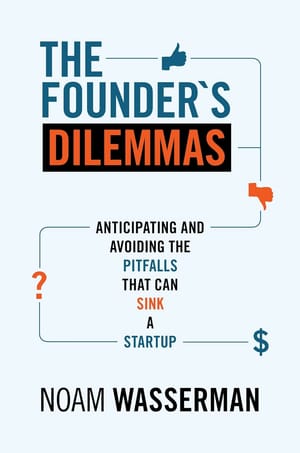
Gates appears in The Founder's Dilemmas by Noam Wasserman as a recurring case study in the trade-off between control and wealth — the "Rich vs. King" dilemma at the center of the book.
Wasserman uses Microsoft's early equity structure to illustrate what happens when a founder retains control: Gates maintained a majority stake and decisive authority over Microsoft for years, which gave him the power to make the IBM deal on his own terms and to keep the company's strategy coherent through rapid change. The flip side, Wasserman notes, is that founders who prioritize control often build less valuable companies overall — but Gates is one of the rare cases where maintaining control and building extraordinary value were not in conflict.
The Microsoft founding story also appears in discussions of co-founder dynamics. Gates and Allen had a genuinely complementary early partnership — Gates's business aggression balanced Allen's technical depth — but their relationship became strained over time. Allen later wrote that Gates had tried to dilute his equity stake while he was ill with Hodgkin's lymphoma. Even the most successful partnerships carry hidden tensions.
Both, genuinely. Gates wrote production code at Microsoft well into the 1980s and did late-night code reviews of his engineers' work. He had an unusual combination of deep technical skill and aggressive business instinct that most programmers lacked.
Three things stand out: First, understand the leverage point in your market — where will value accumulate as everything else commoditizes? Second, retain control for long enough to make the decisions that matter most. Third, hire at the extreme end of the talent distribution — a small number of exceptional people can outperform large teams of average ones.
They operated differently. Jobs was a product visionary who cared intensely about design and user experience. Gates was a platform strategist who cared about owning the layer of the stack that everyone else had to build on top of. Both won, in very different ways.
Current: Co-chair, Bill & Melinda Gates Foundation (now Gates Foundation)
"We always overestimate the change that will occur in the next two years and underestimate the change that will occur in the next ten."
"It's fine to celebrate success, but it is more important to heed the lessons of failure."
"Your most unhappy customers are your greatest source of learning."