Who Is MJ DeMarco?
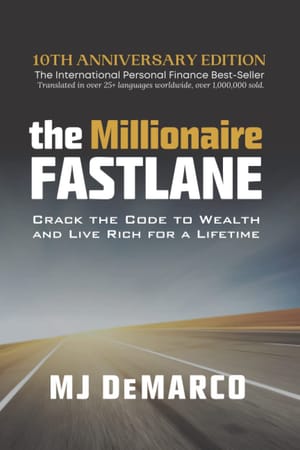
MJ DeMarco is a self-made entrepreneur and author best known for The Millionaire Fastlane (2011), a contrarian book on wealth-building that sold over 500,000 copies with virtually no traditional publishing infrastructure behind it. His story is the material of his books: he grew up in a working-class Chicago household, dropped out of college, drove limousines while building a website for limousine bookings on the side, eventually sold that business, and retired comfortably in his early thirties.
What makes DeMarco unusual in the personal finance and entrepreneurship space is his specific, systematic critique of conventional financial advice. He is not arguing that hard work is bad or that saving is pointless. He is arguing that the specific path promoted by mainstream financial culture — get a job, live frugally, max your 401(k), retire at 65 — is structurally incapable of producing wealth while you're young enough to enjoy it. And he offers a rigorous, framework-driven alternative.
His Story: From Poverty to the Fastlane
DeMarco was born around 1970 in Chicago. His family did not have money, and the message he absorbed from his environment — as he describes it in his books — was the standard script: work hard in school, get a good job, invest steadily, and trust that retirement would eventually deliver financial freedom. He watched adults around him follow this path and found it unconvincing.
He attended Northern Illinois University for a period but didn't complete his degree. By his mid-twenties, he was driving limousines — an experience he describes as clarifying. He was exchanging his time directly for money, with a hard ceiling on what he could earn. No matter how many hours he drove, his income was bounded by how many hours existed in a day.
While driving, he observed that the people who were financially free — the ones being driven rather than doing the driving — had not gotten there by working a job and saving slowly. They had built businesses. That observation became the intellectual seed of the Fastlane framework.
He built LimoLink, a limousine booking website that connected customers with limousine services, in the early 2000s. The business was a marketplace — it could generate revenue while he slept, it could scale without a proportional increase in his time, and it had real exit value. He sold the business (the exact terms have not been disclosed publicly) and retired in his early thirties in Scottsdale, Arizona.
He later built a second business — the Fastlane Forum (thefastlaneforum.com) — and wrote his books through his own publishing company, Viperion Publishing. Neither required a traditional publisher or employer.
The Three Roadmaps
The central metaphor of The Millionaire Fastlane is financial life as a road trip. DeMarco describes three distinct paths, each with its own rules, vehicles, and destinations:
The Sidewalk
The Sidewalk is financial aimlessness — living paycheck to paycheck, spending everything earned (and often more), with no plan and no accumulation. The Sidewalker lives for present consumption: the latest phone, the expensive car on a payment plan, the night out that should have been savings. There is no malice in this; it is often the result of poor financial socialization and the constant marketing pressure to consume. But the destination is poverty and financial precarity, regardless of income level. (DeMarco points out that Sidewalkers can earn large incomes and still be broke, because their spending scales with their earning.)
The Slowlane
The Slowlane is the path most commonly promoted as responsible financial behavior: get a job with good benefits, live below your means, contribute to a 401(k), diversify your investments, and wait for compound interest to do its work over 40 years. DeMarco's critique of the Slowlane is not that it's dishonest — the math is valid — but that it is a deeply flawed wealth vehicle for most people.
His specific objections: the primary input is time, which is finite and non-renewable. You're trading the years between 22 and 65 — when you have energy, health, and capability — for the years after 65, when you may have money but lack the physical capacity to do much with it. The outcome is also heavily dependent on variables outside your control: market returns, inflation, health, longevity. And the upside is capped. No one in the Slowlane becomes extraordinarily wealthy. They become adequately comfortable, if everything goes right.
The Fastlane
The Fastlane is building a business — specifically, the right kind of business, evaluated through the CENTS framework. The Fastlane is not about working harder or grinding longer hours. It is about building a value-creation system that generates revenue independent of the number of hours you work, that can be scaled, and that can eventually be sold or run without your direct involvement.
The key distinction from the Slowlane: in the Fastlane, your wealth is primarily a function of the value you create for others, not the hours you work. The wealth equation he describes is: Wealth = Net Profit + Asset Value. Both variables are scalable in ways that a salary never is.
The CENTS Framework
The CENTS framework is DeMarco's five-part test for evaluating whether a specific business idea can function as a Fastlane vehicle:
Control. Do you control the primary inputs and distribution channels of your business, or are you dependent on a platform, employer, or third party that can change the rules at any time? An Amazon FBA seller has limited control — Amazon can change fees, ban the account, or launch a competing product. A business with its own brand, traffic, and customer relationships has higher control.
Entry. How easy is it to enter this business? If anyone can do it with minimal effort, it will be competed down to low margins. A business with genuine barriers to entry — proprietary technology, regulatory moats, relationships, expertise — has sustainable advantage. "If you can start a business this weekend, so can 100,000 others."
Need. Does the business solve a real problem that real people have? Businesses built on passion rather than genuine customer need tend to fail. The question is not "what do I love?" but "what do people need, and am I solving it better than alternatives?"
Time. Can the business generate revenue without a direct one-to-one relationship between your hours and your income? Consulting, freelancing, and service businesses where your presence is required are time-bound. Software, content, marketplaces, and productized services can break the time-income link.
Scale. Can the business reach a large number of customers? A local service business may be profitable but has a geographic ceiling. A software product, a media property, or a marketplace has national or global scale potential.
A business that scores well on all five dimensions has Fastlane potential. A business that fails multiple criteria is likely to produce a job, not wealth.
Books
The Millionaire Fastlane (2011)
The first and best-known book. DeMarco published it himself through Viperion Publishing, initially with almost no marketing infrastructure. It spread through word of mouth, forum communities (particularly his own Fastlane Forum), and later through social media. The book is written in an aggressive, confrontational style — it repeatedly challenges the reader to evaluate whether their current path actually leads where they think it does. It is dense with frameworks but also with personal narrative from DeMarco's own experience.
Unscripted (2017)
The follow-up, which is longer (456 pages) and broader in scope. Unscripted extends the critique of the Slowlane into what DeMarco calls the "Script" — the entire societal program that conditions people to be employees and consumers rather than entrepreneurs. The TUNEF framework (Time-freedom, Unscripted life, Net-effect, Emancipation, Financial independence) articulates what the Fastlane is actually aimed at: a life defined by choice rather than obligation.
Unscripted is less tightly organized than The Millionaire Fastlane but covers a broader range of business-building principles and is more philosophical about purpose and meaning.
LEAP (2023)
His most recent book, subtitled The D.A.N.G.E.R.O.U.S. Entrepreneur's Guide, focuses on the specific mindset shifts required to move from a consumer/employee orientation to an entrepreneurial one. It is more focused and actionable than Unscripted and introduces new frameworks for thinking about value creation and business model design.
Memorable Quotes
"Stop following the wrong roadmap." — The entire argument of The Millionaire Fastlane in five words.
"Your choices of today become your biography of tomorrow." — On the compound effect of daily decisions.
"Trade your time for a paycheck or trade your ideas for a fortune — the choice is yours." — The central trade-off the Fastlane framework is built around.
"The Fastlane isn't about being rich. It's about having the freedom to live the life you want." — The clarification that wealth is instrumental, not the terminal goal.
Who Should Read His Work
DeMarco's books are most valuable for:
- People who are dissatisfied with the conventional career path and want a rigorous framework for thinking about alternatives
- Aspiring entrepreneurs who want to evaluate whether their business idea has genuine wealth-creation potential before investing years in it
- Anyone who has read mainstream financial advice (index funds, frugality, delayed gratification) and wants a counterargument grounded in business ownership rather than investing
- Young people early in their careers who have time to build a Fastlane business if they start now rather than at 50
His work is not academic and not aimed at people who are already financially sophisticated. The tone is blunt and sometimes strident — he is writing for people who need to be shaken out of comfortable assumptions, not for those who have already discarded them. If that style feels off-putting, the substance is still worth extracting.
FAQs
Is MJ DeMarco's framework just "start a business and get rich"?
No — the CENTS framework is a specific filter for what kind of business can produce Fastlane wealth. Most businesses, including many profitable ones, don't meet the criteria: they're too time-dependent, have too little control, or have no scalability. The framework is more useful as a filter for evaluating business ideas than as a general prescription to start any business.
How does DeMarco compare to Robert Kiyosaki?
Both critique the conventional employment-and-saving path, and both argue for building assets rather than trading time. But DeMarco is more systematic and more honest about his own story. Kiyosaki's Rich Dad Poor Dad is intentionally allegorical and inspirational; DeMarco is more explicit about the mechanics of building a scalable business. DeMarco has also been more transparent about his own path, while Kiyosaki has faced persistent questions about the factual basis of the "rich dad" story.
Is the Fastlane only for tech entrepreneurs?
No. DeMarco's own Fastlane business was a service marketplace (limousine bookings), not a software company. The CENTS framework applies to any business model — physical products, service businesses, content and media, marketplaces, SaaS, professional services that have been productized. The question is not the industry but whether the business structure meets the five criteria.
What's the best book to start with?
The Millionaire Fastlane for most people. It is the tighter, more focused book. Unscripted is better as a second read, once you've accepted the core premise and want the broader framework and philosophy. LEAP is best for readers who are already committed to entrepreneurship and want tactical guidance on mindset and business model design.
Professional Background
Current role: Author; Founder, Viperion Publishing
Previous roles:
- Founder and CEO, LimoLink (limousine booking website, sold ~2005)
- Limousine driver
- Various service industry jobs
Undergraduate: Attended Northern Illinois University (did not complete)
Themes
- The three wealth roadmaps
- CENTS framework for business evaluation
- Scalable value creation
- Financial independence through business ownership
- Rejection of the Scripted consumer-work-retire life path
Influences
- His own experience of poverty and slow wealth-building myths
Popular Works
- The Millionaire Fastlane: Crack the Code to Wealth and Live Rich for a Lifetime (2011)
- Unscripted: Life, Liberty, and the Pursuit of Entrepreneurship (2017)
- LEAP: The D.A.N.G.E.R.O.U.S. Entrepreneur's Guide (2023)
Awards
- Self-published bestseller — The Millionaire Fastlane sold over 500,000 copies with minimal traditional marketing
Contributions
Cultural Impact: Influenced a generation of online entrepreneurs to evaluate business models through the CENTS lens; frequently cited alongside Tim Ferriss and Robert Kiyosaki as an alternative to conventional financial advice
Famous Quotes
"Stop following the wrong roadmap."
"Your choices of today become your biography of tomorrow."
"Trade your time for a paycheck or trade your ideas for a fortune — the choice is yours."
"The Fastlane isn't about being rich. It's about having the freedom to live the life you want."
Links