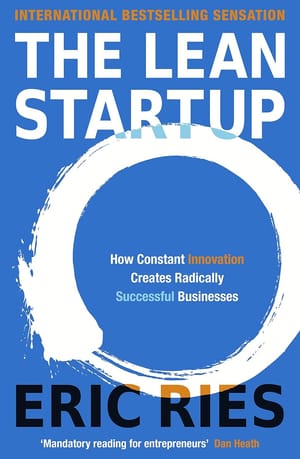
Eric Ries was born in 1978 in New Haven, Connecticut. He left Yale University without completing his computer science degree to co-found a company, went through a series of startup experiences that ranged from failure to modest success, and developed along the way the methodology that he published as The Lean Startup in 2011. The book has sold more than three million copies, has been translated into over thirty languages, and has become the standard reference for early-stage product development worldwide.
Ries is a practitioner rather than an academic. His framework emerged not from research or theory but from painful experience building products that nobody used, at IMVU and at earlier ventures. The specific failures he describes in the book — months spent building features based on untested assumptions, optimization of metrics that did not reflect business health, strategic decisions made on intuition rather than evidence — are familiar to most founders because they are nearly universal experiences. What Ries contributed was a vocabulary and a systematic methodology for avoiding and diagnosing these failures.
He lives in San Francisco and continues to work as an entrepreneur, advisor, and speaker. Since publishing The Lean Startup, he has worked with companies ranging from early-stage startups to General Electric, the U.S. government, and the United Nations to apply lean startup principles in contexts far removed from Silicon Valley software development.
Career
Catalyst Recruiting (2001–2003)
Ries's first company was Catalyst Recruiting, a social software platform for college recruiting. He co-founded it while at Yale and left school to work on it full time. The company failed. Ries has described Catalyst Recruiting as a formative experience in building something that nobody wanted — a product developed based on assumptions about what recruiters and students needed, validated only by the founders' convictions rather than by evidence from actual users. The failure taught him the cost of building on unvalidated assumptions, though he would not develop the systematic response to that lesson until several years later.
IMVU (2004–2008)
IMVU was co-founded in 2004 by Ries, Will Harvey, and several others. The concept was a 3D avatar-based social platform — users would create customizable avatars and use them to interact with other users in virtual spaces. The social platform space was attracting significant attention and investment in the mid-2000s, and the IMVU team believed that 3D avatars offered a genuinely differentiated social experience.
What happened next became the source material for The Lean Startup. The IMVU team spent months building a product based on a series of assumptions that they believed were obviously correct. The most significant was the assumption about integration with existing instant messaging networks: customers already had their social graphs in AIM, MSN Messenger, and Yahoo! Messenger; adding IMVU avatars to those conversations would lower the adoption barrier. They built the integration. Almost nobody used it. The assumption that seemed obvious turned out to be wrong in ways that were only discoverable by actually shipping the product to real users.
The experience of building features nobody used, measuring metrics that felt positive but did not reflect business health, and making strategic decisions based on intuition rather than evidence drove Ries to look for a better approach. He encountered the work of Steve Blank — whose customer development methodology emphasized testing business model assumptions through direct customer interaction — and the principles of lean manufacturing, which emphasized eliminating waste and building quality in through rapid feedback rather than inspection after the fact. He began applying these ideas to IMVU's product development process.
The results were striking. Moving to smaller, faster cycles of building and measuring dramatically reduced the time between a hypothesis and the evidence that validated or falsified it. The team shipped more experiments, learned more, and made better decisions about where to invest. IMVU grew to profitability, and Ries left in 2008 with the conviction that the methodology deserved to be systematized and shared.
The Blog and the Book (2008–2011)
After leaving IMVU, Ries began writing about the methodology on his blog, Startup Lessons Learned, which quickly attracted an audience of founders and product managers who recognized their own experiences in his descriptions of the problems he was trying to solve. The blog posts that generated the most engagement became the chapters of the book.
The Lean Startup was published by Crown Business in September 2011. It debuted on the New York Times bestseller list and remained there for months. It was named one of the best business books of the year by Time magazine, The Economist, and Bloomberg BusinessWeek.
Post-Book (2011–Present)
Since the publication of The Lean Startup, Ries has continued to develop and apply the methodology in a widening range of contexts. He published The Startup Way in 2017, which extends the lean startup principles to large enterprises — addressing how established companies can use the methodology to accelerate innovation, reduce the waste associated with failed product launches, and build the organizational capabilities required for continuous innovation.
He has also been involved in a project called the Long-Term Stock Exchange (LTSE), which he co-founded to address what he sees as a structural misalignment between public market incentives and long-term company building. LTSE received SEC approval in 2019 and launched as a national securities exchange, providing an alternative venue for companies that want to be listed on terms that reward long-term thinking rather than short-term quarterly performance.
Ries continues to advise startups and large companies, speak at conferences, and contribute to the ongoing development of lean startup thinking. The methodology has evolved significantly since 2011 — the product management and startup communities have built on his foundational concepts, and the vocabulary he introduced (MVP, pivot, validated learning, Build-Measure-Learn) has entered the standard language of technology product development.
Ideas and Philosophy
Build-Measure-Learn
The Build-Measure-Learn loop is the structural center of the Lean Startup methodology. Ries's insight was that the natural order of product development — plan, build, measure — buries the most important activity (learning) at the end, after resources have already been committed. He proposes inverting the process: start by identifying what you most need to learn, work backward to what measurement would answer that question, then build only what is required to generate that measurement.
This inversion has consequences throughout the product development process. It changes what constitutes a good MVP (the smallest experiment that generates the most important learning, not the smallest product that is complete enough to ship). It changes what constitutes good metrics (measurements that directly answer the questions you need to answer, not measurements that are easy to generate). It changes what constitutes progress (validated assumptions, not features shipped).
Minimum Viable Product
Ries coined the term "minimum viable product," though he has acknowledged that the concept was being developed simultaneously by others, including Steve Blank and Frank Robinson. His specific contribution is the learning-centered definition: the MVP is not the minimum product you can ship; it is the minimum experiment that generates the maximum validated learning per unit of effort.
The MVP framework has been widely adopted and widely misunderstood. The most common misuse is building a small, incomplete product and calling it an MVP, without asking what assumption the product is testing or what measurement would validate or falsify that assumption. Ries's definition is more demanding: before building anything, identify the most important assumption your business depends on; then design the smallest experiment that could test that assumption.
Pivoting
Ries's definition of a pivot is more specific than the common usage. A pivot is not any change in direction — it is a structured course correction that preserves the validated learning accumulated so far while testing a new hypothesis about a better path forward. The specific taxonomy of pivot types he identifies (zoom-in, zoom-out, customer segment, customer need, platform, business architecture, value capture) is a diagnostic tool: when you determine that a pivot is needed, the taxonomy helps you identify what specifically needs to change.
The pivot-or-persevere decision is one of the most difficult in startup life, and Ries addresses it directly. His prescription is to base the decision on whether your actionable metrics are improving toward the benchmarks that would indicate a viable business. If they are, persevere. If they are not — after genuine attempts to tune the engine — pivot.
Validated Learning
Validated learning is learning that is confirmed by real customer behavior, as distinct from opinions, surveys, or founder convictions. It is the genuine unit of startup progress because, in a startup's early stages, the primary task is not execution but search: finding the product, market, and business model that work.
The Five Whys
Ries adapts the Toyota Production System's "Five Whys" technique — a method for finding root causes of problems by asking "why?" five times in sequence — to the startup context. When a team encounters a problem, applying the Five Whys prevents the common failure mode of addressing symptoms rather than root causes, and reveals whether what looks like a technical problem is actually a human problem, or what looks like an operational problem is actually a strategic one.
Books
The Lean Startup: How Today's Entrepreneurs Use Continuous Innovation to Create Radically Successful Businesses (2011) is Ries's foundational work. It introduces the Build-Measure-Learn loop, the MVP, validated learning, the pivot, and innovation accounting, grounded in the IMVU experience and illustrated with examples from dozens of other startups. It remains the definitive introduction to the methodology.
The Startup Way: How Modern Companies Use Entrepreneurial Management to Transform Culture and Drive Long-Term Growth (2017) extends the lean startup principles to established companies. It addresses the organizational and cultural challenges of applying a startup methodology inside a large corporation, and includes case studies from General Electric, Amazon, Toyota, and the United States government. The central argument is that the conditions of extreme uncertainty that characterize startups — uncertain customer needs, uncertain technology, uncertain market size — are increasingly present throughout the economy, and that the tools startups have developed for navigating uncertainty are therefore increasingly relevant to any organization.
Podcasts and Interviews
Ries has been a prolific speaker and interview subject since the publication of The Lean Startup. Notable appearances include:
- The Tim Ferriss Show — discussion of the lean startup methodology, the IMVU origin story, and the Long-Term Stock Exchange project
- Masters of Scale with Reid Hoffman — conversation on how the lean startup principles apply at scale, and how large companies can maintain entrepreneurial capability
- How I Built This with Guy Raz — IMVU's founding story and the development of the lean startup methodology
- The Knowledge Project with Shane Parrish — deep dive into decision-making under uncertainty, mental models for product development, and the intellectual influences behind the lean startup
- Stanford View from the Top — multiple appearances discussing entrepreneurship, product development, and the enterprise application of lean startup principles
- TED Talk: "The Lean Startup" — one of his most widely viewed talks, summarizing the core methodology for a general audience
- Y Combinator podcast — conversation with YC partners about how lean startup principles interact with the YC model and early-stage startup development
Professional Background
Current role: Author, entrepreneur, and advisor
Previous roles:
- Co-founder and CTO of IMVU (2004–2008)
- Co-founder of Catalyst Recruiting
Undergraduate: BS, Computer Science, Yale University (incomplete — left to co-found a company)
Themes
- Validated learning
- Minimum viable product
- Pivoting
- Build-Measure-Learn
- Innovation accounting
Popular Works
- The Lean Startup (2011)
- The Startup Way (2017)
Contributions
Famous Quotes
"The only way to win is to learn faster than anyone else."
"Success is not delivering a feature; success is learning how to solve the customer's problem."
Related Founders
Eric Ries
Related Companies
IMVU