Who Is Roger Martin?
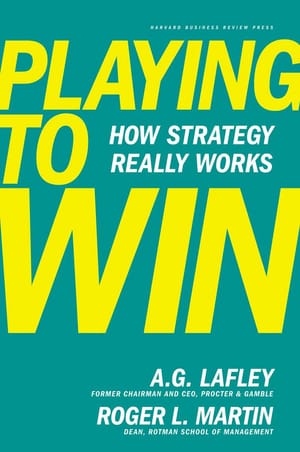
Roger L. Martin is a Canadian business strategist, author, and former Dean of the Rotman School of Management at the University of Toronto. He is best known for co-authoring Playing to Win: How Strategy Really Works (2013) with A.G. Lafley, the former Chairman and CEO of Procter & Gamble — a book that presents arguably the clearest and most actionable framework for corporate strategy published in the past two decades. He was ranked the world's #1 management thinker by Thinkers50 in 2017.
What distinguishes Martin's contribution to business thinking is his ability to do two things simultaneously: build rigorous, philosophically grounded frameworks and apply them directly to real strategic decisions in real companies. His work on Playing to Win was not a consulting project done on the side — he was P&G's primary strategy advisor for years, and the cascade of strategic choices described in the book is drawn from actual decisions made at one of the world's largest consumer goods companies.
Academic Career and Rotman Transformation
Education and Early Career
Martin completed his undergraduate degree in economics at Harvard College and his MBA at Harvard Business School. After working as a strategy consultant at the Monitor Company (later Monitor Deloitte), he returned to academia and joined the Rotman School of Management at the University of Toronto in 1998 as its new Dean.
Dean of Rotman (1998–2013)
When Martin took over Rotman in 1998, it was a well-regarded Canadian business school with limited international profile. Over 15 years, he transformed it into a globally recognized institution known particularly for its integration of design thinking and business, its emphasis on integrative thinking as a core skill, and its reputation for producing original management research.
He recruited exceptional faculty, built connections with the business community, and championed the idea that business schools should be about developing judgment and creative problem-solving, not just transmitting analytical techniques. The Rotman Design Works and the Martin Prosperity Institute (which he led after stepping down as Dean) became internationally recognized research centers.
He also built a remarkable advisory network, working directly with CEOs of major corporations — including A.G. Lafley at P&G, Claudia Kotchka at P&G, Jim Balsillie at RIM, and many others — and bringing those real-world strategic challenges back into the classroom.
Integrative Thinking
Before Playing to Win, Martin's most influential conceptual contribution was the theory of integrative thinking, developed in The Opposable Mind (2007).
The core argument: most decision-making frameworks teach you to evaluate options and select the best one. But exceptional leaders — the ones who consistently produce superior outcomes — do something different. When faced with two opposing options, they don't choose between them. They hold the tension between them and generate a creative synthesis: a third option that incorporates the best elements of both while transcending the limitations of either.
Martin based this on interviews with over 50 extraordinary leaders, from Jack Welch and Bob Rubin to Isadore Sharp (Four Seasons founder). The pattern he found across all of them: a willingness to tolerate the discomfort of holding contradictory ideas in mind simultaneously, rather than prematurely collapsing to one answer.
The name comes from the physical structure of the human thumb — the "opposable" thumb that allows humans to grip things that no other primate can. Martin argues that the most valuable cognitive capacity in business is the equivalent mental feature: the ability to oppose two ideas and work between them rather than forcing a premature choice.
For founders, integrative thinking is directly relevant to the recurring situations where the alternatives on the table all have unacceptable downsides: how to grow fast without sacrificing quality; how to give customers choice without overwhelming them; how to invest for the long term while meeting short-term financial obligations. The integrative thinker doesn't accept that trade-off as fixed — they look for a configuration that dissolves it.
The Playing to Win Framework
Playing to Win (2013), co-authored with A.G. Lafley, is the book most commonly assigned in MBA strategy courses today. Its central argument is one that sounds simple but turns out to be hard to execute: strategy is not a plan — it is an integrated set of choices.
The book builds a five-question cascade that defines a complete strategy:
1. What Is Your Winning Aspiration?
The first question establishes the mission of the enterprise in competitive terms: not "what do we do?" but "what does winning look like?" Martin and Lafley distinguish between aspirations that are genuinely oriented toward winning (being the best in a specific arena, for a specific set of customers) and those that are vague enough to provide no strategic direction (being "the world's most admired company" or "delivering value to all stakeholders").
For P&G under Lafley, the winning aspiration was: "touching and improving more consumers' lives in more parts of the world, more completely." That's a competitive orientation, not just a purpose statement.
2. Where Will You Play?
The second question defines the competitive arena: which markets, which geographies, which customer segments, which channels, which stages of the value chain. "Where to play" is about deciding what to include and, critically, what to exclude. A strategy that tries to be everything to everyone is not a strategy — it is the absence of one.
Martin and Lafley describe P&G's decision to exit the food business (Crisco, Pringles) and focus on health, beauty, and household products as a "where to play" choice that unlocked everything else: clearer brand architecture, more coherent R&D investment, more focused retail relationships.
For founders, "where to play" is the market selection question. It's Peter Thiel's insight — start in a specific niche where you can win completely — expressed in strategic terms.
3. How Will You Win?
"Where to play" without "how to win" is just a wish. The third question defines the competitive advantage that will allow you to win in the chosen arena. Martin and Lafley identify two generic ways to win: cost leadership (being the low-cost producer) or differentiation (offering something distinctive that customers value enough to pay for). But in practice, specific winning strategies are more nuanced — P&G won through superior consumer insight (understanding what consumers actually want better than competitors) and through superior innovation, applied at global scale.
The "how to win" choice must be matched to the "where to play" choice: the same capability that wins in one arena will fail in another.
4. What Capabilities Must Be in Place?
The fourth question is about the activities, skills, systems, and capabilities that are required to execute the "how to win" choice. This is where strategy meets operations. Martin is emphatic that strategy without a capability plan is wishful thinking: the capabilities required to win must be built deliberately, often over years, and they are not interchangeable.
5. What Management Systems Are Required?
The fifth question is the most frequently overlooked: what organizational processes, structures, metrics, and systems need to be in place to support and reinforce the strategic choices? If your "how to win" depends on consumer insight, you need research processes that generate genuine insight (not just market data that confirms existing beliefs), incentives that reward insight-driven decisions, and leadership development that builds insight capability.
Martin and Lafley are explicit: the five questions form a cascade, not a checklist. The choices must be mutually reinforcing — each choice constrains and informs the others. A strategy where the management systems contradict the "how to win" choice will not hold.
The Design of Business and the Knowledge Funnel
In The Design of Business (2009), Martin introduced another framework that has proven durable: the Knowledge Funnel. He argues that all business innovation follows the same progression:
- Mystery — a phenomenon that is not yet understood. Why do some neighborhoods gentrify faster than others? What makes some products viral?
- Heuristic — a rule of thumb that captures the pattern. "Young professionals moving to a neighborhood is an early gentrification signal."
- Algorithm — a precise, executable formula. A specific model for predicting neighborhood price appreciation.
The problem is that corporations reward the management of algorithms (the reliable, efficient execution of known formulas) but systematically under-invest in the exploration of heuristics and mysteries. The result is that the business stays optimized for what it already knows how to do, and loses the capacity to discover what it needs to do next. This is essentially the same trap Christensen describes in The Innovator's Dilemma, arrived at from a different direction.
Other Books
A New Way to Think (2022) is Martin's most recent synthesis — a collection of original frameworks for strategy, innovation, competition, and management, written for executives who want new mental models rather than a single comprehensive approach. It covers 13 distinct domains, including customer choice theory, competition, and corporate governance.
Memorable Quotes
"Strategy is not a plan; it is an integrated set of choices." — The core argument of Playing to Win, distinguishing strategy (mutually reinforcing choices about where to compete and how to win) from planning (a schedule of activities).
"The problem with most strategy processes is that they are designed to produce comfort, not insight." — On why most strategy planning generates consensus documents rather than genuine strategic choices.
"An integrative thinker doesn't ask 'which option is better?' She asks 'how can I create a better answer than any of the options in front of me?'" — The practical application of integrative thinking.
Who Should Read Playing to Win
Playing to Win is essential reading for:
- Founders moving beyond early product-market fit who need to articulate a coherent strategy to investors, employees, and partners
- CEOs of growth-stage companies who need a framework for making "where to play" and "how to win" choices as the company scales
- Corporate strategists who want to stress-test whether their company's current strategy is a genuine integrated set of choices or a plan with aspirations
- Anyone who has found Michael Porter's frameworks useful but wants something more actionable and grounded in recent corporate practice
Martin's work is also valuable paired with Good Strategy Bad Strategy by Richard Rumelt, which covers similar territory with a slightly different emphasis: Rumelt focuses on the anatomy of good and bad strategy; Martin focuses on the process of making the right strategic choices.
FAQs
What is the co-authorship dynamic between Roger Martin and A.G. Lafley?
The book emerged from a genuine intellectual partnership. Lafley was P&G's CEO from 2000–2009 and 2013–2015, during which time Martin served as his primary external strategy advisor. The framework in Playing to Win was developed through real strategic decisions at P&G — not invented in a classroom and then applied to case studies. Lafley brought the experience of actually leading a company through the strategy cascade; Martin brought the conceptual framework and articulation. The book's credibility rests on both contributions.
Is the Playing to Win framework only for large corporations?
No, though most of the examples in the book are drawn from P&G. The five questions — winning aspiration, where to play, how to win, capabilities, management systems — apply at any scale. For a seed-stage startup, the cascade is simpler, but the logic is the same: what market are you entering, what is your specific competitive advantage, what capabilities do you need to build, and what processes will reinforce those choices? Martin has written about and spoken about applying the framework to small businesses and even personal career strategy.
How does Roger Martin's strategy framework compare to Porter's Five Forces?
Porter's Five Forces is a framework for analyzing the attractiveness of an industry — the structural factors that determine whether a market is worth entering and what determines profitability. Playing to Win is about what choices to make once you're competing. They operate at different levels and are complementary: use Porter to evaluate the landscape, use the Playing to Win cascade to make decisions within that landscape. Martin explicitly builds on Porter's work and cites him as an influence.
What is the Thinkers50 ranking and why does it matter?
Thinkers50 is a biennial ranking of the world's most influential management thinkers, based on criteria including the originality of ideas, practical relevance, and impact on business practice. Being ranked #1 is roughly analogous to being recognized as the most consequential management theorist alive at that moment. Martin held that position in 2017; Clayton Christensen held it in 2011 and 2013. The ranking is not an academic prize — it specifically measures real-world influence on how businesses operate.
Professional Background
Current role: Professor Emeritus and Institute Director, Martin Prosperity Institute, University of Toronto; Senior Advisor, Monitor Deloitte
Previous roles:
- Dean, Rotman School of Management, University of Toronto (1998–2013)
- Director, Monitor Company (now Monitor Deloitte)
- Strategy advisor to CEOs of major corporations including P&G, Lego, TD Bank
Undergraduate: AB, Economics, Harvard University
Graduate: MBA, Harvard Business School
Themes
- Strategy as a set of choices, not a plan
- Integrative thinking
- The strategy cascade
- Design thinking in business
- Where to play and how to win
- Knowledge funnel and innovation
Influences
- A.G. Lafley
- Michael Porter
- Herbert Simon
- John Dewey
Popular Works
- Playing to Win: How Strategy Really Works (2013, co-authored with A.G. Lafley)
- The Opposable Mind: How Successful Leaders Win Through Integrative Thinking (2007)
- The Design of Business: Why Design Thinking is the Next Competitive Advantage (2009)
- A New Way to Think: Your Guide to Superior Management Effectiveness (2022)
Awards
- Thinkers50: #1 ranked management thinker in the world (2017)
- Thinkers50: Top 10 management thinkers (2011, 2013, 2015)
- McKinsey Award for best Harvard Business Review article (multiple)
Contributions
Famous Quotes
"Strategy is not a plan; it is an integrated set of choices."
"The problem with most strategy processes is that they are designed to produce comfort, not insight."
"An integrative thinker doesn't ask 'which option is better?' She asks 'how can I create a better answer than any of the options in front of me?'"
Links