Who Is David Goggins?
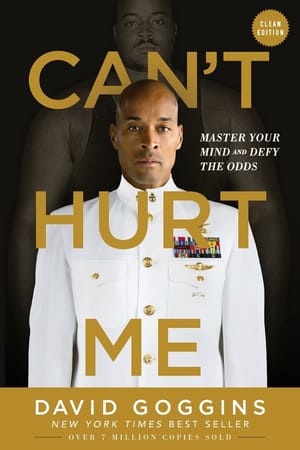
David Goggins is a retired Navy SEAL, ultramarathon runner, ultra-distance cyclist, and author of Can't Hurt Me: Master Your Mind and Defy the Odds (2018). He is one of the most recognized voices on mental toughness in the world — not because of a credential or a degree, but because of what he has actually done. He grew up in poverty with an abusive father, struggled with learning disabilities, worked as a pest control worker in his early twenties weighing nearly 300 pounds, and then systematically transformed himself into one of the most decorated endurance athletes alive.
He has completed more than 60 ultra-distance races, including races of 100+ miles through desert heat and arctic cold. He holds a Guinness World Record for completing 4,030 pull-ups in 17 hours. He is the only member of the U.S. Armed Forces to complete SEAL training, Army Ranger School, and Air Force TACP qualification. His core argument — that the human mind gives up long before the body actually needs to — has reached tens of millions of people and shaped a new vocabulary for discussions of discipline, resilience, and potential.
Background and Early Life
Goggins was born in 1975 in Buffalo, New York. His childhood was defined by his father, Trunnis Goggins, who owned a roller-skating rink and ran it through a combination of forced child labor and physical abuse. By the time Goggins was eight years old, he and his mother escaped to rural Indiana, where he faced racism in school and struggled academically — later discovering he had a learning disability and attention deficit disorder. He describes developing a speech impediment and a fear of others as a result of his early years.
By his early twenties, Goggins had gained significant weight and was working as a pest control worker — spraying cockroaches in fast-food restaurants at night. He describes this period as the low point of his life: directionless, overweight, and aware that he was not living anywhere near his potential.
Military Career
In 1999, at 24, Goggins saw a documentary about Navy SEALs and decided, on impulse, that he would try to become one. There were several problems: he was 106 pounds overweight, his enlistment deadline was weeks away, and he had a history of sickle-cell trait that could disqualify him. In roughly 90 days, he lost the weight through extreme diet and training, qualified medically, and reported for training.
He went through SEAL training (BUD/S) three times — washing out with hypothermia in his first attempt and a stress fracture in his second — before completing it on his third attempt. He deployed multiple times to Iraq and Afghanistan, where two of his close friends from SEAL Team Five were killed in a helicopter crash in 2005.
After the military, Goggins transitioned to ultra-endurance athletics, using races of extreme distance and difficulty as the next arena for testing his frameworks. He ran his first 100-mile race — the San Diego One Day — with almost no preparation, finishing 5th and raising over $100,000 for the Special Operations Warrior Foundation, which supports families of fallen special operations personnel.
Key Frameworks
The 40% Rule
The most widely cited idea from Can't Hurt Me: when your mind tells you that you've hit your limit — that you can't go further, that you have nothing left — you have actually only reached approximately 40% of your true capacity. The remaining 60% is locked away by your brain as a protective reserve, and accessing it requires deliberate mental overriding of the quit signal.
Goggins developed this through personal experience: every time he thought he was done during a race or training session, he discovered that he could continue. The rule is not scientific in the clinical sense — it's an operational framework for ignoring the mind's first, second, and third signals to stop.
For founders and entrepreneurs, the 40% rule applies directly to the moments in building a company when the mind says "this is impossible" or "I can't continue." Goggins' argument is that those moments are not informative about actual capability — they're informative about the current boundary of your mental callousness, which can be expanded.
The Accountability Mirror
Early in his transformation, Goggins developed a practice of writing his most uncomfortable truths on sticky notes and putting them on his bathroom mirror. Not motivational quotes — brutal honesty about who he was, what he was avoiding, what excuses he was making. The mirror became a daily confrontation with the gap between who he was and who he wanted to be.
The accountability mirror is about removing the distance between self-knowledge and self-honesty. Most people know what they need to do. They talk themselves out of confronting it. The mirror practice forces the confrontation every morning before the day's rationalizations have a chance to build.
The Cookie Jar
During extreme physical efforts, Goggins mentally reaches into what he calls the "cookie jar" — a mental inventory of previous hardships he has survived, races he has finished, obstacles he has overcome. When the present moment feels impossible, he draws on evidence from the past that he is capable of surviving impossible things.
The cookie jar is a practical tool for building mental resilience from experience. It requires keeping an accurate inventory of your own hard-won achievements — not your credentials or titles, but the moments where you were genuinely tested and didn't quit.
Callousing the Mind
Goggins uses the metaphor of skin: hands that have never done hard work are soft and blister easily. Hands that have done hard work consistently develop calluses — they become tough. He argues that the mind works the same way. Systematic, repeated exposure to discomfort, failure, and difficulty builds a mind that handles those things without panic or collapse.
The implication is that comfort is not just neutral — it actively weakens your capacity to handle difficulty. Deliberately choosing the harder path, in small ways consistently, builds the kind of mental toughness that holds under genuine pressure.
Books
Can't Hurt Me (2018)
Goggins' debut book was self-published through Lioncrest Publishing, with co-author Adam Skolnick. It is structured as a memoir, moving chronologically through his life, with each chapter ending in a "challenge" — a specific exercise the reader is asked to complete before moving on. The book sold over 5 million copies, largely through word of mouth and social media, without a major publisher behind it.
The book is not a business book or a self-help book in the conventional sense. There are no case studies, no citations, no frameworks borrowed from academic psychology. It is a first-person account of a person who built extreme mental resilience through extreme experience, with practical exercises for readers who want to apply the same approach.
Never Finished (2022)
Goggins' follow-up, Never Finished: Unshackle Your Mind and Win the War Within, extends the work of Can't Hurt Me for readers who have already applied its frameworks and want to go further. It focuses particularly on "The Voice" — the internal narrator that limits self-perception — and on building the kind of sustained discipline that doesn't rely on motivation or inspiration but on cultivated identity.
Memorable Quotes
"You are in danger of living a life so comfortable and soft, that you will die without ever realizing your true potential." — The core challenge of his work: comfort is the enemy of development.
"The most important conversation you'll ever have is the one you have with yourself." — On self-talk and internal dialogue as the foundation of performance.
"We live in a world where mediocrity is rewarded." — His critique of a culture that confuses adequacy with achievement.
"Suffering is the true test of life." — Not a prescription for masochism, but an argument that avoiding difficulty avoids the primary mechanism by which humans grow.
Who Should Read His Work
Goggins' books are particularly valuable for:
- Founders in the "valley of death" — the phase of a startup where growth has stalled, money is running out, and the team is exhausted. His frameworks for accessing reserves beyond the first quit signal are directly applicable.
- Anyone building a difficult physical practice — ultramarathon runners, combat athletes, military aspirants.
- People confronting a specific limiting belief — a story they've told themselves about what they can't do, that they want to challenge.
- Those who respond to raw, unfiltered accounts rather than polished, framework-heavy business books.
His work is not for everyone. The intensity is genuine, and he does not soften the difficulty of the path he describes. If you're looking for reassurance or gentle encouragement, look elsewhere. If you're looking for evidence that the human capacity for endurance is much larger than you currently believe, Can't Hurt Me is one of the strongest cases ever made.
FAQs
Is the 40% rule scientifically validated?
Not in a formal clinical sense. It's a framework Goggins developed through personal experience and has used to push past perceived limits consistently. Exercise physiologists do acknowledge that central governor theory — the idea that the brain limits physical output as a protective mechanism before the body is actually at risk — supports the idea that mental factors significantly constrain physical performance. But the 40% figure is Goggins' heuristic, not a measured finding.
Does Goggins think everyone should become a Navy SEAL or run 100-mile races?
No. His point is about accessing the latent capacity you specifically have, not about achieving a particular external standard. The races and military career are the arena where he tested his frameworks. Your arena may look completely different. The frameworks — accountability mirror, cookie jar, callousing the mind — apply whether you're building a startup, recovering from illness, or learning a new skill.
How does Can't Hurt Me compare to Never Finished?
Can't Hurt Me is the foundation — it's the story and the core frameworks. Never Finished is for readers who have applied those frameworks and want to go deeper. Most people should start with Can't Hurt Me. If the frameworks change how you operate, Never Finished is the natural sequel.
How does Goggins' thinking compare to Jocko Willink's?
Both are retired Navy SEALs who write about discipline and leadership, but the approach is different. Jocko Willink's Extreme Ownership is structured around leadership frameworks and team dynamics — it's a book for leaders of organizations. Goggins' work is more individual and psychological — it's about your relationship with your own limits and your own mind. They complement each other well. Goggins for individual mental toughness; Willink for team leadership under pressure.
Professional Background
Current role: Author, speaker, endurance athlete
Previous roles:
- United States Navy SEAL (multiple deployments to Iraq and Afghanistan)
- United States Army Ranger
- United States Air Force Tactical Air Control Party (TACP)
- Pest control worker
Undergraduate: Graduate, Basic Underwater Demolition/SEAL (BUD/S) training, Naval Special Warfare Center
Themes
- Mental toughness and resilience
- Self-discipline and accountability
- Overcoming trauma and adversity
- Physical endurance as a vehicle for mental growth
- Callousness — systematic exposure to discomfort
Popular Works
- Can't Hurt Me: Master Your Mind and Defy the Odds (2018)
- Never Finished: Unshackle Your Mind and Win the War Within (2022)
Awards
- Guinness World Record: most pull-ups in 24 hours (4,030 pull-ups, 2013)
- Navy SEAL: multiple combat deployments
- Army Ranger: Ranger tab
- New York Times bestseller (Can't Hurt Me)
Contributions
Cultural Impact: One of the most-followed self-improvement voices; Can't Hurt Me sold over 5 million copies without a major publisher
Famous Quotes
"You are in danger of living a life so comfortable and soft, that you will die without ever realizing your true potential."
"The most important conversation you'll ever have is the one you have with yourself."
"We live in a world where mediocrity is rewarded."
"Suffering is the true test of life."
Links